
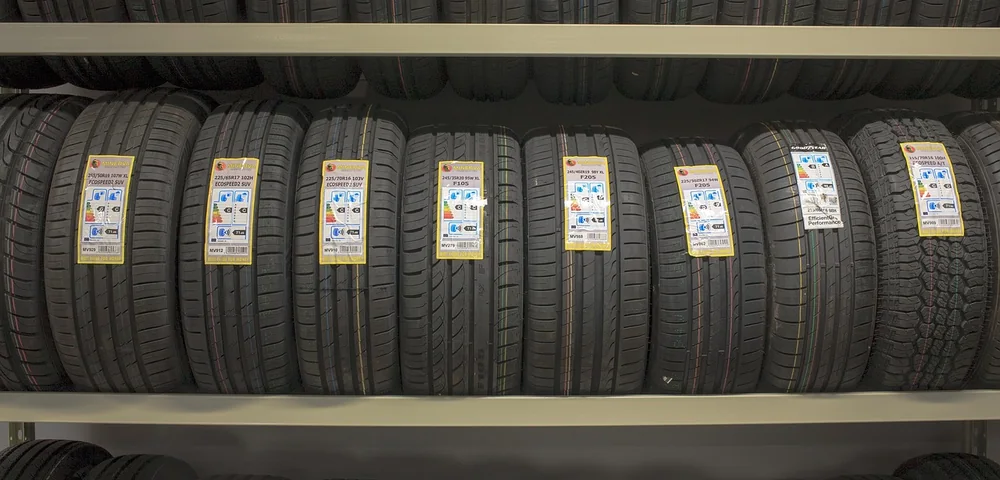
The load index number on your tire’s sidewall — that two or three digit code sitting right next to the speed rating — tells you the maximum weight that single tire can carry when it’s properly inflated. A tire marked 91 can hold 1,356 lbs, while a 100 can hold 1,764 lbs. Get this number wrong and you risk overloading your tires, which leads to overheating, irregular wear, and in the worst cases, a blowout at highway speed. This guide breaks down exactly how to read a tire load index chart, why the number matters more than most drivers realize, and how to avoid the mistakes that lead to unsafe tire choices.
Load Index vs Load Range: Key Differences
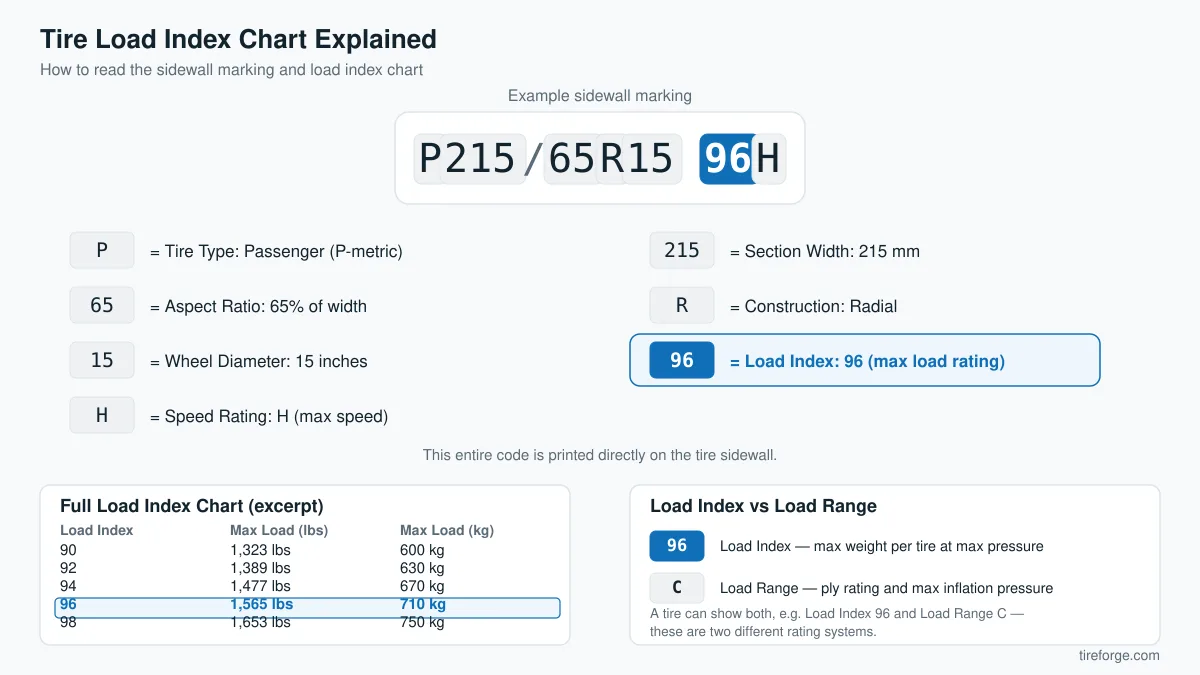
These two terms get confused constantly, and manufacturers don’t help by printing both on the same sidewall. Load index is a numeric code (like 91, 100, or 121) that corresponds to a specific weight capacity per tire at maximum air pressure. It’s used across passenger tires, light truck tires, and many trailer tires.
Load range, on the other hand, is a letter code (B, C, D, E, F) that originated from the old ply-rating system and indicates the tire’s air pressure capacity and relative carcass strength, not a direct weight figure by itself. A Load Range E tire, for example, is built to handle higher inflation pressures (commonly up to 80 psi) and therefore higher loads than a Load Range C tire, but you still need the load index number to know the exact pound rating.
In practice, light truck (LT) tires often show both: something like “LT265/70R17 121/118S E.” Here, 121/118 is the load index (front position/rear dual position), S is the speed rating, and E is the load range. If you want the deeper mechanics of how ply construction ties into load range, our Tire Load Range Explained guide and the companion Tire Ply Rating Explained article cover that in detail.
How to Read the Load Index Number
The load index is not the weight itself — it’s a code that maps to a weight on a standardized chart published by tire and rim associations (like the Tire and Rim Association in the U.S. and ETRTO in Europe). This is why a tire can say “91” instead of just printing “1,356 lbs” directly on the sidewall; the coded system keeps the sidewall text short and standardized across brands and countries.
You’ll find the load index immediately after the tire’s size and before the speed rating in the sidewall code. For example, in “225/65R17 102H,” the 102 is the load index and H is the speed rating. Passenger tires typically range from about 70 to 126 on the chart, while light truck and trailer tires can run higher, sometimes into the 130s for heavy-duty applications.
One detail that trips people up: the load index number reflects the capacity of a single tire at its maximum rated pressure, not the total weight your vehicle can carry across four tires. You also can’t just add up four tires’ capacities and assume that’s your vehicle’s safe payload — the vehicle’s suspension, axle ratings, and GVWR (Gross Vehicle Weight Rating) all factor in too. The tire’s load index is the ceiling, not the whole equation.
Full Load Index Chart (Weight in lbs/kg)
Below is a reference chart covering the load index range most drivers will actually encounter, from compact car tires to heavier light truck applications. Always double-check your specific tire’s rating against the manufacturer’s data, since this chart reflects the industry-standard values.
| Load Index | Max Load (lbs) | Max Load (kg) |
|---|---|---|
| 75 | 852 | 387 |
| 80 | 992 | 450 |
| 85 | 1,135 | 515 |
| 89 | 1,279 | 580 |
| 91 | 1,356 | 615 |
| 94 | 1,477 | 670 |
| 97 | 1,609 | 730 |
| 100 | 1,764 | 800 |
| 103 | 1,929 | 875 |
| 106 | 2,094 | 950 |
| 109 | 2,271 | 1,030 |
| 112 | 2,469 | 1,120 |
| 115 | 2,679 | 1,215 |
| 118 | 2,910 | 1,320 |
| 121 | 3,197 | 1,450 |
| 124 | 3,417 | 1,550 |
| 126 | 3,748 | 1,700 |
Notice how the weight jump between each index number isn’t linear — it accelerates as the numbers climb. Going from 100 to 103 adds about 165 lbs of capacity, but going from 118 to 121 adds nearly 290 lbs. This is why even a small difference in load index, say from 109 to 112, can matter a lot for a truck or trailer carrying heavy cargo.
Why Load Index Matters for Safety
Overloading a tire is one of the most common causes of heat-related tire failure, and it’s largely invisible until something goes wrong. When a tire carries more weight than its load index allows, the sidewalls flex more than they’re designed to with every rotation. That extra flexing generates excess heat, and heat is the enemy of rubber and steel belts alike — it accelerates the breakdown of the internal structure and can lead to tire separation, especially on long highway trips in hot weather.
This is especially critical for trucks, vans, and anyone towing a trailer. A fully loaded pickup truck or a travel trailer packed for a long trip can easily push tires close to or past their rated capacity if the owner never checked the numbers. Trailer tires (ST-rated) are particularly sensitive to this because they’re built with stiffer sidewalls and less heat tolerance margin than passenger tires — see our ST vs LT Tires comparison for why that distinction matters so much for towing safety.
Underinflation compounds the problem. A tire’s load index rating is only valid at the tire’s maximum rated pressure (found on the sidewall, not the door jamb sticker, which reflects the vehicle manufacturer’s recommended pressure for ride comfort and handling). Run a tire below its rated pressure while carrying a heavy load, and its effective capacity drops — you could be overloading a tire even if its load index looks adequate on paper.
Can You Use a Higher Load Index Tire?
Yes, and in most cases it’s perfectly safe to upgrade to a tire with a higher load index than what came stock on your vehicle, as long as the tire’s overall size, diameter, and speed rating remain compatible with your vehicle. Many truck owners intentionally move up in load index when they plan to tow trailers, carry heavy equipment, or add a camper shell and cargo regularly. A higher-rated tire simply gives you more safety margin.
What you should not do is go the other direction — installing a lower load index tire than your vehicle’s manufacturer specifies. Automakers calculate the minimum required load index based on the vehicle’s GVWR divided across the axles, with a safety buffer built in. Dropping below that spec, even if the tire “fits” physically, can put you below the safety margin the vehicle was engineered around.
There are a few tradeoffs to consider when upgrading, though. Higher load index tires often have stiffer sidewalls to handle the added capacity, which can translate to a firmer ride and slightly reduced comfort on rough pavement. They may also weigh a bit more, which can very marginally affect fuel economy and unsprung mass. For most daily drivers, this tradeoff is negligible; for someone who tows occasionally but drives unloaded most of the time, it’s worth test-driving before committing to a full set.
Common Load Index Mistakes
The most frequent mistake is assuming a tire’s size alone tells you its capacity. Two tires can share the exact same size designation, like 265/70R17, but carry completely different load indexes depending on their internal construction and load range. Always check the actual number on the sidewall, not just the size.
Another common error is confusing the door jamb placard pressure with the tire’s max pressure. The door jamb sticker lists the vehicle manufacturer’s recommended cold pressure for optimal ride and handling under normal loads — it is not the pressure at which the tire achieves its maximum load index rating. If you’re carrying a heavy load, you may need to inflate closer to (but never beyond) the tire’s sidewall-listed maximum pressure to unlock its full rated capacity, following the vehicle’s load-inflation tables if available.
People also frequently ignore the difference between single and dual load ratings on LT tires (shown as two numbers, like 121/118). The first number applies when the tire is used as a single at each wheel position; the second, lower number applies when tires are mounted in dual rear configurations, since dual setups distribute weight differently and have different safety considerations. Using the wrong number for your setup can lead to an inaccurate sense of your vehicle’s true carrying capacity.
Finally, many drivers replace tires based purely on price or tread pattern without checking whether the replacement matches or exceeds the original equipment load index. This is especially risky for cargo vans, dually trucks, and anyone who tows — dropping down in capacity to save money on a tire set can leave the vehicle chronically overloaded even under normal daily use.
How Load Index Interacts With Other Sidewall Numbers
The load index doesn’t operate in isolation — it works alongside the speed rating, size, and load range to define what a tire can safely handle. It’s worth understanding the whole code together rather than fixating on one number. For a full breakdown of every character in a tire size string, our guide to reading a tire sidewall walks through each segment in order.
Speed rating deserves particular attention here because load capacity and speed rating are tested together, and a tire’s rated load capacity can actually decrease at sustained speeds above its rating (this matters for track use or high-speed highway driving in some regions). Our tire speed rating guide explains how that relationship works and why swapping to a lower speed rating isn’t just about top-end performance.
For anyone shopping for heavier-duty applications like ATVs, UTVs, or utility trailers, load index conventions can look a little different, and matching tread type to terrain matters just as much as matching load capacity to your rig. Our ATV & UTV Tire Buying Guide covers those sizing quirks in more depth.
Frequently Asked Questions
Is a higher load index always better?
Not necessarily. A higher load index gives you more safety margin for heavy loads, but it can also mean a stiffer ride and slightly higher tire cost. Match the load index to your actual use case rather than simply buying the highest number available.
Where exactly is the load index printed on the tire?
It’s part of the sidewall code, printed right after the tire size and just before the speed rating letter. For example, in 215/55R17 94V, “94” is the load index and “V” is the speed rating.
Do all four tires need the same load index?
Yes, in nearly all cases. Mismatched load indexes across an axle or vehicle can create uneven load distribution and unpredictable handling, especially under braking or in emergency maneuvers.
Does load index affect fuel economy?
Indirectly. Tires built for higher load indexes tend to have stiffer sidewalls and sometimes more mass, which can marginally increase rolling resistance compared to a lighter, lower-capacity tire of the same size. The effect is usually small enough to be a secondary consideration behind safety.
Can I find my vehicle’s required load index somewhere?
Yes — check the tire placard on the driver’s door jamb, the vehicle owner’s manual, or the original equipment tire’s sidewall. These sources list the minimum load index the manufacturer engineered the vehicle around.

2 thoughts on “Tire Load Index Chart Explained: What the Numbers Mean”