
Buying the right ATV or UTV tire comes down to three decisions: getting the size correct for your machine, choosing a tread type that matches your terrain, and picking a ply rating and construction that can handle your riding style and cargo load. Get any one of these wrong and you’ll deal with rubbing fenders, harsh ride quality, punctures, or tires that wear out in a single season. This guide walks through each decision with real numbers you can use at the counter.
Understanding ATV/UTV Tire Sizing
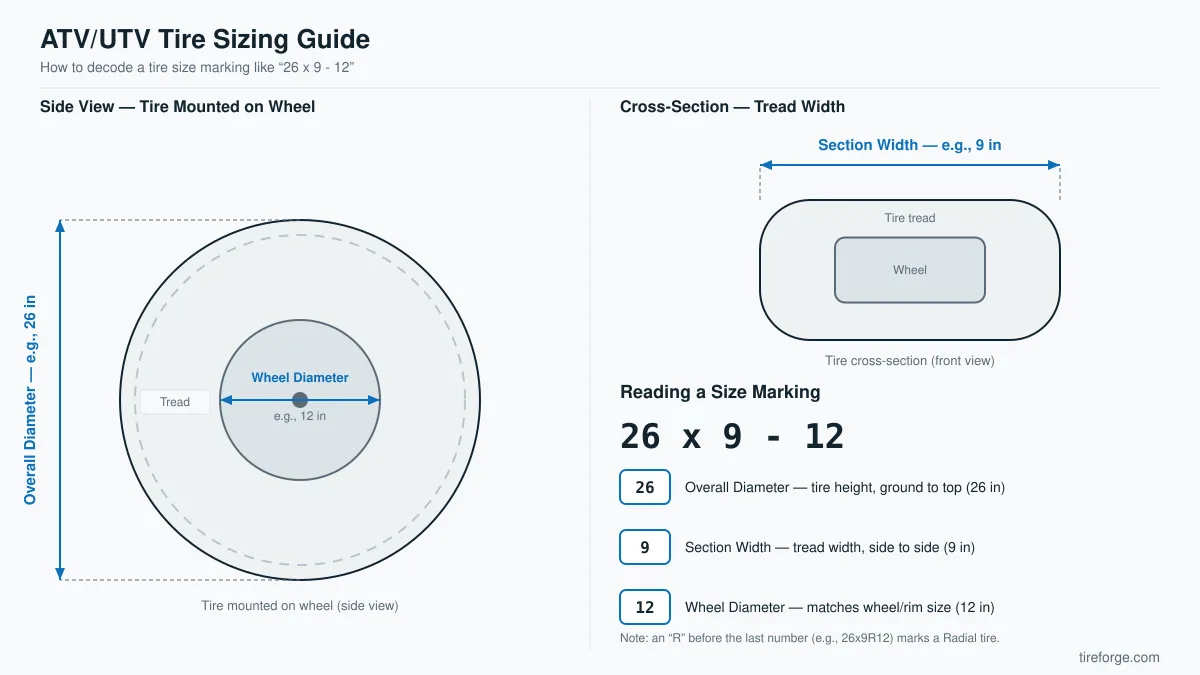
ATV and UTV tires are almost always labeled with three numbers separated by dashes, such as 26×9-12 or 27×11-14. Unlike passenger car tires, there’s no metric percentage involved — everything is in inches. The first number is the overall tire diameter (height) when mounted and inflated. The second number is the tire’s section width. The third number is the wheel diameter it’s designed to fit.
So a 27×11-14 tire stands 27 inches tall, measures 11 inches wide, and mounts on a 14-inch wheel. A handful of manufacturers use a metric-style size (25×8.00R12), but the logic is the same — diameter, width, wheel diameter.
Before swapping sizes, check your owner’s manual for the stock diameter and stay within about an inch of it unless you’re also changing gearing or lift components. Going up 2+ inches in diameter changes your effective final drive ratio, straining the CVT belt or transmission, and can cause fender rub or bog down acceleration. Width changes affect flotation (wider tires float better on soft terrain) and cornering stability, but excessive width can rub A-arms or require wheel spacers, which alters suspension geometry and bearing load.
Mud vs Trail vs All-Terrain ATV Tires
Tread pattern is where most of the terrain-matching happens, and the three broad categories perform very differently outside their intended environment.
Mud Tires
Mud tires use tall, widely-spaced lugs — often 1 to 1.5 inches deep — with aggressive, self-cleaning shoulder blocks that fling mud out as the tire rotates. This open design is what lets a mud tire keep biting instead of packing up with wet soil. The tradeoff is a rougher, louder ride on hardpack or pavement, faster wear on rocky trails, and lugs that can tear or chunk if you ride aggressively on abrasive ground.
Trail Tires
Trail tires use a shorter, tighter lug pattern designed for hardpack, gravel, and mixed dirt. They ride smoother, last longer on abrasive surfaces, and generate less noise, but they’ll pack with mud quickly and lose traction in genuinely wet or soft conditions.
All-Terrain Tires
All-terrain (AT) tires split the difference with medium-depth lugs and a more balanced void ratio. They handle light mud, sand, rock, and hardpack reasonably well without excelling at any one of them — a sensible default if you ride varied terrain and don’t want a quiver of wheel sets.
6-Ply vs 8-Ply Ratings
Ply rating describes a tire’s load-carrying capacity and puncture resistance, not the literal number of fabric layers in modern tires (most use fewer actual plies reinforced to an equivalent strength rating). A 6-ply-rated ATV tire is the common baseline for recreational trail riding — it flexes more, which actually helps traction and ride comfort on rocky or root-covered trails, but it’s more vulnerable to sidewall punctures from sharp rocks.
An 8-ply (or higher) rating adds sidewall stiffness and puncture resistance, which matters if you haul cargo, tow, or ride rock gardens and sharp shale regularly. The stiffer carcass rides harsher and can skate over rocks rather than conform to them, so heavier isn’t automatically better for pure trail traction. For side-by-sides carrying passengers and gear at higher speeds, ply ratings of 8 to 10 are common OEM specs precisely because load capacity matters more than compliance. If you’re unsure how ply rating relates to load capacity on larger tires, the same core logic used for light-truck tires applies — see this tire load range explained breakdown for the underlying math.
Bias-Ply vs Radial UTV Tires
Bias-ply construction crisscrosses the internal cords at an angle, creating a stiffer sidewall that resists punctures and holds up well to sharp rocks and stumps at low speeds. Most stock ATV and entry-level UTV tires are bias-ply because they’re cheaper to produce and tolerant of abuse.
Radial construction runs cords perpendicular to the direction of travel with a stabilizing belt underneath the tread. Radials flex more independently at the sidewall and tread, which improves ride comfort, high-speed stability, and heat dissipation — important for UTVs that regularly hit 40-60 mph on trails and dunes. Radials also tend to deliver a larger, more consistent contact patch, improving traction and tread life. The downside is cost and, in some patterns, slightly less sidewall puncture resistance than an equivalent bias-ply tire. If your UTV sees sustained higher speeds or long trail days, radials are usually worth the upgrade; if you’re doing slow technical rock crawling, a tough bias-ply tire may serve you better.
Matching Tires to Your Riding Terrain
| Terrain | Best Tire Type | Key Trait to Prioritize |
|---|---|---|
| Deep mud/bogs | Aggressive mud tire | Self-cleaning lug spacing |
| Rocky/technical trails | All-terrain or reinforced 8-ply | Sidewall puncture resistance |
| Sand dunes | Paddle or sand-specific tire | Flotation width, low rolling resistance |
| Hardpack/gravel trails | Trail tire | Even wear, low noise |
| Mixed/unknown terrain | All-terrain | Balanced versatility |
A common mistake is buying the most aggressive mud tire available for general trail riding because it

1 thought on “ATV & UTV Tire Buying Guide: Sizing, Types & Terrain Match”