
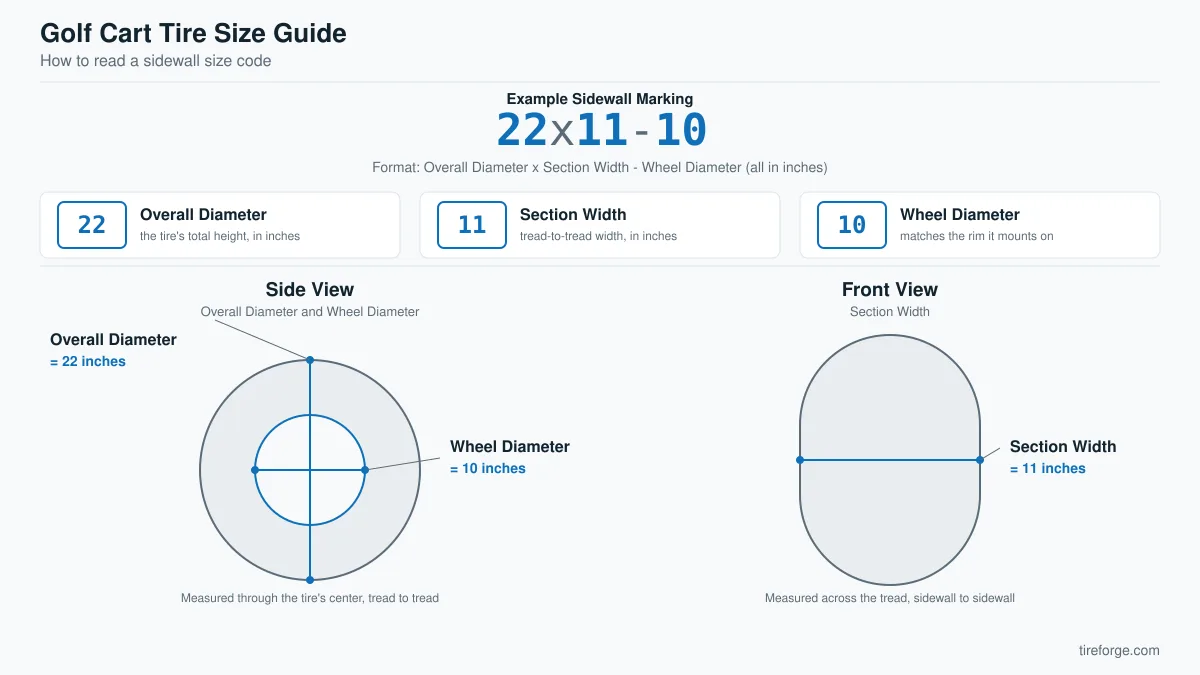
Golf cart tires are sized nothing like your car’s, and that trips up a lot of first-time buyers. If you’re staring at a sidewall that reads “20×10-10” or “18×8.5-8” and wondering what any of it means, the short answer is this: the first number is overall tire diameter in inches, the second is section width in inches, and the third is wheel diameter in inches — all imperial, no metric codes, no speed ratings. Get those three numbers right (and match them to your cart’s lift, fender clearance, and terrain), and you’ll pick a tire that fits correctly the first time. Below is everything you need to know to do that with confidence.
How Golf Cart Tire Sizing Differs From Car Tires
Passenger car tires use an alphanumeric metric code like 225/60R16, where the numbers represent millimeters of width, an aspect ratio percentage, and wheel diameter in inches. Golf cart tires skip that system entirely. Instead, nearly every golf cart tire is labeled in a straightforward inch-based format: Overall Diameter x Section Width – Wheel Diameter, such as 22×11-10.
This matters because there’s no aspect ratio to calculate — the overall diameter is stated directly, so you can see exactly how tall the tire will stand without doing math. That’s a big deal on a golf cart because ground clearance, fender gap, and drivetrain gearing are far more sensitive to small diameter changes than they are on a full-size vehicle. A 2-inch jump in overall diameter on a car tire is barely noticeable; the same jump on a golf cart tire can be the difference between a comfortable ride and a tire that rubs the body on every turn.
Another difference is speed and load rating. Car tires carry a load index and speed rating molded on the sidewall (something we break down in our tire load index chart explained guide). Golf cart tires generally don’t, since carts rarely exceed 25 mph and carry predictable, modest loads. Instead, manufacturers focus on ply rating and tread pattern to communicate durability and purpose, which we’ll cover next.
Reading Golf Cart Tire Sidewalls
Once you know the format, decoding a golf cart sidewall is quick. Take 23×10.5-12 as an example:
- 23 — overall tire diameter in inches, measured from the ground to the top of the tire when properly inflated and mounted.
- 10.5 — section width in inches, the widest point of the tire from sidewall to sidewall.
- 12 — wheel (rim) diameter in inches, which must match your actual wheel.
You’ll also see a ply rating, often 2-ply, 4-ply, or 6-ply. Higher ply ratings mean a stiffer, more puncture-resistant carcass — useful on gravel, rocky trails, or job sites, but it adds a firmer ride on smooth pavement. If you’re unfamiliar with how ply count affects strength and ride quality in general, our tire ply rating explained article covers the mechanics in more depth, and the same principles apply to golf cart tires at a smaller scale.
Some tires also list a load rating in pounds rather than an index number, since golf carts don’t need the standardized index system cars use. If you’re used to reading full-size sidewalls, our how to read a tire sidewall guide is a good refresher on symbols you may still encounter, like DOT codes and country of origin markings, which golf cart tires carry as well.
Street vs Turf vs All-Terrain Golf Cart Tires
Street Tires
Street (or “smooth”) golf cart tires have shallow, car-like tread designed for paved cart paths, neighborhood streets, and parking lots. They’re quiet, roll efficiently, and resist cupping on hard surfaces, but they offer almost no traction on wet grass, mud, or loose dirt. These are the right choice for retirement communities, gated neighborhoods, and any cart that spends 90% of its life on asphalt or concrete.
Turf Tires
Turf tires use a dense pattern of small, closely spaced lugs that grip grass without tearing it up — critical for golf courses, where a tire that digs in leaves visible ruts on the green. They offer moderate traction on wet grass and light dirt but wear faster on pavement and don’t handle mud or rocks well. If your cart stays on a course or manicured lawn, turf tires are non-negotiable from a course-maintenance standpoint.
All-Terrain Tires
All-terrain (A/T) golf cart tires have deeper, more aggressive tread blocks similar to a scaled-down truck tire. They handle gravel, mud, sand, and uneven trails far better than street or turf tires, making them popular for hunting carts, farm use, and off-road recreational carts. The tradeoff is a rougher ride on pavement and faster tread wear if you run them exclusively on hard surfaces. Many owners keep a dedicated set of A/T tires for trail season and swap back to street tires for everyday neighborhood driving — similar in concept to swapping seasonal tires on a car, which we discuss in our guide to storing tires in the off-season.
Lift Kits & Tire Size Compatibility
Lift kits are the most common reason golf cart tire sizing goes wrong. A stock cart typically runs tires in the 18-20 inch overall diameter range. Once you install a 3-6 inch lift, you gain clearance for taller tires — commonly 22 to 23 inches for a modest lift, and up to 23-25+ inches for larger lift kits paired with wider wheels.
The mistake most buyers make is installing a lift and then guessing at tire size instead of checking the lift manufacturer’s maximum tire diameter rating. Going too tall causes several problems: rubbing against fender wells or body panels during turns (the same rubbing issue car owners deal with, explained in our why does my tire rub when turning article), increased strain on the motor and drivetrain, reduced torque since larger tires act like taller gearing, and speedometer or controller calibration errors on electric carts.
As a rule of thumb, stick within the tire diameter range your lift kit specifies, and recheck clearance at full steering lock in both directions, not just straight ahead. If you upsize wheel diameter along with tire diameter — for example moving from a 10-inch to a 12-inch wheel — make sure the section width still clears the fender and that overall diameter doesn’t exceed your lift’s rating. This is conceptually similar to plus sizing wheels on a car, where width and diameter have to be balanced together rather than changed in isolation.
Common Sizes by Cart Model
Exact factory sizes vary by model year and trim, but these ranges reflect what’s typically found on popular cart brands in stock and lightly modified form:
| Cart Type | Typical Stock Size | Common Lifted Size |
|---|---|---|
| Club Car (stock, street) | 18×8.5-8 | 22×11-10 |
| E-Z-GO (stock, street) | 18×8.5-8 or 20×8-10 | 22×11-10 to 23×10.5-12 |
| Yamaha (stock, street) | 18×8.5-8 | 22×11-10 |
| Heavy-duty / off-road builds | N/A | 23×10.5-12 to 25×10-12 |
These figures are general reference points, not universal specs — always confirm against your cart’s owner’s manual or the tire currently mounted before ordering. If the sidewall is too worn or damaged to read, measure the mounted tire directly (diameter from ground to top, width at the widest point) rather than guessing based on cart model alone, since previous owners frequently swap tires to non-stock sizes.
Buying & Replacement Tips
When it’s time to replace golf cart tires, keep these practical points in mind:
- Replace in pairs or full sets. Mismatched tread depth side-to-side can cause pulling or uneven handling, much like the symptoms described in our car pulling to one side article — the same physics apply at low speed on a cart.
- Check tread depth regularly. Golf cart tires don’t have wear bars like car tires, so a simple penny or quarter test (detailed in our how to measure tire tread depth guide) still works as a quick visual check.
- Match ply rating to use case. Don’t buy 6-ply trail tires for a cart that only sees smooth pavement — you’ll pay for durability you don’t need and get a harsher ride.
- Verify wheel bolt pattern before swapping wheels. If you’re upgrading wheels along with tires, confirm bolt pattern compatibility the same way you would on a car, as covered in our wheel bolt pattern guide.
- Keep spare tire access in mind. Many lifted carts lose factory spare mounts; if you carry a spare, make sure it matches your current size, not the old stock size.
- Inflate to the cart’s specified PSI, not a car’s. Golf cart tires run far lower pressures than car tires, typically in the 15-22 psi range depending on tire size and load — check the sidewall or manual rather than assuming.
If you’re comparing a slightly different size than stock because of availability, the same general tolerance principles used for car tires apply: minor deviations in overall diameter are usually fine, but anything beyond a few percent can throw off speedometer accuracy and ground clearance. Our guide on acceptable tire size differences walks through how to calculate that safely.
Frequently Asked Questions
Can I put car tires on a golf cart?
No. Golf cart wheels and hubs are built for low-speed, light-load inch-based tires with specific bolt patterns and offsets. Car tires won’t fit the wheel diameter or load requirements correctly and can create serious handling and safety issues.
Do golf cart tire sizes affect top speed?
Yes. Larger diameter tires effectively raise gearing, which can increase top speed slightly on gas carts but often reduces torque and acceleration, especially on electric carts where the motor has to work harder to turn a larger tire.
How do I know if a bigger tire will rub my cart’s body?
Check your lift kit’s maximum rated tire diameter, then test fit at full steering lock in both directions before driving regularly. Rubbing is more common on tight turns than straight-line driving, so don’t rely on a static check alone.
Are all-terrain tires overkill for a neighborhood cart?
Generally yes. A/T tires wear faster on pavement and ride rougher than street tires. Unless you regularly drive on gravel, mud, or uneven trails, a street or turf tire will serve you better and last longer.