

If you’ve ever stared at a sidewall reading 225/65R17 and tried to figure out what that means in inches, you’re not alone. Tire sizing mixes metric and imperial units in the same code, which trips up even experienced drivers. Here’s the short answer: to convert a metric tire size to inches, divide the section width (mm) by 25.4 for width, multiply width by the aspect ratio and divide by 25.4 for sidewall height, then add that height twice to the wheel diameter (already in inches) to get overall tire diameter. Below, we break down exactly how that math works, give you a ready-to-use conversion chart, and flag the mistakes that lead to rubbing, speedometer errors, and failed inspections.
Why Tire Sizes Use Mixed Metric/Imperial Units
Tire sizing wasn’t designed by one committee with a unified system — it evolved from decades of industry history, and that’s why a single size code like P225/65R17 contains both metric and imperial measurements. The section width (225) and aspect ratio (65) are metric, expressed in millimeters and a percentage. But the wheel diameter (17) is still in inches, a holdover from the era when American tire and wheel manufacturers standardized rim sizes in inches long before metric conventions took over tire width measurements in the 1970s.
This hybrid system, known as P-Metric or Euro-Metric sizing, became the global standard because it preserved compatibility with existing inch-based wheels while adopting the more precise metric measurements for width and profile that European manufacturers had already established. Older tire sizes, like the numeric and alphanumeric systems used before the 1970s (think 7.75-14 or G78-14), were fully imperial or used arbitrary letter codes, and neither offered the precision modern vehicles need.
The result is a size code that’s genuinely useful once you understand it, but confusing if you’re trying to compare it to older imperial-only specs, aftermarket flotation sizes (common on trucks and off-road tires, like 33×12.50R15), or specs from a vehicle manual written in a different format. Understanding the conversion isn’t just academic — it directly affects whether a replacement tire will physically fit your wheel well, match your speedometer calibration, and clear your suspension components without rubbing.
How to Read Metric Tire Sizes (P-Metric vs Euro-Metric)
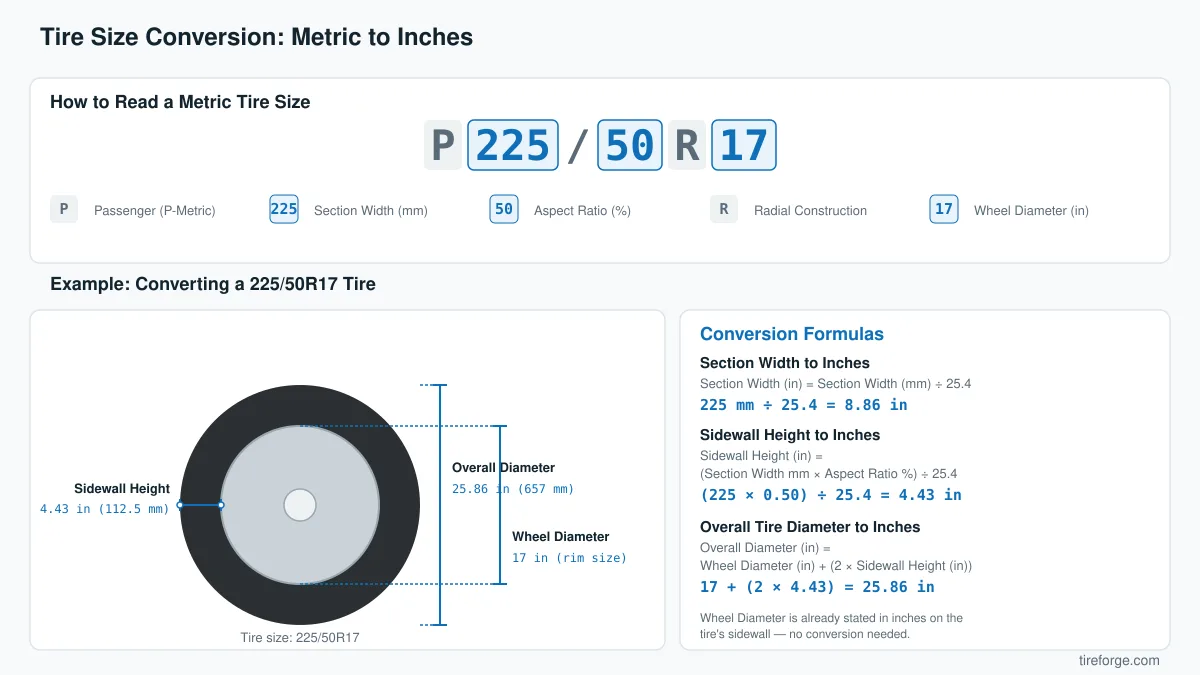
Before converting anything, you need to correctly parse the code. Take P225/65R17 94V as an example:
- P — Tire type. “P” means P-Metric (passenger), used mostly in North America. No letter, or “LT” for light truck, or “ST” for special trailer, indicates a different load and construction standard entirely. “T” means temporary spare. If you’re cross-shopping ST or LT tires, size math is similar but load ratings differ significantly — see our ST vs LT tire comparison for why that matters.
- 225 — Section width in millimeters, measured sidewall-to-sidewall at the widest point of the inflated tire (not tread width).
- 65 — Aspect ratio, meaning the sidewall height is 65% of the section width. Lower numbers (like 40 or 45) mean a shorter, stiffer sidewall; higher numbers (65-75) mean a taller, softer one.
- R — Radial construction, standard on virtually every modern tire.
- 17 — Wheel/rim diameter in inches. This must match your wheel exactly; there’s no conversion flexibility here.
- 94V — Load index and speed rating. These aren’t part of the size conversion but are critical for safe replacement — check our tire load index chart guide before downgrading either number.
Euro-Metric sizes drop the leading letter (just “225/65R17”) but use identical math. The absence of “P” doesn’t change the conversion — it typically reflects a slightly different load formula used by European manufacturers, which matters more for load index tables than for physical dimensions. For a full breakdown of every character on the sidewall, our sidewall decoding guide covers DOT codes, treadwear ratings, and more.
Converting Section Width, Aspect Ratio & Diameter to Inches
Three separate numbers need converting, and each uses a different formula. Here’s exactly how to do it by hand:
Section Width to Inches
Divide the millimeter width by 25.4 (the number of millimeters in one inch).
Example: 225mm ÷ 25.4 = 8.86 inches
Sidewall Height to Inches
Multiply the section width (mm) by the aspect ratio (as a decimal), then divide by 25.4.
Example: 225 x 0.65 = 146.25mm sidewall height. 146.25 ÷ 25.4 = 5.76 inches
Overall Tire Diameter to Inches
Add two sidewall heights (top and bottom of the wheel) to the wheel diameter, which is already in inches.
Example: 17 + (5.76 x 2) = 28.51 inches overall diameter
This last number — overall diameter — is the one that matters most when comparing a metric tire to a flotation-sized tire (like those common on trucks and Jeeps, written as 33×12.50R15). Flotation sizes list overall diameter and section width directly in inches, skipping the aspect ratio entirely. When you’re cross-shopping between the two systems, converting to overall diameter is the only way to make an apples-to-apples comparison, and it’s especially important if you’re chasing a specific lift height or trying to keep your speedometer accurate.
Printable Conversion Chart by Common Sizes
Use this chart as a quick reference for popular metric sizes and their inch equivalents. Values are calculated using the formulas above and rounded to two decimal places.
| Metric Size | Section Width (in) | Sidewall Height (in) | Overall Diameter (in) |
|---|---|---|---|
| 195/65R15 | 7.68 | 4.99 | 24.98 |
| 205/55R16 | 8.07 | 4.44 | 24.88 |
| 215/60R16 | 8.46 | 5.08 | 26.16 |
| 225/45R17 | 8.86 | 3.99 | 24.97 |
| 225/65R17 | 8.86 | 5.76 | 28.51 |
| 235/75R15 | 9.25 | 6.94 | 28.88 |
| 245/70R17 | 9.65 | 6.75 | 30.51 |
| 265/70R17 | 10.43 | 7.30 | 31.61 |
| 275/60R20 | 10.83 | 6.50 | 32.99 |
| LT285/75R16 | 11.22 | 8.41 | 32.83 |
Keep in mind these are calculated dimensions, not exact molded dimensions. Actual measured tire width and diameter can vary by roughly 1-3% between manufacturers, even within the same nominal size, due to differences in construction, tread design, and how the tire is measured (mounted vs. unmounted, at what pressure). If you’re calculating clearance for a lift, wheel spacer, or larger wheel-and-tire package, always allow a margin rather than treating these figures as exact to the millimeter.
Common Conversion Mistakes That Affect Fitment
Most fitment problems don’t come from bad math — they come from misunderstanding which numbers are interchangeable and which aren’t. Watch for these specific errors:
- Assuming wheel diameter converts too. The “17” in 225/65R17 is already in inches — there’s nothing to convert. People sometimes try to run it through the same formula as width and aspect ratio, arriving at a nonsensical number. Wheel diameter must match your actual wheel size exactly; there’s zero tolerance here.
- Confusing section width with tread width. Section width is measured sidewall-to-sidewall on the inflated tire’s widest point, which is usually wider than the actual contact patch touching the road. Don’t use section width to estimate how much tread is gripping the pavement.
- Ignoring overall diameter changes when changing aspect ratio. Dropping from a 65 to a 55 aspect ratio (a common “plus-sizing” move when upgrading wheels) shrinks the tire’s overall diameter unless you also increase the wheel size or width to compensate. A mismatch here throws off your speedometer accuracy and can affect ABS and traction control calibration, which rely on wheel rotation speed.
- Overlooking load index during conversion. Getting the dimensions right doesn’t mean the tire can carry your vehicle’s weight. Two tires with identical converted dimensions can have very different load ratings depending on construction and ply rating — always cross-check the load index, not just the size numbers.
- Rounding too early. Rounding intermediate numbers (like sidewall height) before completing the diameter calculation compounds errors. On a 265/70R17, rounding sidewall height from 7.30 to 7.3 is fine, but rounding to “7” flat introduces a half-inch error in your final diameter — enough to matter for clearance checks.
- Mixing metric and flotation sizes without full conversion. If you’re comparing a 245/70R17 (metric) to a 32×11.50R17 (flotation), convert both to the same unit system fully before deciding they’re “close enough.” A half-inch diameter difference across four tires can visibly affect ride height and may cause rubbing during hard turns — see our guide on diagnosing tire rub when turning if you’re already experiencing this.
When in doubt, measure your current tire directly with a tape measure rather than relying purely on the printed size, especially on older or worn tires. Actual diameter shrinks slightly as tread wears down, which you can also gauge using a tread depth check to see how much life — and diameter — remains.
When Precise Conversion Really Matters
Not every conversion scenario carries the same stakes. Here’s when you genuinely need to get the math right versus when close enough is fine.
High-stakes scenarios include changing wheel diameter (plus-sizing or minus-sizing), fitting a spare that differs from your factory tires, installing tire chains where clearance is measured in millimeters (our tire chain measuring guide covers this in detail), and any lift or leveling kit installation where you’re calculating clearance against fender liners or control arms. In these cases, a half-inch error in overall diameter calculation can mean the difference between a clean fit and constant rubbing.
Lower-stakes scenarios include simply understanding your existing tire’s dimensions for curiosity, comparing general size categories when browsing (all-season vs. all-terrain, for example), or explaining tire dimensions to someone unfamiliar with metric sizing. Here, rounding to the nearest tenth of an inch is more than sufficient.
Regardless of the scenario, always verify your final tire choice against your vehicle’s placard (usually on the driver’s doorjamb) rather than relying solely on what was previously mounted, since a prior owner may have already deviated from factory spec. And once new tires are mounted, a proper alignment and balance check ensures the size change doesn’t introduce vibration or uneven wear down the road.
Frequently Asked Questions
How do I convert a metric tire size to inches without a calculator?
Use these rounded shortcuts: divide millimeters by 25 (close enough to 25.4 for quick estimates) to get inches. For a 225mm width, 225 ÷ 25 = 9 inches, which is within 0.15 inches of the precise 8.86-inch figure — accurate enough for casual comparisons but not for exact clearance calculations.
Why does my tire’s actual measured width differ from the sidewall number?
Section width printed on the sidewall assumes the tire is mounted on the manufacturer’s specified “design rim width.” Mounting the same tire on a wider or narrower wheel than that spec stretches or compresses the sidewall, changing the measured width by up to half an inch in either direction.
Can I mix metric and flotation-sized tires on the same vehicle?
It’s not recommended. Even if the overall diameters are close, differences in section width, load rating, and speed rating between the two systems can cause handling inconsistencies, especially front-to-rear. Stick to one sizing system per axle set, and ideally across all four tires.
Does converting tire size affect my speedometer accuracy?
Yes. Your speedometer calibration is based on the factory tire’s overall diameter and revolutions per mile. Increasing diameter by more than about 3% causes your speedometer to under-read actual speed, while decreasing it causes over-reading. Always recalculate overall diameter in inches before switching to a significantly different size.
Is a Euro-Metric size the same as a P-Metric size with the same numbers?
The physical dimensions convert identically, but the load index formula differs slightly between the two standards. A Euro-Metric tire may carry a marginally different maximum load rating than a P-Metric tire of the same numeric size, so always check the load index chart rather than assuming a straight match.