

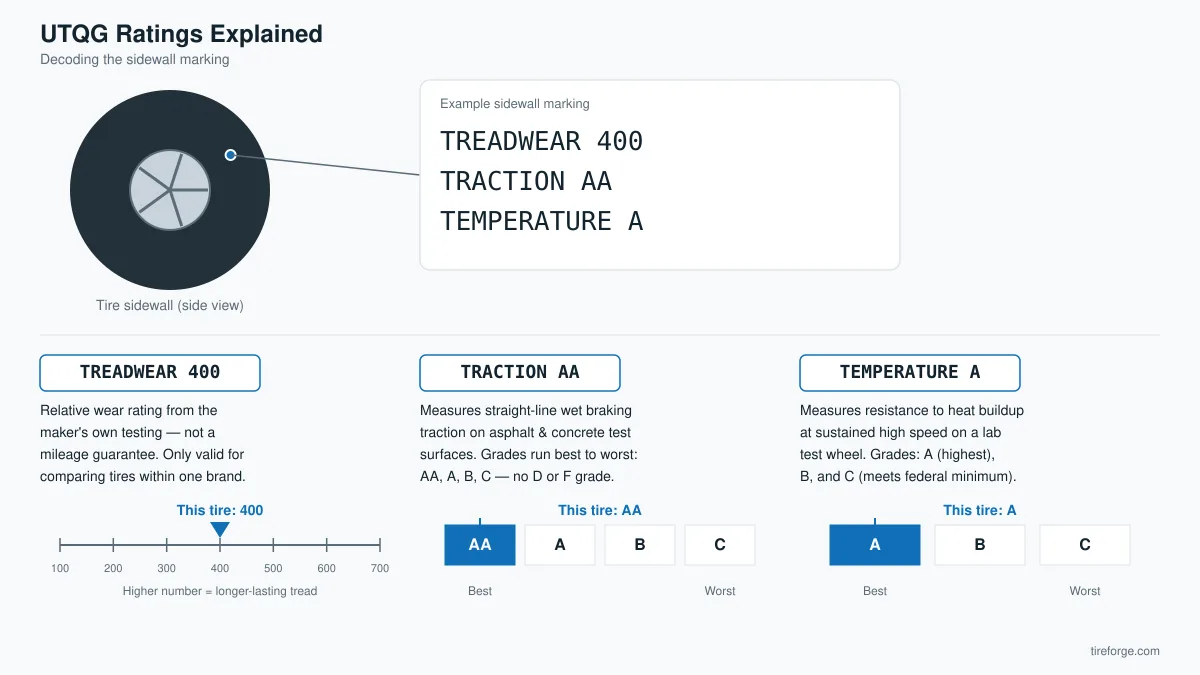
UTQG stands for Uniform Tire Quality Grading, and it’s the three-part code — treadwear, traction, and temperature — molded into the sidewall of nearly every passenger and light truck tire sold. If you’ve ever seen something like “Treadwear 400 Traction AA Temperature A” stamped near the tire size, that’s the system at work. It’s meant to give shoppers a quick way to compare durability, wet grip, and heat resistance across brands. Understanding it can genuinely help you avoid a bad purchase, but only if you know what each number actually measures and where the system falls short.
What Is UTQG and Who Sets It?
UTQG was created by the National Highway Traffic Safety Administration (NHTSA) in the United States and has been required on most new passenger car tires since the early 1980s. The goal was simple: force manufacturers to test and disclose comparable performance data so consumers weren’t relying purely on marketing copy or a salesperson’s opinion.
Here’s the catch that trips up almost everyone: the government sets the testing methodology, but it does not run the tests. Each tire manufacturer tests its own products and self-reports the grades. There’s no independent lab verifying every submission before it hits the shelf. That doesn’t mean the numbers are meaningless — there are legal consequences for fraudulent grading, and competitors do watch each other closely — but it does mean UTQG should be treated as a standardized starting point, not an absolute truth.
UTQG only applies to summer and all-season passenger and light truck tires. Winter tires, temporary spares, and many off-road-focused light truck tires are exempt from treadwear grading (though traction and temperature grades may still appear). If you’re cross-shopping something like an all-terrain tire for a truck, don’t be surprised if the treadwear number is missing entirely.
Treadwear Grade Explained
The treadwear grade is a comparative number, typically ranging from around 60 on soft, sticky performance tires up to 800 or higher on long-wear all-season and touring tires. The baseline reference is set at 100, meaning a tire graded 200 is projected to wear roughly twice as long as the reference tire under the same test conditions, and a tire graded 400 roughly four times as long.
The test itself involves running a set of tires on a government-specified test route (historically a loop in Texas) for 7,200 miles, measuring wear at intervals, then extrapolating a projected lifespan. This is where the number gets soft: it’s a projection based on one controlled test loop, not a guarantee for your specific driving conditions, climate, or vehicle weight.
A common mistake is treating treadwear grade as an exact mileage warranty. It isn’t. A 500-treadwear tire from one manufacturer might genuinely outlast a 600-treadwear tire from another, because each brand runs its own test and there’s no shared calibration tire being tested simultaneously anymore in most cases. Use treadwear grade to compare tires within the same manufacturer’s lineup, and treat cross-brand comparisons as a rough directional signal rather than a precise ranking.
Traction Grade (AA, A, B, C) Explained
Traction grade measures straight-line wet stopping ability, tested on wet asphalt and wet concrete surfaces at controlled speeds. The grades run from AA (highest) down through A, B, and C (lowest that’s still legal for sale). Note what this grade does not measure: dry traction, cornering grip, snow performance, or hydroplaning resistance at high speed. It’s specifically a wet braking traction test.
Most mainstream all-season and touring tires land in the A range, which is why the traction grade often feels less useful for differentiating tires than treadwear does — the majority of the market clusters near the top. Where it becomes genuinely useful is when you spot a C grade, which is uncommon and worth investigating further, or when comparing a budget economy tire against a premium touring tire where the gap can show up clearly.
A frequent misunderstanding is assuming a AA traction grade means a tire will feel confident and grippy in every situation, including cornering or highway on-ramps in the rain. It doesn’t test lateral (cornering) grip at all. A tire can have excellent straight-line wet braking and still feel nervous when cornering hard in the wet. If wet handling in curves matters to you, that’s a job for tire reviews and real-world testing, not the UTQG label alone.
Temperature Grade (A, B, C) Explained
The temperature grade rates a tire’s ability to dissipate heat and resist degradation at sustained high speeds, tested on a laboratory wheel under controlled conditions. Grades run A, B, or C, with C representing the minimum performance required by federal safety standards for tires sold in the U.S. — meaning even a C-graded tire meets legal safety minimums, it’s just not as heat-resistant as an A or B tire under sustained high-speed conditions.
Heat is one of the primary enemies of tire longevity and structural integrity. Excess heat accelerates rubber degradation, weakens the internal belts and casing over time, and is a major contributor to catastrophic tire failures, especially on tires that are underinflated or overloaded relative to their rating. A tire with an A temperature grade is built with compounds and internal construction that shed heat more effectively at speed.
This grade matters more than most people realize if you drive long highway stretches at higher speeds, tow, or live somewhere with hot summers and long interstate commutes. It’s less critical for someone doing mostly stop-and-go city driving at moderate speeds. It’s also worth pairing this understanding with proper load range and inflation practices — heat buildup gets dramatically worse on an underinflated or overloaded tire regardless of its temperature grade, so understanding concepts like tire load range alongside UTQG gives you a fuller safety picture.
How to Find UTQG on Your Tire
UTQG grades are molded directly into the tire’s sidewall, usually near the tire size and DOT code, on the same section of the sidewall used for load index and speed rating information. The format typically reads something like: “TREADWEAR 400 TRACTION AA TEMPERATURE A.” It’s raised rubber lettering, not a sticker, so it won’t wear off or peel like a paper label might.
If you can’t find it on the tire itself — sometimes it’s on the inner sidewall facing the vehicle rather than the outer, visible side — check the manufacturer’s website or the tire’s product page, where UTQG data is almost always listed alongside load index, speed rating, and ply construction. Retailer sites like Tire Rack, Discount Tire, and manufacturer sites list this in spec sheets for every model.
Remember that UTQG doesn’t appear on every tire type. Winter/snow tires, some light truck all-terrain and mud-terrain tires, and spare tires are commonly exempt, particularly from the treadwear portion. If you’re shopping for an off-road-oriented tire and can’t find a treadwear number, that’s expected, not a sign of missing information — cross-reference something like an ATV/UTV tire buying guide or a manufacturer’s terrain-specific spec sheet instead, since those categories are graded on different priorities entirely.
Limitations of UTQG Ratings
UTQG’s biggest limitation is self-reporting. Because manufacturers test their own tires without a mandatory third-party audit before sale, there’s an inherent incentive to test under favorable conditions or interpret ambiguous test parameters generously. This has led to periodic industry disputes and even litigation between competitors accusing each other of inflated treadwear numbers.
The tests also don’t reflect real-world variability. Your actual tread life depends heavily on alignment, inflation pressure, driving style, climate, road surface, and rotation habits — factors the standardized test loop simply can’t capture. Two drivers on the same tire model, same size, same city, can see treadwear differ by 20,000 miles or more based on habits alone.
UTQG also says nothing about dry traction, snow and ice performance, ride comfort, road noise, or hydroplaning resistance. It’s a narrow three-metric snapshot, not a comprehensive scorecard. A tire with excellent UTQG numbers can still be a poor match for your climate or driving style if you ignore everything else, including load range for towing, speed rating for your vehicle, and tread pattern for the terrain you actually drive on.
Using UTQG to Compare Tires
The smartest way to use UTQG is as one filter among several, not the deciding factor. Start by comparing treadwear grades within the same brand’s lineup to gauge relative durability — a 700 vs. a 400 tire from the same manufacturer is a meaningful signal. Then check traction grade to rule out anything unusually low (a C should prompt more research), and check temperature grade if you drive long highway miles, tow, or live in a hot climate.
From there, layer in the information UTQG doesn’t cover: read independent reviews, check load range and speed rating against your vehicle’s requirements, and consider tread pattern for your specific climate and use case. Comparing two well-known brands side by side, such as in a Goodyear vs. Cooper comparison or a Bridgestone vs. Michelin breakdown, often reveals more practical differences in ride quality and real-world wear than the sidewall numbers alone.
Common mistake: shoppers sometimes chase the single highest treadwear number available, assuming it guarantees the best value, only to end up with a harder compound tire that has mediocre wet traction or a noisy ride. Balance is the goal — match the grade profile to your actual priorities, whether that’s long life for a commuter sedan, better traction for a wet climate, or heat resistance for sustained highway towing.
Frequently Asked Questions
Is a higher treadwear number always better?
Not necessarily. Higher treadwear generally means a harder compound built to last longer, but harder compounds can sacrifice wet grip and ride comfort. The right number depends on whether you prioritize longevity or performance.
Can I compare treadwear grades across different brands?
Only loosely. Since each manufacturer self-tests using its own methodology and reference points, cross-brand comparisons are directional at best. Comparisons within the same brand’s lineup are far more reliable.
Do winter tires have UTQG ratings?
Most dedicated winter and snow tires are exempt from UTQG treadwear grading. If you’re shopping for cold-weather tires, rely on winter-specific reviews and the severe snow service (three-peak mountain snowflake) symbol instead.
Does a C temperature grade mean the tire is unsafe?
No. A C grade still meets the federal minimum safety standard. It simply indicates less heat-dissipation margin at sustained high speeds compared to A or B graded tires, which matters more for long highway trips or towing.
Where exactly is the UTQG rating located?
It’s molded into the tire sidewall near the size and DOT information, though it can appear on either the inner or outer sidewall. If it’s hard to spot, check the manufacturer’s product page for the same data.