
Plus sizing means fitting a larger-diameter wheel with a shorter-sidewall tire while keeping the tire’s overall diameter close to the original equipment size. Done correctly, it sharpens steering response and fills out the wheel well without throwing off your speedometer, ABS, or suspension geometry. Done carelessly, it causes rubbing, harsh ride quality, inaccurate speed readings, and premature wear. This guide walks through exactly how to calculate a safe plus-size setup, what changes in the way your car drives, and the mistakes that trip up even experienced enthusiasts.
What Plus Sizing Means (Plus-One, Plus-Two, Plus-Three)
Plus sizing is a naming convention for how many inches you’re increasing wheel diameter above stock, while simultaneously reducing tire sidewall height to compensate. A Plus-One upgrade takes a factory 16-inch wheel to a 17-inch wheel. Plus-Two jumps to 18 inches, and Plus-Three goes to 19 inches, and so on. The number refers strictly to the wheel diameter change, not the tire’s width or the overall package size.
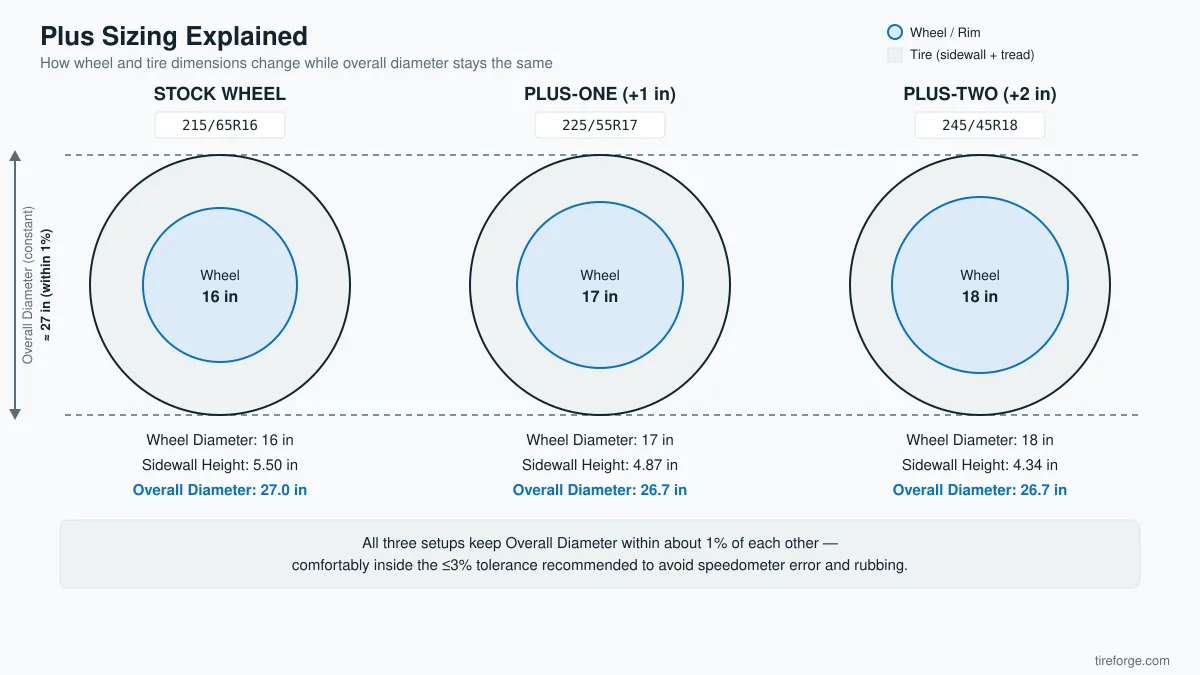
Each step up in wheel diameter requires a corresponding drop in aspect ratio (the sidewall height expressed as a percentage of tread width) so the tire’s outside diameter stays roughly the same. For example, a stock 215/65R16 tire might become a 225/55R17 in a Plus-One setup, or a 235/45R18 in a Plus-Two setup. Notice the aspect ratio dropping from 65 to 55 to 45 as wheel diameter climbs — that’s the mechanism that keeps rolling diameter consistent.
Most enthusiasts stop at Plus-One or Plus-Two because these steps offer a visible styling improvement and handling benefit without pushing sidewalls so thin that ride comfort collapses. Plus-Three and beyond are common in show builds and performance applications, but they demand very precise fitment work and usually sacrifice ride comfort and pothole protection. Before shopping for wheels, it helps to understand exactly what each character on your current tire’s sidewall means, which is covered in detail in our guide to reading a tire sidewall.
How Overall Diameter Must Stay Consistent
The single most important rule in plus sizing is that the new tire and wheel package must produce an overall diameter within about 2-3% of the factory diameter. This tolerance exists because your speedometer, odometer, traction control, and ABS systems are all calibrated around the wheel’s original rotational speed per mile traveled. Stray outside that window and every one of those systems reports inaccurate data.
Calculating overall diameter is straightforward once you know the formula. Tire diameter in inches equals the wheel diameter plus twice the sidewall height. Sidewall height is the tire’s section width (in millimeters) multiplied by the aspect ratio (as a decimal), then converted to inches by dividing by 25.4. So for a 225/55R17: section width 225mm times 0.55 equals 123.75mm of sidewall height, doubled to 247.5mm, converted to inches (9.74″), plus the 17-inch wheel equals roughly 26.74 inches overall diameter.
Run that same formula on your factory tire size and compare the two results. Free plus-sizing calculators exist online and will do this math instantly, but understanding the formula lets you catch a supplier’s or tire shop’s error before it becomes rubbing metal or a check-engine light. Aim for the smallest difference you can find — under 1% is ideal, and anything beyond 3% starts to meaningfully affect the systems described in the next section.
Effects on Speedometer, Ride Quality & Handling
Even a diameter change within the acceptable window produces noticeable side effects, and it’s worth knowing them ahead of time rather than being surprised. A larger overall diameter (even slightly larger) makes your speedometer read low — you’re going faster than the display shows. A smaller overall diameter makes it read high. A 2% error at 70 mph translates to roughly 1.4 mph of speedometer inaccuracy, which is generally tolerable, but larger errors compound at highway speeds and can affect fuel economy calculations and warranty claims tied to mileage.
Handling changes are usually the reason people plus size in the first place. A shorter, stiffer sidewall flexes less under cornering load, which sharpens turn-in and reduces the vague, spongy feeling some factory setups have. Steering feels more direct because less of your input is being absorbed by sidewall flex before the tread actually changes direction.
The tradeoff is ride quality. Shorter sidewalls transmit more impact harshness from potholes, expansion joints, and rough pavement directly into the wheel and suspension. Wider, lower-profile tires also tend to be noisier on coarse asphalt. If ride comfort is a priority, Plus-One is usually the sweet spot — enough of a handling improvement to notice, without the harshness of Plus-Two or Plus-Three. Our article on whether new tires actually improve ride quality digs deeper into how tire construction affects comfort independent of size.
Load Rating & Clearance Considerations
A wider, lower-profile tire is not automatically stronger than the tire it replaces. Load capacity depends on the tire’s internal construction, air pressure, and load index rating — not on the wheel diameter it’s mounted to. When plus sizing, you must confirm that the new tire’s load index meets or exceeds the original equipment tire’s rating, especially on trucks, SUVs, and any vehicle that regularly carries passengers or cargo near its GVWR. Our tire load index chart guide explains how to read and compare these numbers correctly, and the related piece on ply rating is useful if you’re moving between passenger and light-truck constructions.
Clearance is the other half of the equation. A wider tire and wheel combination needs adequate space to clear the strut, brake caliper, control arms, and fender liner throughout the full range of steering lock and suspension travel — not just when the car is sitting still. It’s common for a wheel to clear fine at rest but rub against the fender liner during hard cornering or over compression when the suspension is fully loaded.
Wheel offset and backspacing become critical here. A wider tire mounted on a wheel with the wrong offset can push the tire’s shoulder into the fender lip or pull it inward into the strut. Always verify offset, backspacing, and bolt pattern before ordering — our bolt pattern measuring guide covers the fitment basics that apply to any wheel upgrade, plus sized or not.
Common Plus-Sizing Mistakes
The most frequent mistake is chasing looks first and math second — buying attractive wheels, then trying to force-fit a tire size that doesn’t actually preserve overall diameter. This leads to speedometer errors, altered gearing feel, and in extreme cases, ABS or stability control faults from wheel speed sensor mismatches.
A second common error is ignoring load index while focusing entirely on width and profile. A tire that looks aggressive but carries a lower load rating than stock is a real safety issue on a loaded vehicle, particularly trucks and SUVs used for towing.
Third, people underestimate how offset changes scrub radius and steering effort. A wheel with significantly different offset than stock can make the steering feel heavier, introduce pull to one side, or accelerate wear on wheel bearings. If your car has ever started pulling to one side after a wheel change, mismatched offset is a common culprit worth ruling out.
Fourth, skipping a proper alignment and balance after installation is a shortcut that always costs more later. New wheel and tire dimensions change the effective scrub radius and rolling characteristics enough that a fresh alignment is essential, and understanding the difference between alignment and balancing helps you make sure the shop performs both, not just one.
Finally, many buyers skip test-fitting before committing to a full set. A single test wheel and tire mounted and cycled through full steering lock and a test drive over rough pavement reveals rubbing issues far more reliably than spec sheets and forum threads alone.
Is Plus Sizing Worth It for Your Vehicle?
Whether plus sizing makes sense depends on what you’re optimizing for. If you value crisp handling, want to fill out the wheel well visually, and are willing to accept a firmer ride and possibly a bit more road noise, a Plus-One or Plus-Two setup done within the correct diameter tolerance is a safe, well-proven upgrade path used across the industry for decades.
If your priority is comfort, fuel economy, or you drive frequently on rough roads or in regions with serious potholes, staying closer to factory sizing — or limiting yourself to Plus-One with a tire that still has reasonable sidewall height — protects ride quality and reduces the risk of bent rims from impacts. Thinner sidewalls have less cushion to absorb a hard hit, and a bent rim becomes a more likely outcome of hitting a deep pothole at speed.
Trucks and SUVs used for towing or off-road work need extra caution: load rating must be preserved or improved, and low-profile tires generally sacrifice the sidewall flex that helps with traction and impact absorption off-road. For daily commuter cars, a modest plus size is one of the more reliable ways to improve the driving experience without touching suspension or engine components. Whatever direction you choose, run the diameter math, confirm load index, verify offset and clearance, and get a proper alignment afterward — that combination is what separates a plus-sizing upgrade that works from one that ends in rubbing tires and a warranty headache.
Frequently Asked Questions
Can I mix plus-sized wheels on the front and stock wheels on the rear?
It’s possible on some staggered performance applications, but it should only be done intentionally and to manufacturer or established aftermarket specifications. Mismatched diameters front to rear on a vehicle not designed for it can confuse all-wheel-drive systems and traction control, leading to drivetrain strain or fault codes.
Does plus sizing void my tire warranty?
Plus sizing itself doesn’t void a tire’s manufacturing warranty as long as the tire is used within its rated load and speed limits and properly installed. It’s still worth reviewing the specifics of your coverage, which our tire warranty guide explains in more detail.
How much does plus sizing typically affect fuel economy?
Wider, lower-profile tires generally have slightly higher rolling resistance and more unsprung weight, which can trim fuel economy by a small margin. The effect is usually modest at Plus-One but becomes more noticeable at Plus-Two and beyond.
What’s the maximum diameter difference I should accept?
Most manufacturers and tire professionals recommend staying within plus or minus 3% of the original overall diameter, with under 1% being ideal for minimizing speedometer error and preserving suspension geometry.