

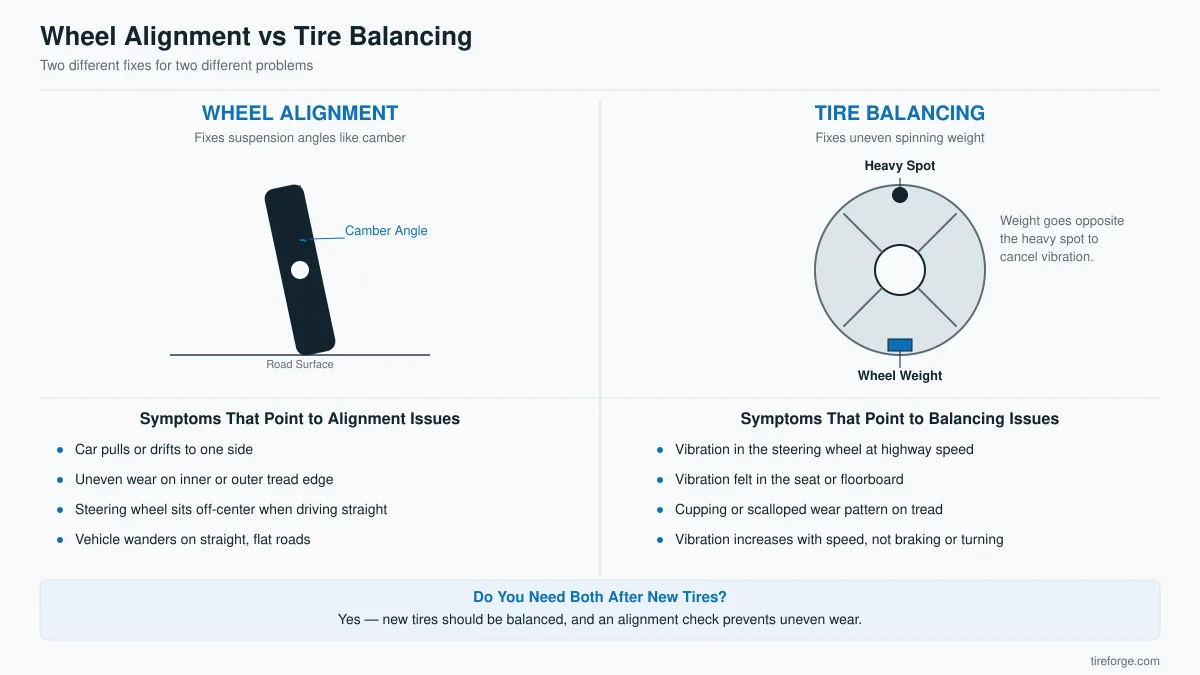
Wheel alignment and tire balancing get lumped together constantly, and it’s easy to see why: both live at your local tire shop, both get recommended after you buy new tires, and both fix vibrations or handling issues. But they solve completely different problems. Alignment adjusts the angles of your suspension so your wheels point and lean the way the manufacturer intended. Balancing corrects weight distribution around the tire and wheel assembly so it spins smoothly at speed. Get the wrong one done, and you’ll pay for a service that never addresses your actual complaint. Below is a full breakdown of both, how to tell them apart by symptom, and how often each one actually needs attention.
What Is Wheel Alignment?
Wheel alignment is the process of adjusting the angles of your wheels relative to each other and to the road surface. It has nothing to do with spinning weight and everything to do with geometry. A technician uses a laser or camera-based alignment rack to measure three primary angles: camber (the inward or outward tilt of the tire when viewed from the front), toe (whether the tires point slightly inward or outward when viewed from above), and caster (the forward or backward tilt of the steering axis, which affects steering stability and return-to-center feel).
These angles are set by the factory to precise specifications, usually with a small acceptable range measured in fractions of a degree. Over time, hitting potholes, curbs, speed bumps, or simply the wear of suspension bushings and ball joints will push these angles out of spec. When that happens, the car may pull to one side, the steering wheel may sit crooked even when driving straight, and the tires will wear unevenly because they’re no longer meeting the road flat and square.
Some vehicles need a specialized version called a thrust alignment, which accounts for the rear axle’s alignment relative to the front. If you want the deeper mechanics of that, our alignment types guide covers it in detail. A standard alignment appointment typically takes under an hour; see our wheel alignment timing guide for a realistic breakdown by vehicle type.
What Is Tire Balancing?
Tire balancing addresses a completely different physical problem: uneven weight distribution around the circumference of the tire and wheel assembly. No tire or wheel is manufactured with perfectly uniform weight. The rubber compound isn’t distributed with atomic precision, the wheel casting has minor density variations, and the valve stem itself adds a small amount of weight to one point. When that assembly spins at highway speed, even a slight imbalance creates a wobble or vibration because centrifugal force amplifies the heavier spot with every rotation.
A technician corrects this with a balancing machine that spins the wheel and tire and identifies exactly where and how much weight is missing. Small clip-on or adhesive weights are then attached to the wheel to cancel out the imbalance. There’s also an alternative approach using loose balancing beads or fluid poured inside the tire, which continuously redistribute themselves as the tire spins; our tire balancing beads comparison explains how that method stacks up against traditional weights.
Balance is typically thrown off by normal wear, weight loss from a worn tread pattern, a weight falling off after hitting a pothole, or simply time and mileage causing the rubber to wear unevenly across the tread. It’s a routine service, not a sign that something is broken with your suspension.
Key Differences Explained
The clearest way to separate these two services is by what they physically measure and correct. Alignment is a static geometry adjustment done through the suspension and steering components. Balancing is a dynamic weight-distribution correction done on the wheel and tire assembly itself. One is about angles; the other is about spinning mass.
| Factor | Wheel Alignment | Tire Balancing |
|---|---|---|
| What it fixes | Suspension angles: camber, toe, caster | Uneven weight around the tire/wheel |
| Primary symptom | Pulling, crooked steering wheel, uneven wear | Vibration at specific speeds, usually 50-70 mph |
| Tools used | Alignment rack with sensors/cameras | Wheel balancing machine (spin balancer) |
| Caused by | Potholes, curb strikes, worn bushings/ball joints, ride height changes | Tread wear, lost wheel weights, new tire installation |
| Frequency | Every 2-3 years or after suspension work/impacts | Every tire rotation or when vibration appears |
| Effect on tire wear | Directly causes uneven wear if out of spec | Indirect; vibration accelerates wear over time |
Both services affect ride quality and tire longevity, but they’re diagnosed differently and require entirely different equipment. A shop cannot fix an alignment problem by rebalancing your tires, and vice versa.
Symptoms That Point to Alignment Issues
Alignment problems tend to show up gradually and get worse the longer you ignore them. The most telling sign is a car that pulls or drifts to one side even on a flat, straight road with no wind. If you have to hold the steering wheel slightly off-center just to drive straight, that’s a strong indicator your toe or camber has shifted out of spec.
Uneven tire wear is another major clue. Excessive wear on the inner or outer edge of the tread, while the rest of the tire looks fine, almost always points to a camber or toe problem rather than a balance issue. Our guide on why tires wear on the inside goes deeper into which specific alignment angle causes which wear pattern.
Other signs include a steering wheel that sits crooked when the car is tracking straight, and handling that feels looser or less predictable in corners. Alignment issues typically don’t cause vibration at speed the way balance issues do; instead, they show up as directional and wear-pattern problems. If you recently hit a deep pothole, scraped a curb parking, or had suspension components replaced, get an alignment check even without obvious symptoms, since misalignment can silently chew through a new set of tires within a few thousand miles.
Symptoms That Point to Balancing Issues
Balance problems announce themselves through vibration, and the pattern of that vibration is diagnostic. A vibration that appears specifically in the 50-70 mph range and gets worse as you accelerate, then fades at higher or lower speeds, is the classic signature of an out-of-balance tire. If the vibration comes through the steering wheel, the imbalance is usually in a front tire; if it’s felt in the seat or floor, it’s more often a rear tire.
Unlike alignment issues, balance problems generally don’t cause the car to pull to one side, and they don’t create a crooked steering wheel. They also don’t produce the same uneven edge-wear patterns; instead, prolonged imbalance can cause cupping or scalloping, a wavy wear pattern around the tread.
Balance can be knocked off by something as simple as a wheel weight falling off after hitting debris, or a new tire that wasn’t balanced correctly at installation. If you feel a new vibration shortly after any tire service, balance should be the first thing checked, since it’s the fastest and cheapest service to rule out. For a deeper look at exactly what knocks weights loose or shifts tread weight unevenly, see what causes tires to become unbalanced. If the vibration is paired with an actual wobble you can see or feel in the wheel itself, it’s worth also reading about rear tire wobble causes, since a bent rim or failing wheel bearing can mimic a balance problem but requires different repairs entirely.
Do You Need Both After New Tires?
Yes, in almost every case, new tires should get balanced at installation, and it’s smart to have the alignment checked at the same time even if you’re not required to. Balancing is non-negotiable: every new tire gets mounted on the wheel and must be balanced before it leaves the shop, because an unbalanced tire will vibrate almost immediately at highway speed regardless of how new or high-quality the tire is.
Alignment is a separate question. New tires don’t automatically need an alignment, but a few situations make it strongly worth doing anyway. If your old tires showed uneven wear before you replaced them, that’s a sign the alignment was already off, and putting new tires on the same misaligned suspension will just start the same wear pattern over again. If you’re replacing tires after a significant amount of mileage (most shops suggest checking alignment every 10,000-15,000 miles regardless), a new-tire installation is a convenient time to combine the services. Many shops also offer package pricing that bundles balancing and alignment with a tire purchase.
Skipping alignment on brand-new tires when the old ones wore unevenly is one of the most common and expensive mistakes tire buyers make. You end up prematurely wearing out an expensive new set the same way the last one wore out, often within a year or two. When shopping for replacements, matching size correctly also matters for how evenly a new set wears; our guide on acceptable tire size differences is useful if you’re mixing tire ages or brands across an axle.
How Often to Get Each Service
Tire balancing is generally checked every time you rotate your tires, which most manufacturers recommend every 5,000-7,500 miles. Balancing doesn’t degrade on a fixed schedule the way alignment can; it only needs correction when something changes the weight distribution, such as tread wear, a lost weight, or a new tire mount. If you’re not feeling any vibration, there’s no urgent need to rebalance outside of your normal rotation interval, though it’s inexpensive enough that many shops check it as a matter of routine.
Alignment operates on a different timeline. Even without any obvious symptoms, most manufacturers and tire shops recommend a full alignment check every 2 to 3 years or roughly every 20,000-30,000 miles, since suspension bushings and components naturally wear and settle over time even under normal driving. That interval should move up any time you experience a specific event: hitting a significant pothole, curbing a wheel, having any suspension or steering component replaced, or noticing a change in ride height after loading heavy cargo repeatedly.
A common mistake is assuming that because a car