
All-season tires are a compromise built for mild-to-moderate climates, all-weather tires are a hybrid built to handle light snow without sacrificing summer usability, and winter tires are a dedicated cold-weather compound designed for ice, deep snow, and sub-freezing temperatures. If you drive somewhere with real winters, an all-season tire will not keep you safe once the temperature drops below about 45°F, no matter what the sidewall says. The three categories exist because no single rubber compound or tread design can be optimized for hot dry pavement, warm rain, and frozen roads at the same time. Understanding what each one actually does — and doesn’t do — is the only way to avoid buying the wrong tire twice.
Defining All-Season Tires
All-season tires are the default fitment on most new cars sold in the U.S., and for good reason: they’re a reasonable jack-of-all-trades for drivers who see occasional light snow but mostly deal with dry and wet pavement. The tread compound is formulated to stay reasonably flexible from roughly 45°F up into summer heat, and the tread pattern balances wet traction, dry handling, and tread life rather than maximizing any one trait.
The tradeoff is that the rubber compound stiffens significantly once temperatures drop below that 45°F threshold, which is well above freezing. A stiff tire can’t conform to the road surface or bite into snow and ice, so braking distances and cornering grip fall off fast in cold conditions — even on dry, cold pavement, not just snow. All-season tires also carry shallower, less aggressive tread patterns than winter tires, with fewer biting edges (sipes) to grip loose snow.
Most all-season tires carry a treadwear warranty and are rated for 50,000 to 80,000 miles, which is their biggest advantage over dedicated winter rubber. They’re the right call if your winters mean occasional flurries and mostly plowed roads, not sustained sub-freezing temperatures or regular snowfall. If you’re shopping for a specific vehicle, guides like the ones for the Toyota Prius or Honda Odyssey can help you narrow down a solid all-season option for your climate.
Defining All-Weather Tires
All-weather tires are a newer category that sits deliberately between all-season and winter tires, and the distinction matters: an all-weather tire is not just a marketing rename of “all-season.” All-weather tires use a cold-weather-capable compound that stays flexible in freezing temperatures, combined with a more aggressive tread pattern with additional sipes for snow traction — and critically, they carry the Three-Peak Mountain Snowflake (3PMSF) certification, meaning they’ve passed a standardized snow traction test.
The idea is to give drivers one tire they can run year-round in regions with moderate winters — think mid-Atlantic, Pacific Northwest, or parts of the Midwest that get periodic snow but not months of deep accumulation. You get winter-tire-rated snow traction without needing a second set of wheels and tires, and without the seasonal swap-and-storage routine.
The compromise is real, though. All-weather tires wear faster than a comparable all-season tire because the softer, more temperature-tolerant compound is inherently less durable, and they’re noticeably less capable than a true winter tire in deep snow, extreme cold, or sustained ice. They also tend to have slightly higher rolling resistance and road noise than all-season tires. All-weather is a genuine middle ground, not a replacement for either end of the spectrum — treat it as the right answer for a specific climate band, not a universal upgrade.
Defining Winter/Snow Tires
Winter tires are purpose-built for cold, snow, and ice, and nothing else. The rubber compound is formulated to remain pliable well below freezing, often down to 0°F or colder, using higher concentrations of natural rubber and silica that keep the tread flexible when everything else on the road has gone rigid. That flexibility is what allows the tread to conform to icy and snow-packed surfaces and actually generate grip.
Tread design reinforces this with deep, aggressive lugs and a dense network of sipes — thin zigzag slits cut into the tread blocks — that bite into snow and channel slush and water away from the contact patch. Many winter tires also use directional patterns optimized for straight-line traction and evacuation of slush, at some cost to dry-pavement cornering precision.
The catch is that this same compound and tread design becomes a liability once temperatures climb. Above roughly 45°F, winter tire rubber gets too soft, wearing quickly and delivering vague, spongy handling on dry roads. This is exactly why running winter tires through spring and summer is a mistake — for the full breakdown of what happens to the compound and tread life, see Winter Tires in Summer: Why They Don’t Work. Winter tires are meant to be mounted seasonally, typically on a dedicated set of wheels, and swapped out once temperatures reliably stay above freezing.
Three-Peak Mountain Snowflake Symbol Explained
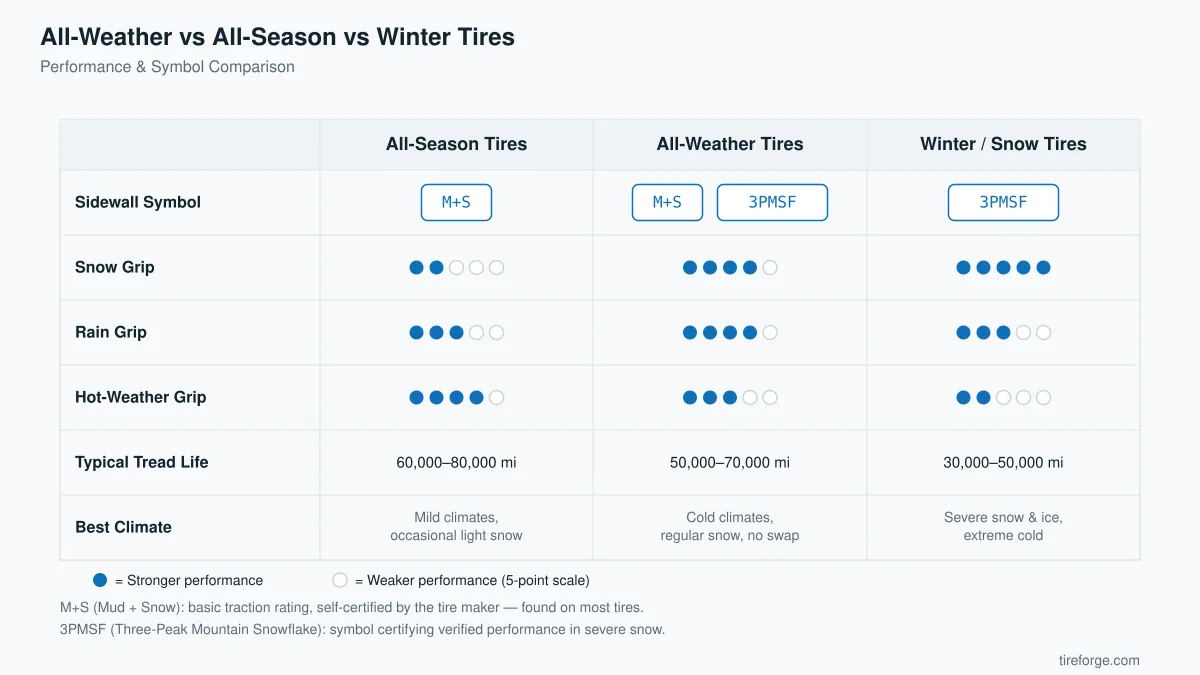
The Three-Peak Mountain Snowflake (3PMSF) symbol is a small mountain-with-snowflake icon molded into the sidewall, and it’s the only reliable way to know a tire has passed a standardized snow traction test rather than just being marketed as “good in winter.” To earn the symbol, a tire must achieve at least a 110% traction index compared to a reference all-season tire on packed snow, tested under a formal industry protocol.
This matters because plenty of all-season tires include words like “weather” or images of snowflakes in their branding without meeting this standard — that’s marketing, not certification. Only tires that pass the actual test can legally carry the 3PMSF symbol. Both winter tires and all-weather tires carry it; true all-season tires generally do not (a few all-season tires marketed as “all-season plus” have started to appear, but the base category doesn’t require it).
The older “M+S” (Mud and Snow) marking is a different, much weaker designation. M+S tires only need to meet a tread-geometry requirement — void ratio and lug spacing — with no actual traction test involved. Nearly every all-season tire sold carries M+S, which is why it tells you almost nothing about real snow performance. When comparing tires, treat 3PMSF as the meaningful snow credential and M+S as background noise. If winter driving is a real consideration for your climate, filter your options down to 3PMSF-rated tires first, then compare tread life and price from there.
Performance Comparison in Snow, Rain & Heat
Each tire type has a genuine strength and a genuine weak point, and the numbers tell the story better than marketing copy.
| Condition | All-Season | All-Weather | Winter |
|---|---|---|---|
| Packed snow | Weak — shallow tread, stiff cold compound | Good — 3PMSF certified | Best — purpose-built compound and tread |
| Ice | Poor | Fair to good | Best |
| Wet roads, 50-80°F | Good | Good | Fair — softer compound, less precise |
| Dry summer heat | Best | Good | Poor — accelerated wear, vague handling |
| Cold dry pavement (32-45°F) | Fair — stiffening begins | Good | Best |
The pattern is consistent: winter tires dominate cold and snow but underperform in heat, all-season tires dominate warm conditions but fall apart in the cold, and all-weather tires never win outright but never fail badly either — they’re the compromise curve smoothed across the middle. This is the same logic that applies broadly across the tire world: a tire optimized for one extreme trades away performance at the other, similar to how run-flat tires trade ride comfort for puncture security. There’s no free lunch in tire engineering — every gain in one condition is paid for somewhere else.
Which Tire Type Fits Your Climate?
Match the tire to your actual winter, not the worst storm you can remember. A useful way to think about it:
- Rare frost, snow a few days a year, roads plowed quickly: A quality all-season tire is enough. Spending more for winter capability you’ll use once every few years isn’t worth the tradeoff in summer performance and tread life.
- Regular light-to-moderate snow, temperatures often near or below freezing for weeks at a time, but not extreme cold: All-weather tires are the sweet spot. You avoid the seasonal swap while still getting 3PMSF-rated snow traction.
- Sustained sub-freezing temperatures, heavy snowfall, or icy roads for months: Dedicated winter tires, swapped seasonally, are the only category that delivers real safety margin. This is non-negotiable in mountain or northern climates regardless of how capable your vehicle’s all-wheel-drive system is — AWD helps you accelerate, not stop or turn on ice.
Vehicle type matters too. Crossovers and SUVs commonly driven in mixed climates — like a Subaru Outback or Subaru Forester — are exactly the kind of vehicle where all-weather tires often make more sense than a standard all-season set, since these vehicles are frequently driven specifically because their owners deal with mixed weather. The common mistake is buying based on where you live in July instead of where you drive in January.
Cost & Longevity Tradeoffs
All-season tires generally offer the longest tread life and lowest total cost per mile because their compound is formulated for durability across a wide temperature range rather than maximum grip at either extreme. Treadwear warranties in the 60,000-80,000 mile range are common.
All-weather tires typically wear faster than all-season tires — often landing in the 45,000-65,000 mile range — because the softer, cold-tolerant compound needed for snow certification sacrifices some durability. You’re paying that cost year-round since there’s no seasonal swap to spare the tire from summer heat.
Winter tires have the shortest effective lifespan per season but the longest calendar life, since they’re only mounted for a few months a year. A set can last 4-6 winters if stored properly and swapped promptly once temperatures rise. However, winter tires require either a second set of wheels (recommended to avoid mounting/dismounting costs twice a year) or seasonal mounting fees, which adds to the real cost of ownership. Factor in storage, too — tires degrade faster from heat and UV exposure than from age alone if left outside.
The financial mistake most drivers make is comparing sticker price per tire instead of cost per mile per season. A $180 all-weather tire that lasts five winters without a wheel swap can be cheaper overall than a $150 winter tire plus a second set of wheels and biannual mounting labor — do the full math before deciding based on category alone.
Frequently Asked Questions
Can I use all-weather tires instead of winter tires in heavy snow?
All-weather tires handle light-to-moderate snow reasonably well thanks to 3PMSF certification, but they don’t match dedicated winter tires in deep snow, extreme cold, or sustained ice. If you regularly drive in mountain passes or northern climates with harsh winters, winter tires still offer a meaningful safety margin all-weather tires can’t fully replicate.
Do all-season tires really perform worse than all-weather tires in the cold?
Yes. The rubber compound in a standard all-season tire stiffens noticeably below about 45°F, reducing grip even on dry, cold pavement — this isn’t limited to snowy conditions. All-weather compounds are formulated to stay flexible at those same temperatures, which is the core reason they carry the 3PMSF symbol and most all-season tires don’t.
Is it safe to run winter tires year-round to avoid the seasonal swap?
No. Winter tire compounds wear rapidly and handle poorly once temperatures consistently exceed 45-50°F, and dry-weather braking and cornering suffer noticeably. It’s both a safety and cost mistake — you’ll burn through expensive winter tread on summer pavement for no traction benefit.
Do I need a 3PMSF symbol if my tire already says M+S?
Yes, if snow traction matters to you. M+S only reflects tread geometry and involves no traction testing, so it appears on the vast majority of all-season tires regardless of actual snow performance. Only the 3PMSF symbol confirms a tire has passed a standardized snow traction test.