
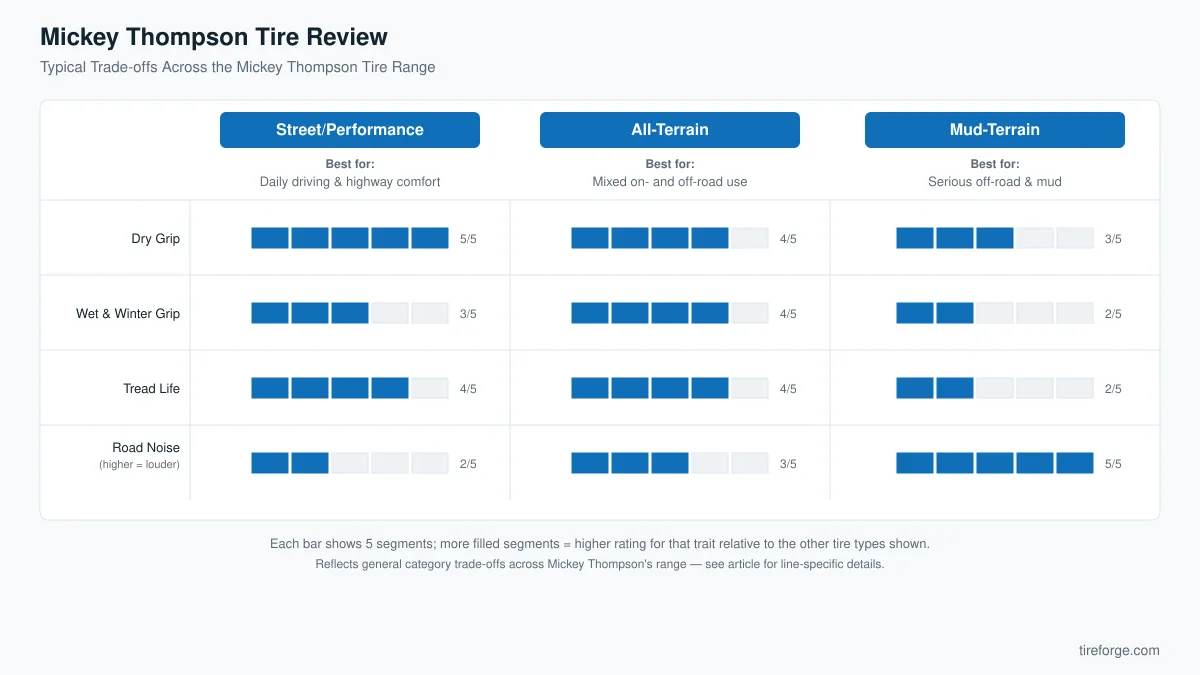
Mickey Thompson tires are built for trucks, Jeeps, and muscle cars that need aggressive looks and off-road or drag-strip capability more than all-season refinement. If you’re cross-shopping for a daily-driver commuter tire, Mickey Thompson probably isn’t the right fit. If you’re building a lifted truck, a rock crawler, or a street/strip car and want a brand with genuine motorsport roots, it deserves a serious look. This review breaks down where the brand fits, which lines matter, how they actually perform, and who should spend their money elsewhere.
Who Makes Mickey Thompson and Where It Sits in the Market
Mickey Thompson started as the personal brand of a legendary hot-rodder and land-speed racer, and the tire line built on his name has always leaned into performance: drag radials, off-road mud terrains, and street/strip rubber. The brand is now owned by Cooper Tire, which itself became part of Goodyear. That ownership structure matters practically: Mickey Thompson tires benefit from Cooper’s manufacturing footprint, compound research, and quality control, while keeping a separate identity focused on enthusiast and off-road categories rather than mainstream commuter tires.
In the market hierarchy, Mickey Thompson sits as a specialty/performance brand rather than a budget or mainstream all-season maker. Pricing generally lands in the mid-to-upper range for light truck and off-road tires — above budget import brands, roughly in line with or slightly below premium off-road names like BFGoodrich or Toyo. You’re not paying for a quiet commuter ride; you’re paying for aggressive tread designs, reinforced casings, and a brand with real racing credibility. That positioning explains almost everything about how the tires perform and who they’re aimed at.
Mickey Thompson Tire Range and What Each Line Is For
The lineup splits cleanly into a few purpose-built categories rather than one broad all-purpose family.
- Baja Boss / Baja Boss A/T: The flagship mud-terrain and all-terrain lines for lifted trucks and Jeeps. The Baja Boss is a hybrid mud tire with a quieter tread than a pure mud tire, while the Baja Boss A/T targets daily-drivable off-road use with better wet and highway manners.
- Baja Legend EXP: An all-terrain tire aimed at trucks and SUVs that split time between pavement and trail, with reinforced sidewalls to resist punctures.
- Deegan 38: A rally-inspired all-terrain co-developed with Baja racer Brian Deegan, known for aggressive shoulder lugs and sidewall protection.
- ET Street and ET Drag: Drag radials and bias-ply drag tires built for straight-line grip at the strip, not everyday driving.
- Sportsman S/R and Street Comp: Street/strip performance tires for muscle cars that still need to be street-legal.
The common thread is specialization. Each line is engineered for a specific use case rather than trying to be everything to everyone, which is both the brand’s strength and its limitation — there’s no strong all-season commuter option here.
Performance: Dry, Wet and Winter Grip
Dry performance is where Mickey Thompson earns its reputation. The Baja Boss and Deegan 38 use aggressive, self-cleaning tread blocks with stone ejectors that bite hard on dirt, gravel, and rock, and the drag-oriented lines deliver exceptional straight-line dry traction — that’s literally what they’re designed for. On pavement, the off-road lines trade some cornering precision for traction versatility, which is normal for the category.
Wet performance is more mixed and depends heavily on which line you pick. The Baja Boss A/T and Baja Legend EXP have tread designs with more circumferential channels for water evacuation, giving reasonably competent wet grip for an all-terrain tire. The more aggressive mud-terrain-leaning Baja Boss and drag radials, however, are noticeably weaker in standing water and heavy rain — wide voids and sticky, soft compounds on drag tires can actually reduce wet traction compared to a standard all-season design. If you drive in frequent rain, prioritize the A/T-labeled models over the mud-heavy ones.
Winter grip is the clearest weak point. None of the mainstream Mickey Thompson passenger and light-truck lines carry the 3-Peak Mountain Snowflake (3PMSF) severe-service winter rating, so they should not be treated as snow tires. Some A/T patterns handle light snow acceptably thanks to open tread voids, but on ice or packed snow the compounds aren’t formulated for cold-weather flexibility the way a dedicated winter tire is. Anyone in a real winter climate should run dedicated winter tires seasonally rather than relying on an all-terrain Mickey Thompson year-round.
Tread Life, Warranty and Value
Tread life on Mickey Thompson’s off-road and performance lines tends to run shorter than mainstream all-season truck tires, which is an inherent trade-off of soft, grippy compounds and aggressive void ratios. Owners commonly report the Baja Boss and Deegan 38 wearing faster than a comparable Baja Legend EXP or a standard highway all-terrain, especially with heavier lifted trucks or aggressive driving. Warranty coverage reflects this reality: Mickey Thompson’s off-road lines typically carry limited or no mileage warranty, in contrast to mainstream all-terrains from brands like BFGoodrich or Falken that often advertise 50,000-mile treadwear warranties.
That doesn’t automatically mean poor value — it means the value equation is different. You’re buying capability and looks, not longevity. For a weekend trail rig or a truck that sees moderate off-road use, the traction and sidewall durability can justify the shorter tread life. For a daily-driven work truck racking up highway miles, the lack of a meaningful treadwear warranty combined with faster wear can make total cost of ownership higher than a mainstream all-terrain. Buyers should budget for replacement sooner and factor that into the purchase price comparison, not just the sticker cost at checkout.
Road Noise and Comfort
Road noise scales directly with how aggressive the tread pattern is. The Baja Boss, with its large lug spacing and mud-terrain heritage, generates noticeable hum and drone at highway speeds — expect a meaningfully louder cabin than a standard highway tire, particularly as the tread wears unevenly. The Baja Boss A/T and Baja Legend EXP are quieter thanks to more continuous tread design and noise-reducing pitch sequencing, making them more livable as daily drivers.
Ride comfort follows a similar pattern. Off-road-focused casings, especially those with reinforced sidewalls for puncture resistance, tend to transmit more harshness over sharp bumps and expansion joints compared to a comfort-tuned highway tire. Drag radials and street/strip tires are a different story — they’re built with stiffer, performance-oriented sidewalls that prioritize handling response over plushness, so comfort was never the design goal. If a quiet, cushioned ride matters more than off-road capability, this brand’s core lineup will disappoint; that’s simply not the customer it’s built for. Anyone sensitive to cabin noise should read up on