
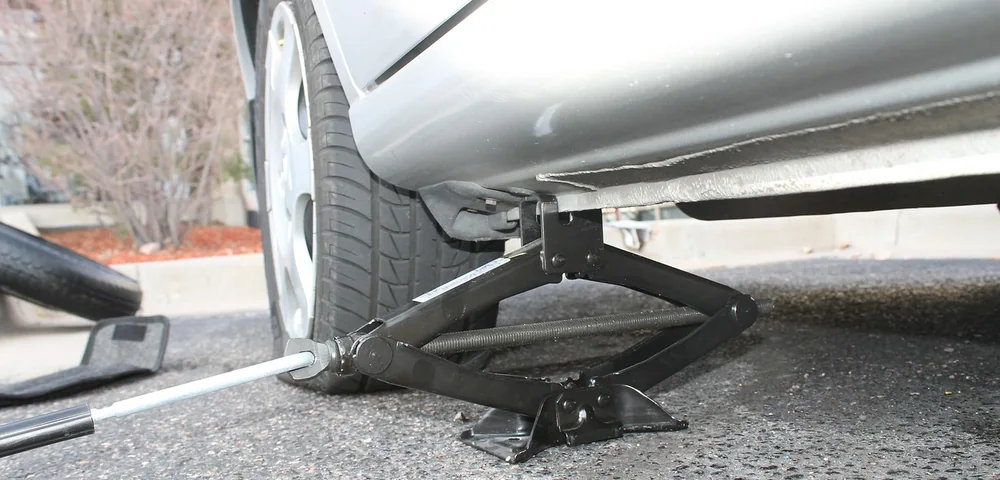
Changing a flat tire without a jack is possible if you use terrain, leverage, or manpower to lift the car enough to pull the wheel. The safest options are driving onto a ramp-like surface (a curb, log, or stack of solid material) so the flat tire clears the ground, or physically lifting the corner of the car with several people while someone swaps the wheel. None of these methods are as controlled as a proper jack, so they should be treated as emergency techniques, not routine practice.
This guide walks through what to do when you’re stuck without a jack, three practical lifting methods, the safety rules that keep you from getting hurt, what you should be carrying in your trunk to prevent this situation, and when it’s smarter to just call for help instead of improvising.

When You Might Not Have a Jack
Jacks disappear or fail more often than people expect. Some newer cars ship without one at all — automakers cut them to save weight and cost, assuming you’ll use run-flat tires or roadside assistance instead. Other times the jack is there but broken: a stripped screw thread, a cracked scissor arm, or hydraulic fluid that leaked out of a bottle jack in the garage. If you bought the car used, a previous owner may have borrowed the jack for another project and never returned it.
There’s also the scenario where you have a jack but can’t use it. Soft mud, deep sand, or a steep highway shoulder won’t support a jack’s small base — it will simply sink or tip the moment you apply weight. A jack that isn’t rated for your vehicle’s weight is another hidden trap; using an underrated jack is arguably more dangerous than having no jack at all, because it can fail mid-lift.
Finally, some drivers simply forget to check their emergency kit after buying a car or after a previous repair. If you’ve never physically opened the trunk panel and confirmed the jack, lug wrench, and spare are all present and undamaged, you’re gambling on a flat tire happening somewhere convenient. That’s the gap this article is meant to cover — what to do when the gamble doesn’t pay off.
Method 1: Using a Ramp or Curb
The ramp method uses gravity and geometry instead of mechanical lift. If you can drive the car forward so the flat tire rolls up onto something solid — a curb edge, a low concrete parking block, a stack of flat pavers, or a purpose-built rubber tire ramp — the opposite corner of that axle lifts off the ground just enough to remove the wheel. This only works if the tire still holds enough shape to roll a few feet; a tire that’s shredded down to the rim usually can’t be driven onto anything without damaging the wheel further.
To do this safely, approach the curb or ramp slowly and dead straight, at idle speed, and stop the instant the tire is seated against the raised surface. Shift into park, engage the parking brake, and chock the wheels on the ground diagonally opposite the flat (front-left flat means chock the rear-right, for example). Only then loosen the lug nuts and pull the wheel.
The main risk is the car rolling backward off the ramp while you’re working underneath the wheel well. Never place any part of your body under the vehicle with this method — you’re relying on friction and a chock, not a locked mechanical lift. If the tire is too flat to roll or the road has no curb, log, or ramp nearby, move on to another method. This technique is best suited to parking lots and residential streets, not highway shoulders.
Method 2: Using a Spare Tire Wedge
This method uses your inflated spare (or a full-size spare stored underneath the vehicle on trucks and SUVs) as a wedge to prop up the corner of the car instead of a jack. It works best on vehicles with reasonable ground clearance and a fairly rigid frame section near the flat wheel.
Start by loosening — not removing — the lug nuts on the flat tire while all four wheels are still on the ground; you need the resistance of a grounded wheel to break the nuts free. Then place the spare tire on its side directly beneath the frame rail or a solid suspension point near the flat, as close to the wheel as safely possible. Slowly rock or drive the car a few inches so the flat tire’s corner settles down onto the spare, which acts like a stopper and lifts the flat tire slightly off the ground — often just an inch or two, but sometimes enough to slide the wheel free once fully unbolted.
This method has real limits. It rarely lifts the tire completely clear of the ground, so you may need to combine it with a curb or a few flat rocks to gain the last bit of clearance. It also depends heavily on your vehicle’s frame geometry — some unibody cars have no clean, flat contact point near the wheel well, making this approach unstable. Never fully commit your weight or reach under the car when it’s resting only on a tire wedge; treat it as a temporary prop while you finish other prep work, not a stable lifting platform.
Method 3: Group-Lift Technique
If you have two or three capable people nearby, physically lifting the corner of the car is often the most controllable no-jack method, especially for smaller sedans and hatchbacks. Loosen the lug nuts first while the car is grounded, exactly as with the wedge method. Then position people at the strongest lift points — typically the frame rail behind the front bumper or ahead of the rear bumper, never on plastic body cladding, bumpers, or rocker panel trim, which will crack under load.
On a signal, everyone lifts together, bending at the knees rather than the back, while one person immediately slides a stack of solid material — bricks, a curb, a log round, or a sturdy toolbox — under the frame to hold the lift. The goal is never to hold the car in the air with muscle alone for the entire tire swap; you’re using people to create just enough height to slide a solid support underneath, then lowering the car onto that support.
This works because most sedans weigh less at any single corner than the total vehicle weight suggests — a corner lift is often a few hundred pounds, which three adults can manage briefly with proper form. It becomes impractical or dangerous with larger trucks, SUVs, or anyone with back problems. Never attempt this alone, and never let anyone put hands or feet under the car once it’s set down on the support — treat that support the same way you’d treat a jack stand.
Safety Precautions
Every no-jack method removes a layer of the safety margin a real jack provides, so precautions matter more here, not less. Always set the parking brake and put an automatic in park or a manual in first/reverse before touching a lug nut. Chock at least one wheel on the ground with a brick, wood block, or the size-appropriate factory wheel chock if your vehicle has one.
Work only on flat, firm, level ground whenever you have a choice — a car on a slope is far more likely to shift off any improvised support. Keep bystanders, kids, and pets away from the work area, and stay off the traffic side of the vehicle if you’re near a road; if the flat is on the traffic-facing side, consider driving a short distance further to a safer spot even on the rim rather than working inches from moving traffic, since