
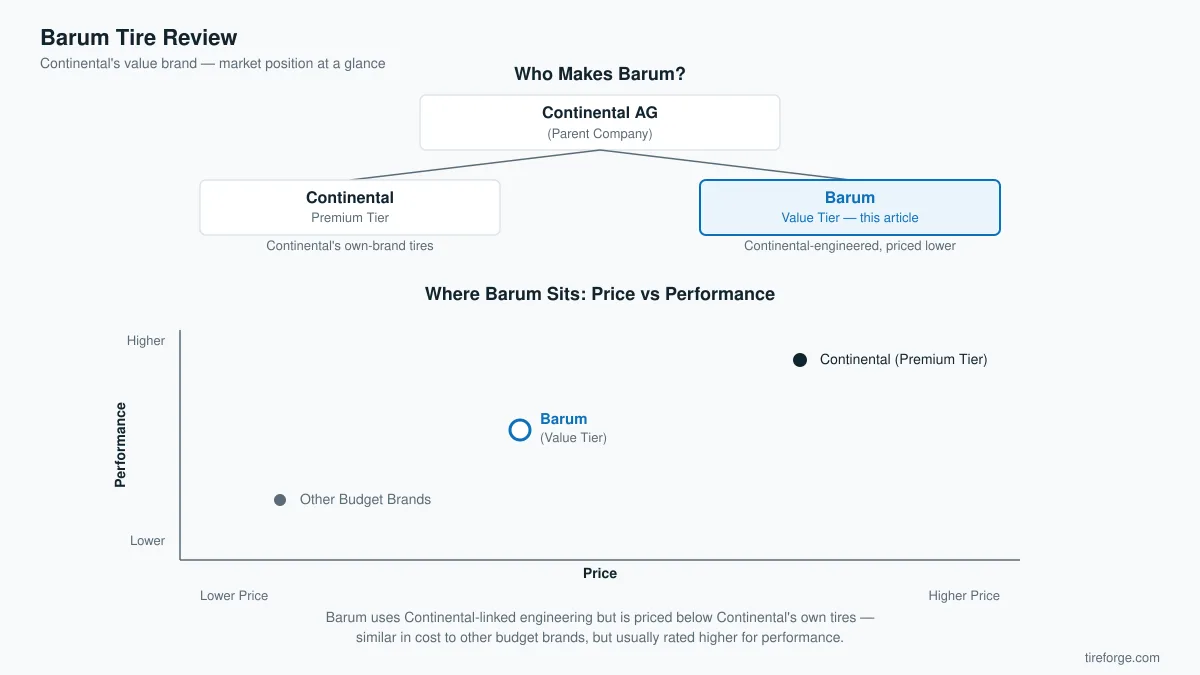
Barum is a Czech tire manufacturer owned by Continental AG, and that ownership is the single most important fact in this review. Barum tires are built in Continental’s own plant in Otrokovice, Czech Republic, using engineering knowledge that trickles down from Continental’s premium lines, but sold at a noticeably lower price point. If you’re asking whether Barum is worth buying, the short answer is: yes, if you drive mostly in Europe or the UK, want a tire that outperforms typical budget brands, and don’t need the absolute best-in-class grip or the longest warranty. It’s a strong mid-tier choice, not a flagship one.
Who Makes Barum and Where It Sits in the Market
Barum has existed as a Czech tire brand since the 1930s and became part of Continental’s portfolio after Continental acquired a majority stake in the early 1990s. Today it operates as Continental’s value-tier brand for the European market, similar to how some manufacturers run a secondary label to compete on price without diluting their flagship name. This is a common structure in the tire industry — General and Cooper have a related relationship in North America, for example — and it generally means the budget brand gets access to compounding research, testing data, and manufacturing standards that a truly independent low-cost tire maker wouldn’t have.
In practice, this places Barum a step above bargain-bin brands and a step below Continental itself. Expect tread compounds and casing construction that are more refined than what you’d find from a purely low-cost import, but without the last few percent of wet braking performance or tread life that Continental’s own UC7 or PremiumContact lines deliver. Barum is sold almost exclusively in Europe; if you’re shopping in the US, it’s worth comparing against similarly positioned value brands covered in our Sentury Tires review or the Sumitomo Tire review, since those occupy a comparable price bracket.
Barum Tire Range and What Each Line Is For
Barum’s lineup is organized by season and vehicle type rather than by performance tier, which makes shopping straightforward once you know what each name means.
- Bravuris (5HM and successors): The summer/performance-oriented touring line for passenger cars. Aimed at drivers who want reasonably sporty handling without paying for an ultra-high-performance tire.
- Brillantis 2: The economy summer tire, positioned for older or lower-value vehicles where cost per mile matters more than outright grip.
- Quartaris 5: Barum’s all-season option, built for drivers in climates with mild winters who don’t want to swap tires twice a year.
- Polaris 5 and Polaris 6: Dedicated winter tires, Barum’s most respected line, benefiting heavily from Continental’s winter compound research.
- SnowVan / Vanis: Commercial and van-specific tires built for higher load ratings and delivery-type duty cycles.
The practical takeaway: match the line to your actual driving pattern rather than picking whatever’s cheapest at the shop. A Brillantis buyer who actually drives in freezing, wet conditions all winter is setting themselves up for disappointment; that driver should be looking at Polaris or a proper winter tire, similar to the logic covered in our Nokian tire review.
Performance: Dry, Wet and Winter Grip
Dry handling on the Bravuris line is genuinely competitive with mid-pack mainstream brands — steering response is predictable, and the tire doesn’t feel vague at speed, which is common with cheaper compounds. It won’t match a proper UHP tire from Michelin or Pirelli in ultimate cornering grip, but for daily driving and highway merging, most drivers won’t notice a deficit.
Wet performance is where Barum’s Continental DNA shows up most clearly. Braking distances on wet pavement, tested in independent European tire comparisons, consistently place Barum’s Bravuris and Quartaris lines ahead of true budget brands and only modestly behind Continental’s own tires. Hydroplaning resistance is solid thanks to circumferential grooves borrowed conceptually from Continental’s tread designs, though the outright water-clearing capacity trails the very best all-season tires.
Winter grip is Barum’s strongest category. The Polaris line uses a silica-rich compound that stays pliable in low temperatures, and independent winter tire tests in European markets have repeatedly placed it in the upper-middle tier — behind category leaders like Nokian or Michelin’s winter offerings, but ahead of most other value brands. If snow and ice are a real factor where you live, the Polaris is the Barum tire worth paying attention to.
Tread Life, Warranty and Value
Barum doesn’t market aggressive treadwear mileage claims the way some US brands do, and warranty coverage varies by country and retailer rather than following a single global policy. What you can rely on is a tread life that sits in line with the price: it will not outlast a premium touring tire mile-for-mile, but it’s competitive against other tires in its price bracket, and noticeably better than the cheapest import brands that sacrifice compound durability to hit a rock-bottom price point.
The real value proposition is cost per mile relative to performance, not cost per mile in isolation. Buying the absolute cheapest tire on the shelf often means replacing it sooner and accepting worse wet braking in the meantime — a false economy if you drive in variable weather. Barum tends to land in a sweet spot where the upfront price is meaningfully lower than Continental, Michelin, or Bridgestone, but the performance gap is smaller than the price gap would suggest. That’s the classic value-brand pitch, and Barum executes it better than most because of the manufacturing pedigree behind it. Before buying, always confirm the load index and speed rating match your vehicle’s original equipment — our guide on how to read a tire sidewall walks through exactly what those codes mean.
Road Noise and Comfort
Cabin noise is a category where budget tires often cut corners, since noise-reducing tread designs and multi-layer sidewall construction add cost without a marketing-friendly headline number. Barum performs reasonably well here relative to its price. The Bravuris and Quartaris lines use tread block patterns designed to break up resonance frequencies, and most drivers describe them as quieter than expected for a value tire, though not silent at highway speed the way a flagship touring tire would be.
Ride comfort follows a similar pattern — a sidewall construction tuned for a reasonably compliant ride over expansion joints and rough pavement, without the plush, isolated feel of a tire specifically engineered for luxury sedans. If your priority is a hushed cabin above all else, you’ll still get a better result from a dedicated comfort-touring tire, but Barum won’t be the source of an annoying drone or harsh impact harshness that some ultra-budget brands are known for.
How Barum Compares With Rivals at the Same Price
| Brand | Typical Position | Strength vs. Barum | Weakness vs. Barum |
|---|---|---|---|
| Barum | Continental’s European value tier | — | — |
| Sentury | Independent budget import | Often cheaper upfront | Less consistent wet braking data |
| Sumitomo | Dunlop-adjacent value brand | Comparable manufacturing pedigree | Narrower model range in Europe |
| General | Continental’s US value tier | Stronger US retail presence | Similar performance profile overall |
| Nokian | Winter specialist, higher price | Superior ice and deep-snow grip | Meaningfully higher cost |
The clearest comparison is with General, since both are Continental-family value brands serving different regions — General leans US retail, Barum leans European. Against fully independent budget brands, Barum’s advantage is consistency: because it shares R&D infrastructure with a tier-one manufacturer, its performance floor tends to be higher even when its ceiling is similar. If you’re cross-shopping against a dedicated winter specialist like Nokian, expect to pay more for genuinely superior ice grip — Barum’s Polaris line is good, not class-leading.
Who Should Buy Barum — and Who Shouldn’t
Barum makes sense for drivers who want more performance and reliability than a rock-bottom budget tire but don’t want to pay flagship prices — commuters, families running a second car, and fleet or rental operators who need predictable performance across a large number of vehicles. European buyers in particular benefit from strong local availability and service network support, since Barum is backed by Continental’s distribution infrastructure.
Barum is a weaker choice for drivers chasing the last word in dry grip for spirited driving, for anyone in North America where availability is limited and warranty support can be inconsistent, and for drivers in extreme winter climates who need the absolute best ice and deep-snow performance — that group is better served by a dedicated winter specialist. If ultimate longevity is your only criterion, a premium all-season tire with a longer mileage warranty, even at a higher upfront cost, may work out cheaper over the life of the tire.
Frequently Asked Questions
Is Barum the same as Continental?
No, but they’re related. Barum is a separate brand wholly owned by Continental AG and manufactured in Continental’s Czech facility. It shares engineering knowledge and manufacturing standards with Continental but is positioned and priced as a lower-cost alternative, not a rebadged version of Continental’s flagship tires.
Are Barum tires good for winter driving?
The Polaris winter line is Barum’s strongest product and performs well in independent European winter tire tests, generally landing in the upper-middle tier. It’s a solid choice for typical winter conditions, though dedicated specialists still lead in extreme ice and deep-snow scenarios.
Can I buy Barum tires in the United States?
Availability is limited. Barum is primarily distributed in Europe, so US buyers will likely find better local support, warranty service, and retail availability with Continental-family brands sold domestically, or with comparably positioned value brands.
How does Barum compare to other budget tire brands on value?
Barum generally outperforms fully independent budget brands on wet braking and consistency, largely due to its Continental manufacturing pedigree, while still costing noticeably less than premium-tier tires. It’s a strong middle-ground pick rather than the absolute cheapest option on the shelf.