
If you’re choosing between studded and studless winter tires, the short answer is this: studded tires win on glare ice but lose on dry and wet pavement, while studless (modern winter) tires are the better all-around choice for most drivers because they perform nearly as well on ice and significantly better everywhere else. The right pick depends on how much of your winter driving happens on actual ice versus packed snow, slush, and dry roads — and whether your state or province even allows studs. Let’s break down how each works before comparing them directly.
What Are Studded Tires & How They Work
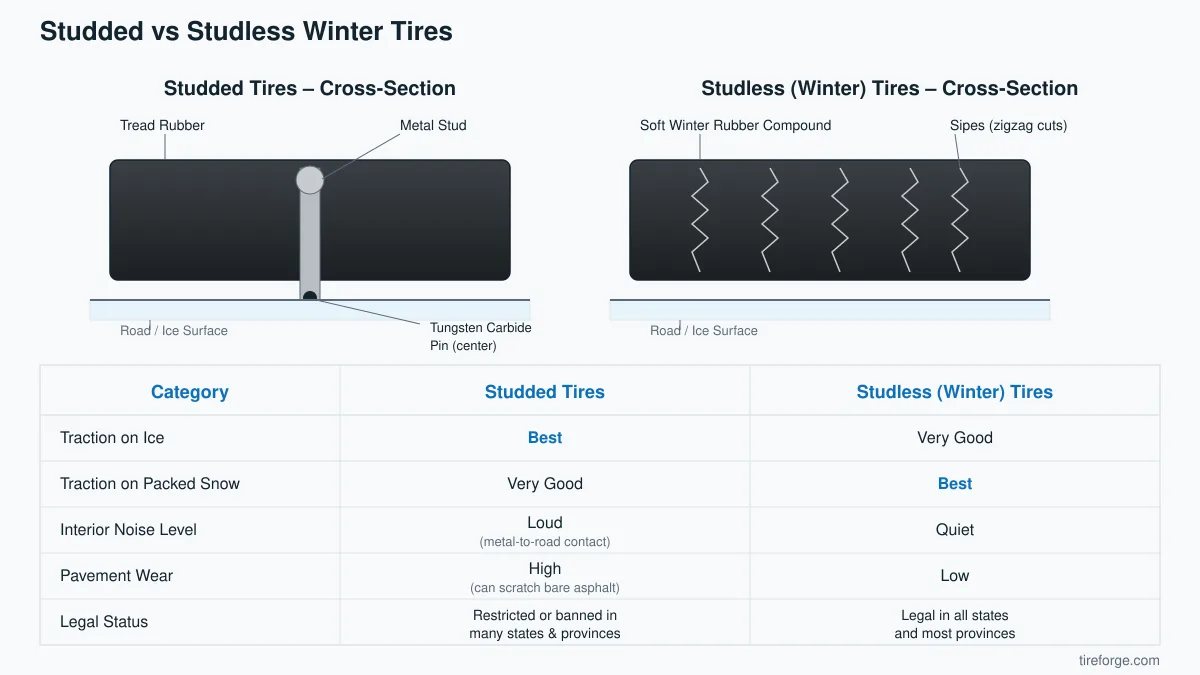
Studded tires are winter tires embedded with small metal pins — typically tungsten carbide cores set in an aluminum or steel jacket — that protrude a millimeter or two beyond the tread surface. As the tire rolls, those studs dig into ice and compacted snow, creating mechanical grip that rubber alone can’t match. Think of it like crampons for your car: on smooth, hard ice, that physical bite is the difference between stopping in 100 feet and sliding through an intersection.
Studs are installed at the factory or by a tire shop with specialized equipment, usually in a staggered pattern across the tread blocks — more studs in the center and shoulder for straight-line traction and cornering bite. Most tires accept between 100 and 150 studs depending on size. A common mistake is assuming more studs always means more grip; beyond a certain density, you actually lose tread rubber contact area and can reduce traction on anything that isn’t pure ice.
Studded tires need a break-in period of 500–600 miles at moderate speed so the studs seat properly in the rubber. Skipping this step causes premature stud loss. It’s also worth noting studs wear down and can pop out over a season or two of use, especially if you spend a lot of time on dry pavement, which erodes both the studs and the road.
What Are Studless (Winter) Tires & How They Work
Studless winter tires rely entirely on compound chemistry and tread geometry to generate grip in the cold. The rubber is formulated to stay pliable well below freezing — often down to -20°F or colder — unlike all-season rubber, which stiffens and loses grip once temperatures drop below about 45°F. That single difference is why a winter tire outperforms an all-season tire long before you even hit snow.
The tread itself is packed with thousands of micro-slits called sipes. These thin cuts open up under braking and cornering forces, creating extra biting edges that grab onto snow and ice crystals, then squeeze out slush and water through deep, wide grooves. Some tires also use silica- or walnut-shell-infused compounds to add micro-texture that grips ice at a near-molecular level, mimicking what a stud does mechanically but without the hardware.
The tradeoff is that studless tires depend heavily on tread depth and compound freshness — a winter tire worn below 6/32″ loses a meaningful chunk of its ice and snow traction, even though it would be considered fine for a summer tire. Many drivers make the mistake of running winter tires for 5-6 seasons without checking tread depth, not realizing the compound has also hardened with age and UV exposure, quietly reducing grip each year even if the tire looks fine.
Traction on Ice vs Packed Snow: Performance Comparison
This is where the decision usually gets made. On clear, smooth ice — think a frozen parking lot or a glazed bridge deck — studded tires still hold a real advantage, particularly for stopping distance. Independent testing over the years has consistently shown studded tires braking shorter on ice than even premium studless tires, sometimes by 10-20%, especially near freezing temperatures where ice is at its slickest.
But that gap narrows or disappears in several common scenarios. On packed snow, modern studless tires often match or beat studded tires because the sipe network and soft compound conform to snow better than rigid metal studs. In acceleration and cornering grip on mixed surfaces, studless tires are frequently more predictable because they engage consistently across the whole tread rather than relying on point contact from individual studs.
On dry or wet pavement — which is most of the road surface drivers actually encounter even in winter — studless tires are clearly superior. Studs reduce rubber-to-road contact, which lengthens braking distance on dry roads and can make for a buzzy, slightly unsettled ride on bare highway. If your winters involve mostly plowed roads with occasional icy patches rather than sustained glare ice, a quality studless tire will likely serve you better overall.
| Condition | Studded Tires | Studless Tires |
|---|---|---|
| Glare ice | Best | Very good |
| Packed snow | Good | Best |
| Dry pavement | Reduced braking, more noise | Best |
| Wet pavement | Average | Best |
| Tread/compound longevity | Studs wear out over time | Depends on tread depth only |
Legal Restrictions by State and Province
Studded tires are regulated, and the rules vary enough that you need to check before buying. In the U.S., several states ban studs outright, including warmer-climate states where ice is rare and road damage concerns dominate. Many northern and mountain states allow studs only during a defined season — commonly mid-October through mid-April — and some restrict use to specific counties or elevations. A handful of states, like Alaska, allow broader use given the severity of winter conditions there.
In Canada, provinces are similarly split. Quebec requires winter tires (studded or studless) by law for a set period each winter, while some provinces permit studs seasonally and others restrict or ban them in urban areas due to pavement wear concerns. Local municipalities sometimes layer on their own rules even within a province that otherwise allows studs.
The common mistake here is assuming a rule from your home state applies everywhere you drive. If you commute across a state or provincial line, or take road trips in winter, it’s worth checking both ends of your route. Fines for driving on studs outside the legal window do get enforced, particularly in jurisdictions that take pavement damage seriously. Because the patchwork changes periodically, always verify current rules with your state DOT or provincial transportation authority before mounting studded tires, rather than relying on last year’s regulation.
Noise, Ride Comfort & Pavement Wear Differences
Studded tires are noticeably louder than studless tires, especially at highway speeds on dry or lightly wet pavement. That metallic hum or clicking sound comes from hundreds of studs tapping the road surface thousands of times per mile, and it doesn’t go away — it’s simply the tradeoff for the mechanical bite. Drivers who log significant highway miles in winter often find this fatiguing on long trips.
Ride comfort also differs subtly. Studded tires can feel slightly harsher over bare pavement because the rigid stud housings don’t flex the way pure rubber does, and some drivers notice a faint vibration at speed. Studless tires, by contrast, ride close to a standard all-season tire in comfort, with the softer winter compound actually absorbing small road imperfections well.
Pavement wear is the other major consideration, and it’s a big reason for the legal restrictions discussed above. Studs grind against asphalt and concrete every rotation, and over a season of heavy studded-tire traffic, this measurably accelerates rutting on well-traveled roads, particularly in the wheel paths of highways and bridges. This is a real cost that falls on public infrastructure, not just the tire itself, which is precisely why transportation departments regulate the season and locations where studs are legal. Studless tires create essentially no additional pavement wear beyond normal tire use, which is one more point in their favor for drivers who don’t strictly need the stud advantage.
Which Type Fits Your Climate and Driving Needs
For most drivers in regions with cold winters but mixed conditions — some snow, some ice, mostly plowed roads, regular highway driving — studless winter tires are the practical choice. They deliver excellent cold-weather grip without the noise, dry-pavement compromise, or legal headaches of studs, and they work well with all-wheel-drive vehicles like a Subaru Outback or Forester that already have strong mechanical traction and mainly need a tire that keeps its grip in freezing temperatures.
Studded tires make the most sense for drivers in genuinely ice-dominant climates: rural routes that go unplowed and refreeze repeatedly, mountain passes, or regions where black ice is a daily hazard rather than an occasional one. If you drive mostly on routes that rarely see bare pavement all winter, and your jurisdiction allows studs, the extra ice traction can be worth the noise and the dry-road tradeoff.
A middle path many drivers overlook is a studdable winter tire — purchased without studs initially, with the option to add them later if conditions demand it, or a