
Outer edge tire wear happens when the tread wears down faster on the shoulder closest to the outside of the vehicle than it does in the center or on the inner shoulder. The usual culprits are underinflation, aggressive cornering, and alignment problems involving excess positive camber or toe-out. The fix almost always involves a combination of a pressure check, an alignment inspection, and a look at how the vehicle is driven. Below we break down what this wear pattern looks like, why it happens, how it differs from inside-edge wear, and exactly how to diagnose and correct it before it costs you a full tire replacement.
What Outer Edge Wear Looks Like
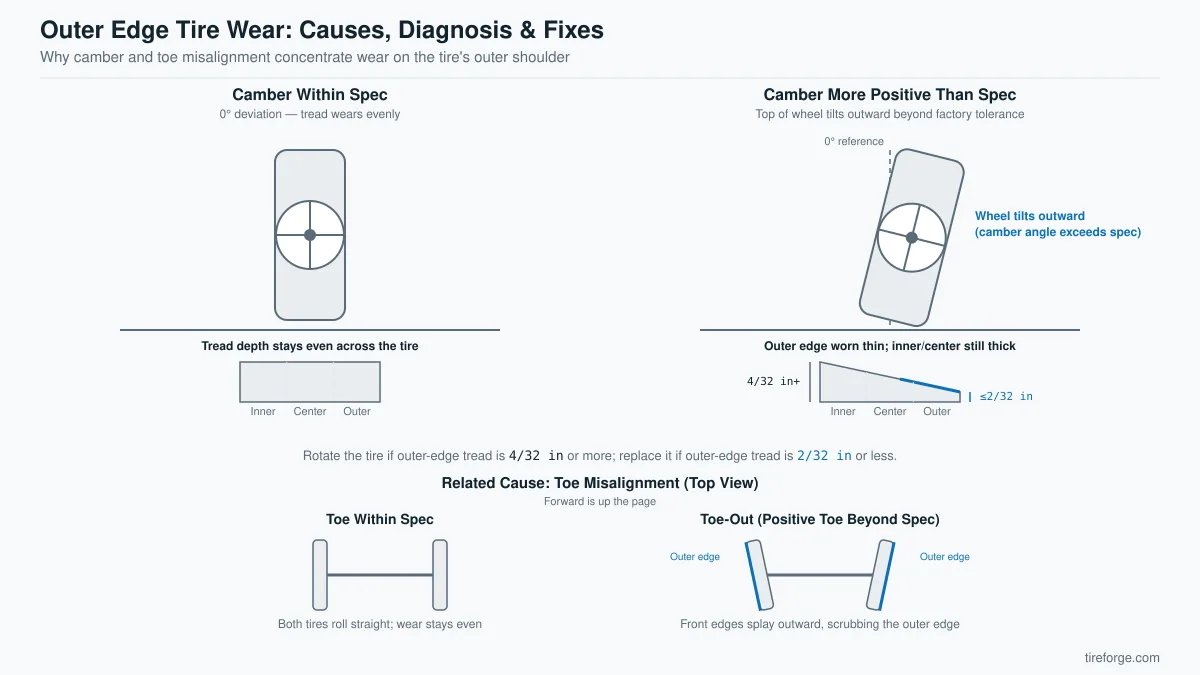
Outer edge wear shows up as a band of thinning tread running along the shoulder closest to the outer side of the tire, while the center and inner shoulder retain more tread depth. Run your hand across the tire face from center to edge and you’ll often feel the drop-off before you can see it clearly. In moderate cases, the wear is gradual and even across that outer band. In more severe cases, you’ll see a sharper, almost stepped edge where the tread block height changes abruptly, sometimes with rounded or feathered edges on the tread blocks themselves.
It’s worth distinguishing uniform outer edge wear from one-sided wear that only affects one tire or one axle. If both front tires show outer edge wear evenly, you’re likely looking at a vehicle-wide alignment or inflation issue. If only one tire is affected, or one side is noticeably worse than the other, that points to an asymmetric problem — a bent component, uneven camber side to side, or a tire that’s been chronically underinflated on just one corner. Use a tread depth gauge or even the penny test across multiple points on the tire face to quantify the difference; a 2/32-inch or greater variance between the outer edge and the center is a clear sign something needs attention. For a detailed walkthrough of measuring technique, see our guide on how to measure tire tread depth.
Common Causes: Alignment, Underinflation & Cornering Habits
Alignment — Camber and Toe
Positive camber, where the top of the tire tilts outward relative to the road, concentrates load on the outer edge of the contact patch. Even a degree or two out of spec can produce noticeable wear over 10,000–15,000 miles. Toe-out, where the front of the tires point away from each other, also scrubs the outer shoulders as the tire is dragged sideways with every rotation. These are the two alignment angles most responsible for outer edge wear, and both can drift out of spec from hitting a pothole, curb strike, or worn suspension bushings — not just from a bad alignment job.
Underinflation
A tire that’s low on air bulges at the sidewalls and rolls more on its shoulders than its center. This is one of the most common and cheapest-to-fix causes, yet it’s frequently overlooked because underinflation can produce wear on both outer edges, not just one, which some drivers mistake for a tire defect. Checking pressure monthly with a reliable gauge prevents this; see our comparison of digital vs analog vs stick gauges for picking a tool you’ll actually use.
Cornering Habits
Taking corners at speed repeatedly loads the outer shoulder of the outside tires through the turn. This is a legitimate mechanical cause, not just an alignment symptom — performance-driven vehicles and spirited daily drivers alike will show accelerated outer edge wear even with a textbook-perfect alignment, simply because the outer tread blocks are doing more work during cornering events.
Outer Edge Wear vs Inside Wear: Key Differences
Inside edge wear is the mirror image of outer edge wear and stems from largely the opposite alignment conditions. Where outer wear is associated with positive camber and toe-out, inside wear is typically caused by negative camber (top of the tire tilted inward) and toe-in. Both patterns can also result from underinflation in combination with other factors, which is why isolating the root cause matters — pressure affects both edges somewhat evenly, while camber and toe tend to favor one edge specifically.
| Factor | Outer Edge Wear | Inner Edge Wear |
|---|---|---|
| Camber | Positive camber (top tilts out) | Negative camber (top tilts in) |
| Toe | Toe-out | Toe-in |
| Underinflation | Possible, usually both edges | Possible, usually both edges |
| Common on | Worn ball joints, bent control arms | Aftermarket lowering springs, worn tie rods |
If you’re seeing both edges wearing while the center stays fuller, that’s a classic underinflation signature rather than a one-sided alignment issue — in that case our guide on what causes tires to wear on the inside covers the inverse pattern in depth and is a useful cross-reference for ruling out confusion between the two.
How to Diagnose the Root Cause
Start with pressure. Check all four tires cold, including the spare if it’s a full-size, and compare against the number on the door jamb sticker — not the number molded into the tire sidewall, which is the maximum, not the recommended pressure. If pressures are fine and wear is still concentrated on the outer edges, move to a visual inspection of the suspension: look for torn or cracked CV boots, play in ball joints (grab the tire at 12 and 6 o’clock and rock it), and uneven ride height side to side, which can indicate a sagging spring.
Next, get a four-wheel alignment check with printed before numbers, not just a verbal