
Outer Edge Tire Wear: Causes, Diagnosis & Fixes
- Camber reading more positive than spec on one or both front wheels
- Toe reading positive (toe-out) beyond the acceptable range
- Caster split between left and right exceeding about half a degree, which can cause pull and compensatory steering wear
Also rule out feathering, a related but distinct pattern where tread blocks wear at an angle rather than a flat edge; it often overlaps with outer edge wear and points toward toe misalignment specifically. Our tire feathering guide walks through how to feel for that angled edge with your hand. Finally, consider driving style honestly: if you regularly take on-ramps and corners briskly, some outer shoulder wear is simply mechanical reality rather than a fault to chase down.
Fixes: Alignment, Pressure & Driving Adjustments
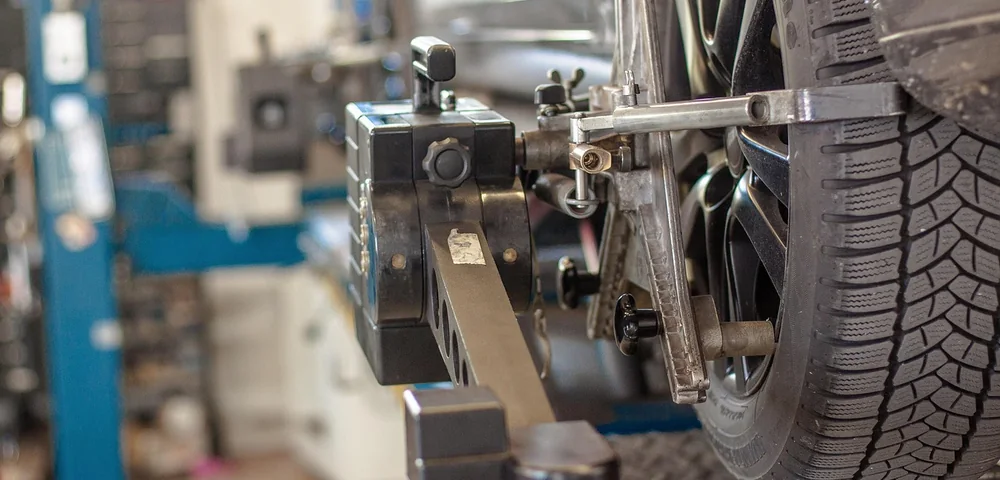
Once you’ve identified the cause, the fix is usually straightforward. For alignment-driven wear, a four-wheel alignment that brings camber and toe back within factory specification will stop further abnormal wear going forward, though it won’t restore the tread already lost. If camber can’t be brought into spec with standard adjustment, the shop may need camber bolts or shims, or may find a bent component that needs replacing — a strut, control arm, or spindle that was tweaked in a curb strike or pothole impact.
For pressure-driven wear, set tires to the door-jamb recommendation and recheck monthly, since tires lose roughly 1 psi per month naturally and more in cold weather. A tire pressure monitoring system warning you of low pressure doesn’t always mean the tire is visibly flat — see why your low pressure light can come on even when tires look fine for why this matters even when nothing looks wrong at a glance.
If driving habits are a contributing factor, the realistic fix isn’t to stop cornering — it’s to accept a slightly shorter tread life on performance-oriented driving, or to choose a tire with a more durable shoulder compound if you drive that way consistently. Rotating tires on a regular schedule, typically every 5,000–7,000 miles, also helps distribute outer edge wear more evenly across all four tires rather than concentrating it on one axle. If a specific wheel seems to cause rubbing or contact under turning, that’s a related but separate issue worth checking — our article on why tires rub when turning covers clearance problems that can accompany or be mistaken for alignment-driven edge wear.
When to Replace vs Rotate
Whether to rotate or replace depends on how much tread remains and how even the remaining wear is. If the outer edge still has at least 4/32 inch of tread and the wear is caught early, rotating the tire to a position with less outer-edge stress (such as moving a front tire to the rear) combined with correcting the root cause can extend useful life meaningfully. If the outer edge has worn down to 2/32 inch or less while the center and inner portions still have substantial tread, replacement of that specific tire is the safer call — an unevenly worn tire can affect handling predictability and wet traction on the worn side well before the rest of the tire is due for replacement.
Also inspect for cord or belt exposure at the shoulder, which is a hard stop regardless of the rest of the tread — that’s a safety issue, not a maintenance one. If only one or two tires are affected and the rest of the set still has significant life, replacing just the worn pair and pairing them on the same axle (typically the rear, per most manufacturer guidance) is usually acceptable, though check your tire’s specific rotation and pairing recommendations. Keep in mind that mismatched tread depth across an axle, even within the same model, can subtly affect all-wheel-drive systems that rely on equal rolling diameter — worth a conversation with your shop if your vehicle is AWD.
Frequently Asked Questions
Can outer edge wear be caused by something other than alignment?
Yes. Chronic underinflation and aggressive or frequent high-speed cornering can both produce outer edge wear even with a perfectly aligned vehicle. Pressure and driving style should be ruled out before assuming the alignment is the sole cause.
Will a wheel alignment fix wear that has already happened?
No. Alignment corrects the geometry causing ongoing wear, but it cannot restore tread that’s already been worn away. It stops the problem from getting worse and protects the replacement tires you install afterward.
How often should I rotate tires to prevent this pattern?
Every 5,000 to 7,000 miles is a reasonable interval for most passenger vehicles, though you should follow your owner’s manual. Regular rotation helps distribute shoulder stress across all four tires rather than letting it concentrate on one or two positions.
Is outer edge wear covered under tire warranty?
Generally no. Wear caused by alignment, inflation, or driving habits is considered a maintenance issue rather than a manufacturing defect, so most tire warranties exclude it. Keep alignment and pressure records if you ever need to dispute a claim.