
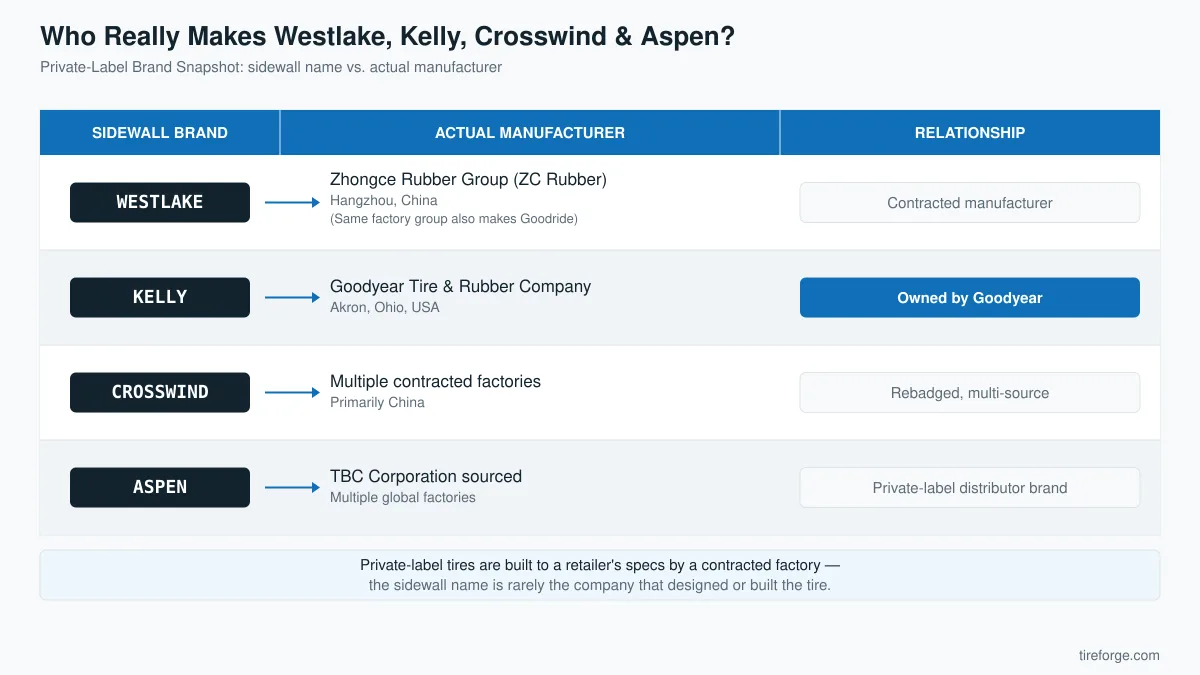
If you’ve ever shopped for tires on a budget, you’ve probably run into names like Westlake, Kelly, Crosswind, or Aspen and wondered who actually builds them. The short answer: none of these companies own a tire factory in the way Michelin or Goodyear does. They’re private-label brands, meaning a manufacturer builds the tire to a buyer’s specification and the buyer slaps its own name on the sidewall. Some of these manufacturers are enormous, well-established tire makers you’d recognize if you saw their corporate names. Others rotate between factories depending on the model and the year. Understanding who’s actually behind the rubber helps you decide whether a cheap tire is a smart buy or a gamble.
What Is a Private-Label Tire?
A private-label tire is a tire manufactured by one company and sold under another company’s brand name. This isn’t unique to tires — it’s the same model Costco uses for Kirkland-brand groceries or how most hardware store paint is mixed by one of three major paint manufacturers. In the tire world, a distributor or retailer works with a factory to spec a tread pattern, compound, and size range, then puts its own name, warranty, and packaging on the finished product.
This matters because the brand name on the sidewall tells you almost nothing about who engineered the tire, where it was built, or what quality control standards were applied during production. Two tires with completely different names might come off the same production line with only the mold logo changed. Conversely, two tires with similar-sounding budget names might be built in entirely different factories on different continents, with very different consistency.
Private labeling isn’t inherently bad. It’s how most budget and mid-tier tires reach the market, and it lets large manufacturers run their factories at full capacity by producing for multiple brands simultaneously. The real question isn’t whether a tire is private-label — most are, in some fashion — but who the manufacturer is and whether that manufacturer has a track record worth trusting.
Westlake Tires: Who Really Builds Them
Westlake is one of the most recognizable budget tire names in North America, and it’s manufactured by Zhongce Rubber Group (often shortened to ZC Rubber), one of the largest tire manufacturers in China and consistently ranked among the top ten tire producers in the world by volume. ZC Rubber doesn’t just make Westlake — it also produces tires under the Goodride and Chaoyang names, among others, giving the company a massive manufacturing footprint and decades of production experience.
What this means practically is that Westlake isn’t a fly-by-night operation assembling tires in a garage. ZC Rubber supplies tires globally, including OEM fitments in some markets, and has invested in modern manufacturing lines. That said, Westlake’s U.S. product lines are generally positioned at entry-level price points, so the compounds and constructions are engineered to hit a price target first and a performance ceiling second. Expect decent capability for daily commuting and light-duty work, but don’t expect them to compete with premium all-season or performance tires on wet braking, high-speed stability, or long-term tread life.
Westlake tires are commonly found on work trucks, trailers, and budget-conscious passenger vehicle replacements. If you’re cross-shopping similarly positioned budget brands, it’s worth reading a Primewell tire review for comparison, since Primewell occupies a similar market tier with a different manufacturing pedigree.
Kelly Tires and Goodyear’s Ownership
Kelly is a different story entirely, and it’s the one private-label brand on this list with a direct, undisputed link to a major American tire manufacturer. Kelly-Springfield Tire Company was an independent manufacturer dating back to the early 1900s, and Goodyear acquired it in 1935. Kelly has operated as Goodyear’s value-tier brand for decades, built using Goodyear’s manufacturing infrastructure and, in many cases, engineering input from Goodyear’s own development teams.
This ownership structure means Kelly tires benefit from a level of corporate oversight and manufacturing consistency that most private-label brands simply don’t have. Goodyear uses Kelly to serve customers who want a trusted name without paying premium pricing, essentially segmenting its own customer base by budget tier rather than ceding that market to a competitor. The tread designs and compounds are usually simplified or cost-reduced versions of technology that trickles down from Goodyear’s higher-tier lines, rather than being developed from scratch by a disconnected factory.
Practically, this makes Kelly one of the safer bets among lower-priced brands, since warranty support and quality control run through Goodyear’s network rather than an overseas distributor with inconsistent factory relationships. If you’re deciding between a Goodyear-family budget option and a pure private-label import, Kelly is generally the more predictable choice, particularly for daily-driven sedans and crossovers where ride comfort and treadwear consistency matter more than ultimate grip.
Crosswind, Aspen & Other Rebadged Lines
Crosswind and Aspen are both examples of true multi-source private-label brands, distributed primarily through American Tire Distributors (ATD), one of the largest tire wholesalers in the United States. Unlike Westlake’s relatively consistent ZC Rubber sourcing or Kelly’s dedicated Goodyear backing, brands like Crosswind and Aspen have historically been produced by whichever contract factory can meet ATD’s specifications and pricing at a given time. That has included manufacturing relationships with various Asian tire producers over the years, and it’s not unusual for the same model name to be sourced from a different plant in a later production run.
This is the defining trait of a true rebadged private-label line: the name stays fixed, but the factory behind it can change. Crosswind is especially common in the trailer tire (ST-metric) and light-truck categories, where budget buyers prioritize price over brand loyalty, and Aspen shows up frequently in similar value-oriented passenger and light-truck segments at independent tire shops supplied through ATD’s network.
None of this means the tires are poorly made — reputable Asian manufacturers like Sentury Tire have produced tires for numerous private-label programs, and you can get a sense of that manufacturing quality by reading a Sentury tires review covering their own branded products. But because sourcing isn’t locked to one factory, consistency from one production batch to the next can vary more than it would with a dedicated single-source brand. If you’re buying trailer tires in this category, also check our best tires for towing guide before committing, since load rating and speed rating matter more than brand name for trailer safety.
Are Private-Label Tires Lower Quality?
Not automatically, but the odds of inconsistency are higher. A private-label tire’s quality ceiling is set by whichever factory happens to be producing it, and that factory’s quality control standards, compound recipes, and curing processes may differ from one production run to the next, especially for multi-source brands. A single-source brand like Westlake (ZC Rubber) or Kelly (Goodyear) tends to be more predictable because the same engineering team and the same plants are responsible for every tire wearing that name.
Where private-label tires most commonly fall short of premium brands is in three areas: wet traction at higher speeds, tread life consistency across the size range, and noise/vibration refinement. Budget manufacturers often use simpler tread compounds that prioritize cost over silica content, which affects wet grip and rolling resistance. They also tend to offer a narrower range of internal constructions, so a given tread pattern might perform great in one size and mediocre in another because the casing wasn’t individually tuned.
The flip side is that private-label tires are frequently fine, even good, for low-mileage drivers, spare/backup vehicles, trailers, and budget-constrained daily commuting where ultimate performance isn’t the priority. The UTQG treadwear, traction, and temperature ratings printed on the sidewall are a useful cross-check regardless of brand reputation — our UTQG ratings explained guide walks through how to read those numbers so you’re not relying on brand name alone.
How to Vet a Lesser-Known Brand
Before buying any unfamiliar tire brand, spend ten minutes doing a little homework. Start by searching the brand name alongside words like “manufacturer” or “parent company” to find out who actually builds it — tire enthusiast forums and wholesale distributor catalogs often reveal this information even when the brand’s own marketing doesn’t.
Next, check whether the tire is DOT-registered, which is a legal requirement for any tire sold in the U.S. and ensures it’s gone through basic federal safety testing. The DOT code on the sidewall also includes a plant code that can sometimes be traced to a specific factory, giving you another clue about sourcing.
Look at the warranty terms closely. A private-label brand backed by a major company (like Kelly’s Goodyear backing) typically offers clearer, more enforceable warranty language than a brand whose distributor might not exist in five years. Check for an actual treadwear mileage warranty, not just a workmanship warranty, since the mileage warranty tells you how confident the manufacturer is in its own product.
Finally, read independent reviews rather than retailer-hosted testimonials, and pay attention to complaints about irregular wear, noise development over time, or sidewall cracking, which are the most common failure patterns in lower-tier tires. A pattern of consistent complaints about one specific issue is more telling than a single bad review.
Buying Tips for Private-Label and Budget Tires
If you decide a private-label brand fits your budget and use case, a few practical habits will help you get the most out of it. First, match the tire’s load range and speed rating to your vehicle’s original equipment specs exactly — budget brands sometimes offer a narrower range of load indexes, and it’s tempting to round down to save money, which is a real safety risk for trucks and trailers.
Second, rotate these tires on schedule, arguably more diligently than you would with a premium tire. Budget compounds and simpler tread designs are often less tolerant of uneven wear patterns, so skipping rotations accelerates problems faster than it would on a higher-tier tire. Our guide on what happens if you don’t rotate your tires explains why this matters even more on tires with lower tread-life margins.
Third, don’t buy a budget private-label tire expecting premium-tire tread life and then judge the brand harshly when it doesn’t deliver — compare it against its actual price-tier competitors. If you’re deciding between two value brands, resources like our General Tire vs Cooper Tire comparison show how to weigh mid-tier options against each other using the same criteria: treadwear warranty, ride comfort, and wet/dry traction scores from independent testing where available.
Finally, keep your receipt and warranty paperwork. Private-label brands change distributors and ownership structures more often than major manufacturers, and having documentation protects you if you need to make a warranty claim down the road.
Private-Label Brand Snapshot
| Brand | Manufacturer / Owner | Sourcing Model | Typical Use Case |
|---|---|---|---|
| Westlake | Zhongce Rubber Group (ZC Rubber) | Single-source, dedicated factory | Budget passenger, light truck, trailer |
| Kelly | Goodyear Tire & Rubber Company | Single-source, corporate-owned | Value-tier passenger and SUV |
| Crosswind | Multiple contract manufacturers via ATD | Multi-source, rotates by production run | Trailer (ST) and light-truck tires |
| Aspen | Multiple contract manufacturers via ATD | Multi-source, rotates by production run | Value-tier passenger and light-truck |
Frequently Asked Questions
Who makes Crosswind tires?
Crosswind is a private-label brand distributed through American Tire Distributors (ATD) and has historically been produced by various contract tire manufacturers rather than a single dedicated factory. The specific manufacturer behind a given Crosswind model can change between production runs, so quality can vary more than it would with a single-source brand.
Is Westlake the same as Goodride?
They’re related but not identical. Both are brand names produced by Zhongce Rubber Group (ZC Rubber), the same parent manufacturer, but they’re sold as distinct product lines with their own tread patterns and positioning, similar to how one automaker might sell slightly different trims under two nameplates.
Does Goodyear still own Kelly tires?
Yes. Goodyear acquired Kelly-Springfield in 1935 and continues to operate Kelly as its value-tier brand, which means Kelly tires benefit from Goodyear’s manufacturing and engineering infrastructure rather than being an independent or disconnected private-label operation.
Are private-label tires safe to use?
Any tire sold legally in the U.S. must meet DOT safety standards, so private-label tires are safe in the baseline regulatory sense. The bigger consideration is consistency and long-term performance, which is why checking UTQG ratings, warranty terms, and independent reviews matters more with these brands than with established premium manufacturers.
Should I avoid private-label tires entirely?
Not necessarily. They can be a reasonable choice for low-mileage vehicles, trailers, spares, or tight budgets, as long as you match the load and speed ratings correctly and set realistic expectations for tread life and wet-weather performance compared to premium brands.