
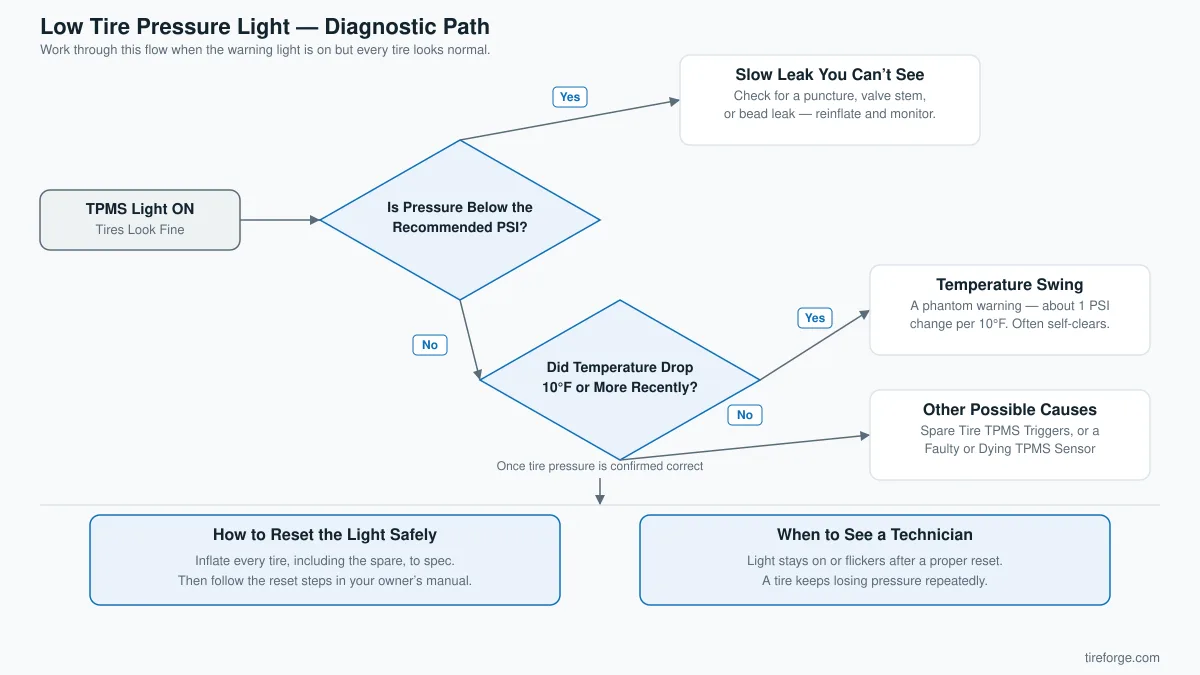
If your low tire pressure warning light is glowing but every tire looks normal, don’t ignore it — but don’t panic either. The most common cause by far is temperature-driven pressure loss that’s too small to see with your eyes but large enough to trip the sensor’s threshold. That said, the light can also mean a dying sensor, a forgotten spare, or a genuine slow leak that simply hasn’t deflated the tire enough to be visually obvious yet. Here’s how to figure out which one you’re dealing with.
How TPMS Actually Works
Modern vehicles use one of two Tire Pressure Monitoring System designs. Direct TPMS uses a small battery-powered sensor mounted inside each wheel, usually attached to the valve stem, that measures actual air pressure and transmits it to a receiver module. Indirect TPMS has no sensors at all; it infers pressure by comparing wheel rotation speed through the ABS system, since a lower-pressure tire has a slightly smaller rolling diameter and spins marginally faster.
Direct systems are far more common on vehicles built in the last 15-plus years and are what most drivers mean when they talk about a TPMS light. These sensors typically report pressure in real time or at set intervals, and the dash light illuminates once pressure drops below a threshold set by the manufacturer — commonly around 25% under the recommended cold pressure, though this varies by automaker.
Understanding this matters because direct TPMS doesn’t measure tread wear, sidewall condition, or anything visual — purely pressure (and on some systems, temperature inside the tire). That’s exactly why the light can come on when a tire looks completely fine: the sensor is reporting a number, not an appearance. A tire can be 6 or 8 psi low and show no visible sag at all, especially on a stiffer sidewall or a larger wheel with a low-profile tire. For a deeper look at reading actual numbers instead of guessing, a quality tire pressure gauge is the single best tool for confirming what the dash is telling you.
Temperature Swings & Phantom Warnings
Tire pressure is directly tied to temperature. As a rule of thumb, tire pressure changes roughly 1 psi for every 10°F change in ambient temperature. That means a tire set at 35 psi on a 70°F afternoon can read closer to 31-32 psi the next morning if temperatures drop into the 30s overnight — enough to cross the warning threshold on many vehicles.
This is the single most common reason the light comes on with no visible problem. It’s especially frequent in fall and winter when daily temperature swings are largest, and it often triggers first thing in the morning or after a long highway drive followed by a cold soak overnight. The light may even turn itself off once you drive for 10-15 minutes and the tires warm up and pressure rises back above threshold — this is normal and doesn’t mean the problem fixed itself permanently.
The mistake most drivers make here is assuming the light is faulty and ignoring it repeatedly. Temperature-related warnings are legitimate pressure drops, just not leaks. The fix isn’t to dismiss the light — it’s to add air to compensate for the season. Many manufacturers actually recommend setting pressures slightly higher heading into cold months for this exact reason. Check your door jamb sticker for the correct cold pressure and adjust accordingly rather than chasing the light every time temperature shifts.
Faulty or Dying TPMS Sensors
TPMS sensors contain their own small lithium battery, and that battery is not replaceable separately — once it dies, the whole sensor unit needs replacement. Typical sensor battery life runs 5 to 10 years, so if your vehicle is in that age range and the light behaves erratically, a failing sensor is a realistic culprit.
Signs that point to a sensor problem rather than an actual pressure issue include: the light flickering on and off with no pressure pattern, one specific wheel position always reading oddly low or not reporting at all, or the light coming on immediately after wheel or tire service. Sensors can also be damaged during tire mounting and dismounting if a technician isn’t careful with the valve stem assembly, or they can corrode internally in climates with heavy road salt use.
A scan tool that reads live TPMS data (many auto parts stores offer this for free) can show you the actual reported pressure per wheel. If one sensor reports an implausible number like 0 psi or a wildly different reading than the others while the tire is visibly fine, that’s a strong signal the sensor itself has failed rather than the tire losing air. Replacement sensors need to be programmed to the vehicle’s receiver module, so this is usually a shop job rather than a pure DIY fix.
Spare Tire TPMS Triggers
Some vehicles, particularly SUVs and trucks with full-size spares, include a TPMS sensor in the spare tire as well as the four road wheels. If that spare has slowly lost pressure sitting under the vehicle or in a hard-to-reach mount, it can trigger the warning light even though every tire you can see and check is completely fine.
This catches people off guard because it never occurs to most drivers to check the spare, and it’s often the last place anyone looks when troubleshooting a dash warning. Spares frequently sit unchecked for years, slowly leaking through the valve or simply losing pressure over time the way any tire does when parked.
If your TPMS light stays on after confirming all four road tires are at correct pressure, pull the spare and check it with a gauge. This is especially relevant on trucks and SUVs that carry full-size spares as a fifth monitored position — common on vehicles frequently set up for towing, where a full-size matching spare is the norm. Not every vehicle monitors the spare, so check your owner’s manual, but it’s a five-minute check that rules out a genuinely overlooked cause.
Slow Leaks You Can’t See
A slow leak can drop a tire’s pressure by just a pound or two per week — easily enough to eventually cross the warning threshold while the tire still looks round and normal to the eye. Common sources include a small nail or screw lodged in the tread that’s sealing itself intermittently, a corroded or cracked valve stem, a wheel that’s slightly bent and not sealing perfectly against the bead, or porosity in an older wheel’s casting.
The mistake people make is assuming a leak would be obvious — hissing, visible damage, or a flat tire within hours. In reality, most slow leaks are gradual enough that the tire looks completely fine for days or weeks before it becomes visually noticeable. A soapy water test around the valve stem and bead area will show bubbling at the leak point, and it’s a far more reliable test than eyeballing the tire.
If a puncture is found and it’s in the repairable zone of the tread, a proper plug-and-patch repair from the inside is the correct fix — plug-only repairs from outside are a stopgap at best, and it’s worth understanding the limitations of tire plugs before relying on one long-term. Valve stem issues are often overlooked entirely; even valve caps play a small role in keeping debris and moisture out of the stem over time.
How to Reset the Light Safely
Before resetting anything, confirm every tire — including the spare if monitored — is at the manufacturer’s recommended cold pressure using a reliable gauge, not just a glance. Resetting the light without actually correcting the pressure just masks the warning temporarily; it will come back once the system re-polls the sensors.
Once pressures are correct, most vehicles self-clear the light within a few minutes of driving at speeds above roughly 15-20 mph, since the system continuously monitors and will turn the light off automatically once all sensors report in-range pressure. If it doesn’t clear on its own, many vehicles have a dedicated TPMS reset button, typically located under the dash near the steering column, that you hold for a few seconds with the ignition on and engine off.
On vehicles without a reset button, the process usually involves a sequence through the trip odometer or infotainment menu — this varies enough by make that checking your owner’s manual is faster than guessing. Avoid disconnecting the battery as a reset method; it can clear more than just TPMS data and doesn’t reliably reprogram sensor relearn procedures on many systems anyway.
When to See a Technician
If pressures are correct, temperatures have stabilized, and the light still won’t clear after a proper reset attempt, it’s time for a shop visit rather than repeated guessing. A technician can pull actual sensor IDs and live data with a scan tool, something a visual inspection or home gauge simply can’t replicate, and quickly tell you whether it’s a dead sensor, a programming mismatch after a tire rotation, or a real leak too small to detect by ear or eye.
You should also see a technician promptly if the light comes on alongside a noticeable handling change, a pulling sensation, or unusual vibration, since these can point to issues beyond TPMS — including problems that overlap with unbalanced tires or alignment concerns rather than pressure alone. It’s worth knowing the difference between a balancing issue and an alignment issue, since both can masquerade as vague