
The best tire pressure gauge is whichever one you’ll actually use correctly and consistently — but not all gauges are created equal, and the cheap stick gauge in your glovebox could be off by 3-5 PSI without you ever knowing it. That margin of error matters more than most drivers realize: it’s the difference between even tread wear and a tire that’s quietly cooking itself from the inside out. This guide breaks down digital, analog (dial), and pencil/stick gauges, shows you how to test any gauge for accuracy, and gives you a practical shopping list so you can pick the right tool for your vehicle and budget.
Why Gauge Accuracy Matters
Tire pressure isn’t a “close enough” number. Most passenger vehicles run recommended pressures in a narrow band — often 30 to 36 PSI — and every 1-2 PSI off that target has a real effect. Underinflation by just 10% increases rolling resistance, raises heat buildup, and accelerates wear on the outer tread edges. It’s also one of the leading contributors to sidewall flexing that leads to tire separation over time. Overinflation, on the other hand, wears down the center tread faster and makes the ride harsher while reducing the contact patch that gives you grip in rain or snow.
The problem is that a bad gauge gives you false confidence. You check your tires, see “32 PSI,” and drive off satisfied — except the gauge is actually reading 4 PSI high, so you’re really at 28. Over months, that gap shows up as premature shoulder wear, lower fuel economy, and a harsher ride that owners often blame on the tires themselves rather than the tool they used to set them up. A cheap, inaccurate gauge isn’t a minor inconvenience; it actively works against every other maintenance habit you’ve built, including rotations, alignment checks, and tread monitoring like the techniques covered in our guide on measuring tire tread depth.
Digital vs Analog vs Pencil/Stick Gauges
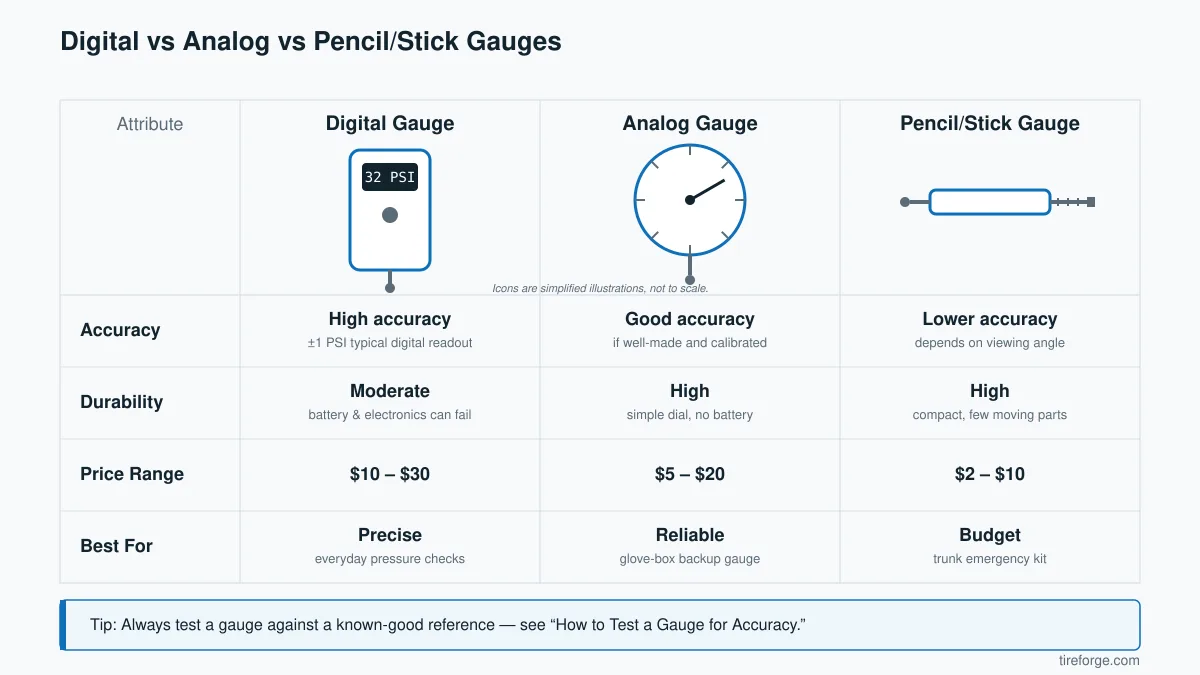
There are three basic gauge designs on the market, and each works on a different mechanical principle.
Digital gauges use an electronic pressure sensor and display the reading on an LCD screen, usually to the nearest 0.5 or 0.1 PSI. They run on small batteries and often include backlighting, unit conversion (PSI/BAR/KPA), and sometimes a memory function that holds the last reading after you remove the gauge from the valve stem.
Analog (dial) gauges use a mechanical Bourdon tube — a curved, flattened metal tube that straightens slightly under pressure, moving a needle across a printed scale. No batteries, no electronics, just a sealed mechanical linkage. Quality varies enormously here; a $8 dial gauge and a $40 dial gauge may look similar but have very different internal tolerances.
Pencil/stick gauges are the simplest design: a spring-loaded piston inside a slim tube pushes a calibrated stick outward when air pressure is applied, and you read the number where the stick stops. These are the gauges that come free with tire shop purchases or sit in glove compartments for a decade without ever being checked for accuracy.
Each design has a different accuracy ceiling, a different failure mode, and a different price-to-performance ratio, which is why the right pick depends on how often you check pressure and how precise you need to be.
Pros & Cons of Each Type
| Type | Pros | Cons |
|---|---|---|
| Digital | Precise readings (often ±1% or better), easy to read in low light, unit conversion, hold function | Needs batteries, can fail or drift if dropped, display can be hard to read in direct sunlight |
| Analog (dial) | No batteries, durable if well-made, large easy-to-read face, good middle ground on accuracy | Internal mechanism can drift out of calibration with age or impact, quality varies widely by price |
| Pencil/Stick | Cheap, compact, nearly indestructible, no batteries | Least accurate design, small increments are hard to read precisely, spring can weaken over years of use |
For most drivers who just want a reliable monthly check, a quality digital or analog gauge is worth the upgrade. Stick gauges are fine as a backup in the glovebox or trunk kit, but they shouldn’t be your primary tool if you’re trying to dial in pressure for towing loads, performance driving, or tracking slow leaks around a failing valve stem.
How to Test a Gauge for Accuracy
You don’t need a lab to find out if your gauge is lying to you. Here’s a practical field test:
- Cross-check against a known-good reference. Many gas stations and tire shops have calibrated digital gauges on their air pumps. Check your tire with your own gauge, then immediately check the same tire with the shop’s gauge. A difference of more than 1-2 PSI means one of them is off.
- Test repeatability. Check the same tire three times in a row with your gauge, waiting a few seconds between readings. If you get three different numbers (not just the same number repeated), the gauge has a consistency problem, which is often worse than a gauge that’s simply off by a fixed amount.
- Compare two gauges you own. If you have both a digital and an analog gauge, check the same valve stem with each. If they agree within 1 PSI, you can trust either. If they disagree significantly, test a third gauge to find the outlier.
- Watch for zero drift. On a dial gauge, check that the needle sits exactly at zero with no pressure applied. A needle resting slightly above zero means the entire scale is reading high, and every pressure check will be inflated by that same offset.
Do this test once when you buy a new gauge and again about once a year, since mechanical gauges especially can drift after being dropped or left in a hot glovebox for years.
Features to Look For
Not every feature matters equally. Here’s what’s actually worth paying for:
- Resolution: A gauge that reads in 0.5 PSI increments is plenty for daily driving; 0.1 PSI resolution helps if you’re setting pressures for towing or performance tires where small changes matter.
- Angled or swivel chuck: A rigid straight chuck is hard to seat on valve stems tucked behind wheel spokes or in tight wheel wells, especially on trucks and larger wheels like those discussed in our Ford F-150 tire guide. A swivel or angled head saves frustration and reduces air loss from repeated attempts to get a good seal.
- Bleed valve: A built-in button to release small amounts of air lets you fine-tune pressure without removing the gauge and guessing.
- Range: Make sure the gauge’s max range comfortably exceeds your tire’s needs. Passenger car gauges topping out around 60 PSI are fine, but if you run towing setups or truck tires that call for higher sidewall pressures, look for a gauge rated to 100-160 PSI.
- Build quality of the hose/chuck seal: Cheap rubber seals leak air during the measurement itself, causing the reading to drop as you hold the gauge in place — a common reason people think their tire is losing air when it’s actually the gauge losing it.
- Battery type and backlight (digital only): Standard, replaceable batteries (not odd coin cells you can’t find locally) and a backlight for checking pressure in a dim garage or driveway at night.
Our Top Picks by Type
Rather than chase specific model numbers that change over time, here’s how to shop smart within each category based on what actually drives accuracy and durability:
Best digital pick criteria: Look for a digital gauge with a stated accuracy of ±1% or ±1 PSI, an auto-off function to preserve battery life, a rubberized grip for stability, and a large, high-contrast display. Mid-range digital gauges from established tool and automotive brands typically outperform bargain-bin options because the internal pressure transducer is better calibrated from the factory.
Best analog pick criteria: Choose a dial gauge with a glycerin- or oil-filled housing if possible — the fluid dampens needle vibration and protects the internal mechanism from shock, which keeps it accurate longer. A larger dial face (2 inches or more) is easier to read precisely than a small one.
Best stick/pencil pick criteria: If you want a stick gauge as a glovebox backup, pick one with a metal body rather than plastic, since metal resists the heat cycling that warps cheaper plastic housings over years of sitting in a hot car.
Best for towing or truck use: Prioritize a gauge with a high-pressure range and a sturdy angled chuck, since larger truck and trailer tires often sit at higher pressures and valve stems can be harder to reach. This pairs well with the pressure guidance in our best tires for towing article, where correct inflation is critical for load capacity.
How Often to Check Pressure
Check tire pressure at least once a month and always before a long road trip or before loading a vehicle with extra weight, such as before towing. Pressure naturally drops about 1-2 PSI for every 10°F decrease in ambient temperature, so seasonal swings — especially the shift into fall and winter — are a common time for tires to quietly fall underinflated even with no leak at all. This is also the time of year many drivers install tire chains for snow and ice, and correct pressure matters just as much with chains mounted as without.
Always check pressure when tires are “cold” — meaning the vehicle has been parked for at least three hours or driven less than a mile. Driving heats the air inside the tire and raises the reading by several PSI, giving you a falsely high number that doesn’t reflect the tire’s resting state. If you must check after driving, note that the reading will run high and adjust your expectations rather than letting air out to match the cold-spec number.
Beyond the monthly check, inspect pressure any time you notice uneven handling, a vibration, or a tire that looks slightly lower than its neighbors — these can be early signs of a slow leak around a plug repair or valve stem rather than normal pressure loss. If you find a leak, see our walkthrough on diagnosing and re-plugging a leaking tire.
Frequently Asked Questions
Are digital tire gauges more accurate than analog ones?
Generally yes, a quality digital gauge offers finer resolution and tends to hold calibration longer than a basic analog dial gauge. However, a well-made, glycerin-filled analog gauge can match or beat a cheap digital gauge, so price and build quality matter more than the digital-vs-analog label alone.
Can I trust the gauge built into a gas station air pump?
These are convenient but inconsistent — some are well-maintained and calibrated regularly, while others are old and worn. Use them as a rough reference, not your primary tool, and verify important readings with your own gauge.
How much does tire pressure change with temperature?
As a rule of thumb, tire pressure changes roughly 1 PSI for every 10°F change in ambient temperature. This is why tires often read a few PSI lower on cold mornings even with no actual air loss.
Do I need a different gauge for truck or trailer tires?
If your truck or trailer tires run higher pressures than typical passenger car tires, make sure your gauge’s range comfortably covers that pressure — a standard 60 PSI gauge will pin at max and give an inaccurate reading on tires that need 80-100+ PSI.
How do I know when to replace a tire pressure gauge?
If it fails the repeatability or cross-check tests described above, if a dial gauge’s needle doesn’t return to zero, or if a digital gauge gives inconsistent readings even with a fresh battery, it’s time to replace it.