
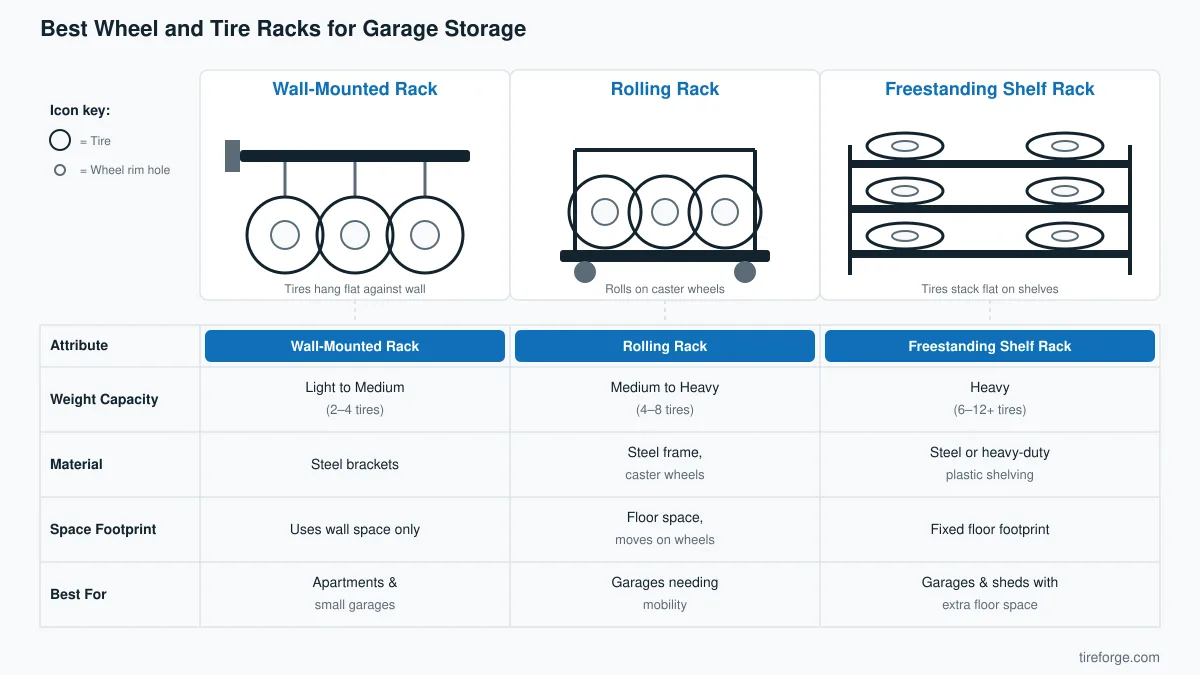
If you swap between summer and winter tires, keep a spare set of take-offs, or just need to get a stack of rubber off the floor, a dedicated tire rack is the cheapest upgrade you can make to a garage. The best wheel and tire racks for most people are either a wall-mounted horizontal rack (for garages with limited floor space) or a heavy-duty rolling rack (for anyone who wants to move tires around or store them in a shed). Freestanding shelf units work well when you have floor space to spare and want maximum capacity. Which one is right for you depends on your available wall space, floor space, ceiling height, and how often you need to move the tires once they’re stored.
Why Use a Tire Rack Instead of Stacking
Stacking tires flat on the floor is the default for a lot of garages, and it’s also the worst way to store them long-term. A flat stack puts the full weight of the tires above on the ones below, which can cause the bottom tire’s sidewalls to deform permanently over months of storage. This is especially true in warm garages, where heat softens rubber compounds just enough to let that deformation set in. A rack keeps tires upright or hung vertically so the sidewalls don’t bear sustained weight, which preserves the tire’s round profile and reduces the odds of vibration after you remount it.
There’s also a practical space argument. A stack of four 17-inch all-season tires takes up roughly 4 square feet of floor space and grows every time you add a mounted wheel. A vertical wall rack holding the same four tires can occupy as little as 2 feet of wall width and zero usable floor space, which matters in a two-car garage where every square foot is already fighting for a workbench, bikes, or a lawn mower.
Racks also keep tires off concrete, which matters more than most people realize. Concrete floors can leach plasticizers out of rubber over time, especially in damp or unsealed garages, contributing to dry rot and cracking years before the tread wears out. Elevating tires on a rack, even a simple one, breaks that direct contact and extends usable tire life. If you’re already dealing with tires that look faded or discolored from sun and floor contact, it’s worth reading up on what causes tires to turn orange and how to prevent it going forward.
Wall-Mounted vs Rolling vs Freestanding Racks
Wall-Mounted Racks
Wall-mounted tire racks bolt into studs or masonry and hold tires horizontally on hooks or brackets, usually stacked two to four high. They’re the best choice when floor space is the scarce resource, which is true in most single and two-car garages. A quality wall rack with four mounting points, properly anchored into studs, can hold 200-300 lbs across four tire-and-wheel assemblies. The tradeoff is installation effort: you need to find studs or use heavy-duty concrete anchors, and you need a clear, unobstructed wall section roughly 3 feet wide and 4 feet tall.
Rolling Racks
Rolling racks are freestanding units on locking casters, usually built from steel tubing, that hold four to eight tires vertically on a shaft or in cradles. The big advantage is mobility — you can roll a full set of winter tires out of the way in seconds, move them to a different corner of the garage during a cleanout, or wheel them out to a driveway for a seasonal swap. They do consume floor space, typically a 2×3-foot footprint, and the casters need to be rated for the load or they’ll seize or crack under four mounted wheel-and-tire assemblies, which can easily weigh 100+ lbs combined per tire.
Freestanding Shelf Racks
These are stationary multi-tier shelving units, often shared with general garage storage, where tires sit flat on wide shelves rather than hanging or standing vertically. They offer the highest raw capacity — some units hold six to eight tires plus bins of accessories — but they take up the most floor space and don’t solve the flat-storage sidewall issue unless the shelves are deep enough to let tires stand on edge instead of lying flat.
| Rack Type | Best For | Floor Space Used | Typical Capacity |
|---|---|---|---|
| Wall-Mounted | Small garages, fixed storage | None | 4 tires |
| Rolling | Frequent swaps, sheds, shared spaces | Moderate | 4-8 tires |
| Freestanding Shelf | Large garages, mixed storage | High | 6-8+ tires |
Weight Capacity & Material Considerations
Weight capacity is the single most important spec on any rack, and it’s also the one people skip reading. A mounted all-season tire on a midsize sedan wheel typically weighs 25-35 lbs; a mounted all-terrain tire on a full-size truck wheel can weigh 70-90 lbs. Multiply that by four and you can be asking a rack to hold anywhere from 100 lbs to well over 300 lbs. Always check the manufacturer’s stated capacity per shelf or per hook, not just the total rack rating, since a rack rated for 400 lbs overall might only support 100 lbs per individual tier.
Material matters as much as the number on the box. Powder-coated steel is the standard for a reason — it resists rust, handles load without flexing, and tolerates temperature swings in an unheated garage. Raw or painted steel without a powder coat will rust at contact points within a year or two in humid climates. Plastic and resin racks are lighter and cheaper but tend to sag or crack under sustained heavy loads, especially truck and SUV tires, and they become brittle in cold unheated garages. Wood racks, whether bought or DIY, work fine for lighter passenger tires but should be treated or sealed, since raw wood absorbs moisture from tire rubber and can warp.
For wall-mounted units specifically, the anchoring hardware is part of the weight-capacity equation. A rack rated for 300 lbs is only as strong as the screws holding it to the wall. Anchoring into studs with lag bolts is non-negotiable for anything heavier than two passenger tires; drywall anchors alone will fail under sustained load, usually without warning.
Best Racks for Garages, Sheds & Apartments
The right rack changes depending on where you’re actually storing tires, and matching the rack to the space avoids a lot of wasted money.
Standard two-car garages usually have the wall space to spare but not the floor space, making a wall-mounted horizontal rack the most efficient option. Mount it above a workbench or beside a garage door track where the wall would otherwise sit empty.
Sheds and detached garages often lack finished walls or easy stud access, which tips the scale toward a rolling rack or a freestanding shelf unit that doesn’t require anchoring at all. Rolling racks also make sense in sheds because you may need to move tires outside temporarily during yard work or seasonal equipment storage.
Apartments and condos with limited garage or storage-unit space benefit most from compact, stackable racks or vertical tire totes that hold one to two tires each and can be tucked into a closet or storage cage. In these situations, a single small rack combined with a tire cover often beats a bulky four-tire unit that won’t fit through a storage locker door. For more compact options and accessories suited to tight spaces, the roundup of garage tire storage products covers smaller-footprint solutions worth comparing against a full rack.
Whichever space you’re working with, measure twice before buying. Rack listings usually state footprint dimensions and required clearance, but garage layouts are rarely as open as they look once a car, a mower, and bikes are factored in.
DIY Rack Alternatives
A dedicated rack isn’t mandatory, and plenty of reasonable alternatives exist if you’re not ready to buy one or only need temporary storage. A simple ceiling-mounted hoist pulley system, the kind sold for bikes and kayaks, can hoist a tire-and-wheel assembly up and out of the way using a loop of rope or strap through the center bore, provided your ceiling joists can handle the weight and you’re not hoisting anything heavier than a passenger tire. Heavy-duty J-hooks screwed directly into wall studs, spaced to match tire diameter, work almost as well as a manufactured wall rack for a fraction of the cost, though they lack the finished look and adjustable spacing of a purpose-built unit.
Wood pallet racks are another common DIY approach: standing a pallet on end against a wall creates slots that tires can lean into vertically, keeping them off the floor and spaced apart for airflow. This works best for two to four tires and should be anchored to the wall so the pallet can’t tip forward under load.
Common mistakes with DIY setups include undersizing the hardware (using drywall screws instead of lag bolts into studs), ignoring tire weight when it’s a loaded wheel-and-tire assembly rather than a bare tire, and failing to account for spring-back force — tires under tension on a hoist or strap can shift suddenly if a knot slips. DIY solutions are a reasonable bridge, but anything holding more than two mounted tires above head height should be treated with the same weight-capacity scrutiny as a commercial rack.
Buying Checklist
Before buying any rack, run through these points:
- Confirm per-tire and total weight capacity against your actual tire-and-wheel weight, not an estimate — truck and SUV wheels are heavier than most buyers assume.
- Measure your space, including clearance for opening a garage door, walking around a parked car, and any ceiling height restrictions for stacked units.
- Check the mounting hardware included for wall units — lag bolts and anchors rated for your wall type (stud, concrete, masonry) should come with the rack or be purchased separately.
- Pick material based on climate — powder-coated steel for humid or unheated spaces, treated wood or resin only for mild, dry conditions.
- Decide if mobility matters — if you do seasonal swaps yourself, a rolling rack saves real effort versus unbolting a wall unit every six months.
- Factor in tire covers if the rack is near a window or garage door that lets in UV light, since sun exposure accelerates rubber degradation regardless of how the tires are stored.
If you’re storing a seasonal set and want to track when they actually need attention again, it helps to pair rack storage with a reminder tied to your tire rotation schedule — rotating on remount is an easy way to even out wear between swaps.
Frequently Asked Questions
Should tires be stored standing up or lying flat?
Mounted tires (tire plus wheel) store best standing upright, since the wheel supports the weight and the tire’s sidewall isn’t under sustained pressure. Unmounted tires without a wheel inside are generally better stored flat, stacked no more than four high, because an unsupported sidewall can distort if left standing for months.
Can I store tires outside on a rack?
You can, but UV exposure and temperature swings accelerate rubber aging regardless of the rack. If outdoor storage is unavoidable, use a rack under a covered area and add tire covers to block direct sunlight.
How much weight can a typical wall-mounted tire rack hold?
Most consumer wall racks are rated between 200 and 300 lbs total across four mounting points, enough for four passenger car tires but potentially insufficient for four large truck or SUV tire-and-wheel assemblies — check the per-tire rating, not just the total.
Is a rolling rack worth the extra cost over a wall-mounted one?
If you do your own seasonal tire swaps or need to move tires out of the way periodically, yes — the mobility saves real time and effort. If the tires are going up once and staying put for months, a wall-mounted rack is usually cheaper and just as effective.