
Used tires can be worth it only in narrow situations: a short-term stopgap, a budget emergency, or a verified low-mileage take-off from a reputable shop. For anything involving daily driving, highway speeds, wet roads, or a vehicle carrying passengers, new tires are almost always the better financial and safety decision once you account for remaining tread life, hidden damage risk, and age. The math on used tires looks good only if you ignore what you can’t see.
How Used Tire Shops Grade & Price Inventory
Most used tire shops buy inventory in bulk from wholesalers who source take-offs from dealerships, fleet vehicles, and tire recyclers. Tires get a rough visual grade — usually something like A, B, or C — based on remaining tread depth and visible condition, not on any internal inspection. A “Grade A” used tire typically has 70-90% of its tread remaining, while Grade B or C tires might have 40-60% left with visible wear or minor cosmetic flaws.
Pricing is usually a fraction of new tire cost, often 30-50% of what a comparable new tire would run, scaled to tread depth remaining. This sounds like a straightforward value proposition, but the grading process almost never includes dismounting the tire from the wheel, checking the inner liner for bubbles or patches, or inspecting for internal belt separation. A tire can look great from the outside and still have an invisible flaw that makes it unsafe at speed.
Reputable used tire dealers will at least spin-check for balance and visually inspect sidewalls, but few run air-retention tests overnight or check for slow leaks from bead damage. The lack of standardized grading across the used tire industry means a “good deal” at one shop might be junk at another with the exact same label. Always ask the seller directly what their inspection process includes before assuming any grade means more than tread depth.
Hidden Risks: Age, Hidden Damage & Prior Repairs
Tread depth is the easiest thing to see and the least important factor in whether a used tire is actually safe. Rubber compounds degrade with age regardless of how many miles are on the tire, and a tire’s true age is stamped in the DOT code on the sidewall as a four-digit week/year combination. A tire manufactured eight years ago with 60% tread remaining is often a worse buy than a four-year-old tire with 40% tread, because rubber hardening and micro-cracking increase the risk of tread separation as tires approach the 6-10 year mark. For more on how to read this and why it matters even on new inventory, see our guide on how old new tires should be when you buy them.
Beyond age, used tires carry risks that are completely invisible without dismounting: prior punctures repaired with plugs instead of proper plug-patch combinations, sidewall bulges from impact damage that haven’t yet failed, and bead area damage from improper mounting or dismounting with tire irons. A tire that was run underinflated for months can suffer internal structural damage — ply separation, liner cracking — that never shows up as a visible defect but dramatically shortens remaining life and increases blowout risk.
Unlike buying a used car with a title history, there’s no VIN-equivalent for tires. You’re trusting a stranger’s prior driving habits, maintenance, and storage conditions with zero paperwork to verify any of it.
How to Inspect a Used Tire Before Buying
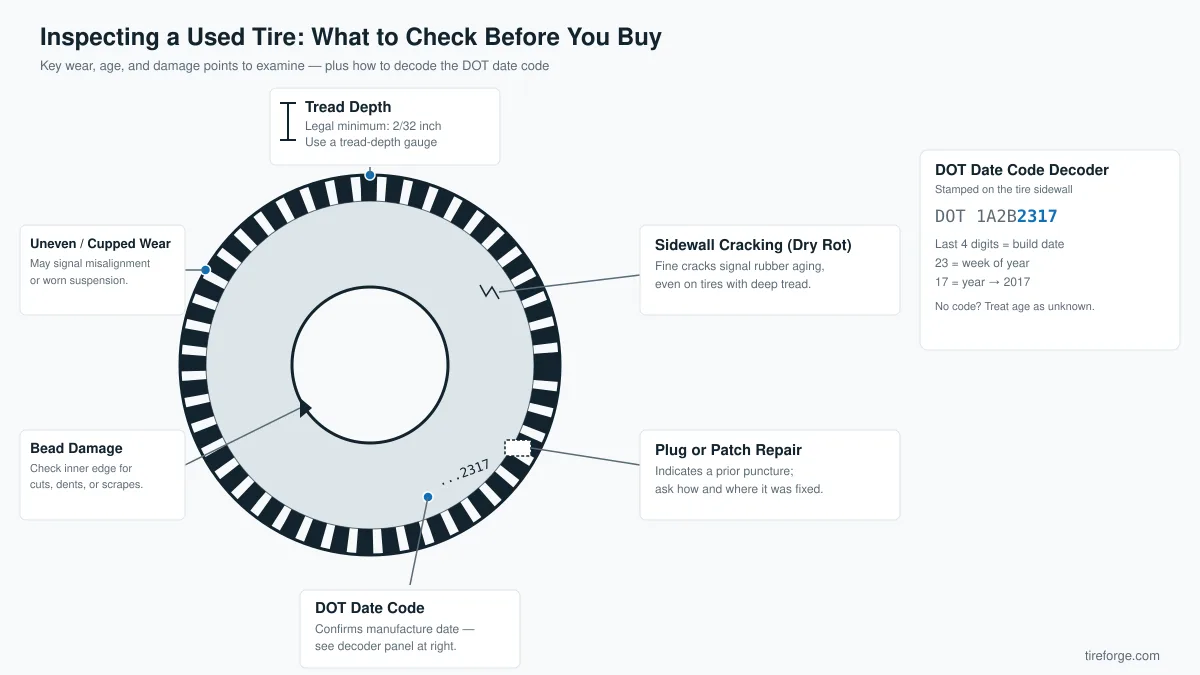
If you’re set on buying used, a careful physical inspection is non-negotiable. Start with the DOT date code — look for the four digits at the end, representing week and year of manufacture, and avoid anything older than 5-6 years regardless of tread depth. Next, check tread depth with a gauge or the penny test across multiple points on each tire; uneven wear (more on one edge, or cupping patterns) suggests the tire was run with an alignment or suspension problem, which may mean other issues exist too.
- Sidewalls: Look for bulges, cracks, or repair patches that extend into the sidewall — sidewall repairs are never considered safe and should be an automatic pass.
- Tread surface: Check for uneven wear patterns, which can indicate unbalanced tires or alignment problems from the previous vehicle.
- Bead area: Inspect where the tire meets the wheel for cracking, tears, or scraping from improper mounting tools.
- Inner liner: If possible, ask the seller to dismount the tire so you can check the inside for bubbles, patches, or discoloration.
- Valve stem and vent spews: These small details can hint at how the tire was stored and handled — learn what’s normal versus a warning sign in our piece on why tires have hairs.
If a seller refuses to let you inspect the inner liner or won’t tell you the DOT date, walk away. That refusal alone tells you most of what you need to know about inventory quality.
Cost Savings vs Long-Term Value
The upfront savings on used tires are real — a set of four might cost 40-60% less than new equivalents. But cost per mile tells a different story. A new all-season tire might be rated for 50,000-70,000 miles and cost a certain amount; a used tire with 50% tread remaining from that same model has, at best, half that mileage left, assuming no hidden damage shortens it further. If the used set costs 50% of new price for 50% of the life, you’ve broken even at best — and that’s the optimistic scenario where nothing fails early.
Factor in the higher likelihood of needing replacement sooner due to age-related degradation, and the real cost-per-mile on used tires frequently exceeds new tires when things go wrong. There’s also an opportunity cost: time spent researching, inspecting, and potentially returning bad tires, plus the risk of a blowout causing wheel or body damage that costs far more than the tire savings.
Where used tires sometimes do win on pure economics is when you catch genuinely low-mileage take-offs — tires removed from a vehicle after only a few thousand miles because an owner upgraded wheel size or tire type. These can offer 85-95% of new tire life at a steep discount, which is a legitimately good value if the age and inspection check out.
When Used Tires Make Sense (and When They Don’t)
Used tires make the most sense as a temporary bridge: you need to pass inspection this week, you’re selling the car soon and don’t want to invest in new rubber, or you have a spare vehicle that sits mostly unused and covers minimal annual mileage. In these cases, a well-inspected used tire with decent tread and a recent manufacture date can reasonably bridge the gap without major risk, especially on a low-speed commuter or backup vehicle.
Used tires make far less sense in several common scenarios people overlook:
- Highway-heavy driving: Sustained speed generates more heat, and age-degraded or damaged tires are far more likely to fail catastrophically at speed than at parking lot velocities.
- Trailers and towing: Trailer tires already fail more from age than mileage; buying used compounds that risk significantly. See our breakdown of ST vs LT tire differences for why trailer-specific tires need extra scrutiny.
- Wet or winter conditions: Reduced tread depth on a used tire means reduced water evacuation and traction margin exactly when you need it most.
- Mismatched sets: Buying four used tires from different sources often means mismatched tread depths and wear patterns, which can affect handling and even stress your alignment and balancing over time.
If your vehicle is a daily driver carrying family members, or regularly sees highway miles, the risk calculus strongly favors new tires or at minimum, very carefully vetted take-offs.
Safer Alternatives: Take-Offs & Closeouts
If budget is the real driver behind considering used tires, there are safer middle-ground options. Take-offs are tires removed from new vehicles at the dealership, often because a buyer upgraded to a different wheel/tire package or wanted a different tread pattern. These frequently have single-digit mileage and are essentially new tires at a discount — the key is verifying the DOT date is current and the tire hasn’t sat in storage for years before resale.
Closeout or discontinued-model new tires are another strong alternative. Tire manufacturers regularly phase out model lines, and shops will discount remaining new inventory of a discontinued tread pattern significantly. You get a genuinely new tire, full warranty coverage in most cases, and no unknown history — just an older tread design that’s no longer the latest version. This is often the best value play for budget-conscious buyers who still want the safety assurance of new rubber.
Seconds or blemished tires — new tires with minor cosmetic flaws that don’t affect performance — are sometimes available directly from manufacturers or large retailers at a discount, though these are less common to find than they used to be. When evaluating any discounted new tire, compare specs against a known-quality brand using resources like our Continental vs Michelin or Hankook vs Michelin comparisons to make sure the discount reflects inventory clearance and not a genuine quality gap.
Frequently Asked Questions
Are used tires ever as safe as new tires?
A genuinely low-mileage take-off that’s been properly inspected can perform close to a new tire, but there’s no way to fully verify internal condition without dismounting and X-ray-level inspection most shops don’t do. Treat any used tire as carrying more risk than a new one, even if it looks fine.
How can I tell how old a used tire really is?
Check the DOT code on the sidewall — the last four digits indicate the week and year of manufacture. A tire stamped 2318 was made in the 23rd week of 2018. Avoid tires more than 5-6 years old regardless of how much tread remains.
Is it legal to sell tires with less than 2/32 inch tread?
Most states prohibit selling tires below 2/32 inch tread depth, the common legal minimum, but enforcement varies and private-party sales are harder to regulate. Always measure tread yourself rather than trusting a seller’s claim.
Do used tires come with any warranty?
Rarely. Most used tire sellers offer no warranty beyond a short return window, if that. Compare this to new tires, which typically include manufacturer tread-life and workmanship warranties — a meaningful part of the total value you’re giving up by buying used.
Can I mix used tires with new ones on the same vehicle?
It’s not ideal. Mismatched tread depths between axles can affect handling balance and all-wheel-drive systems in particular are sensitive to tread depth differences, which can strain the drivetrain. If you must mix, put the tires with more tread on the rear axle for stability.