
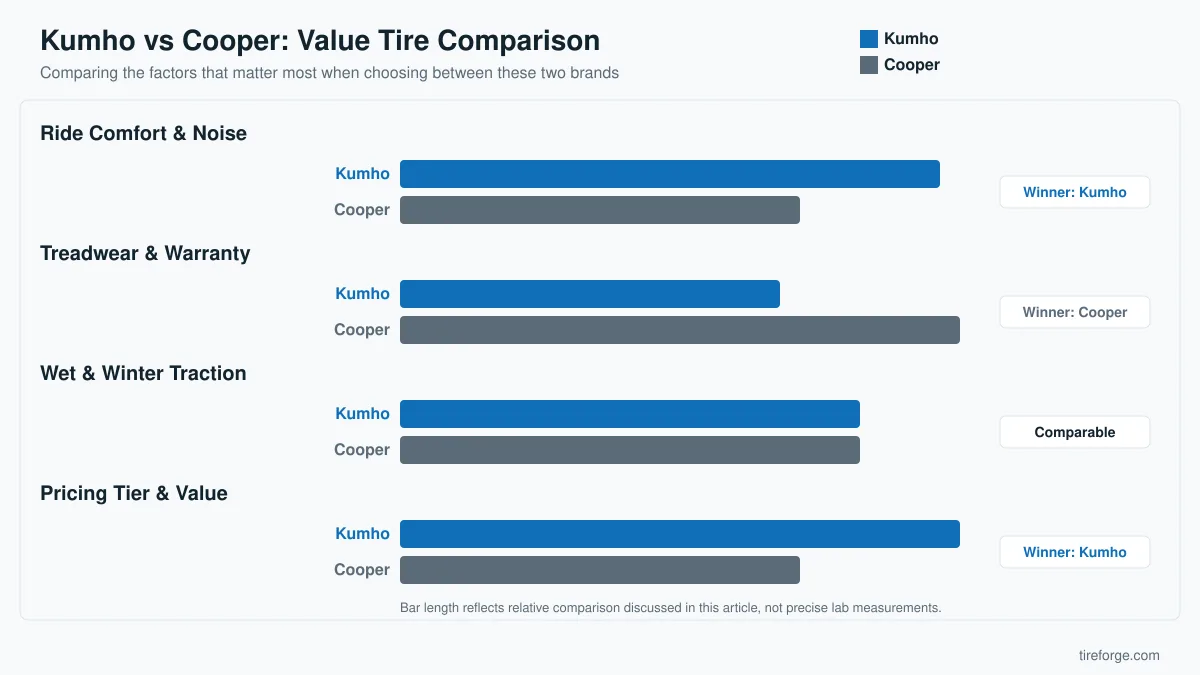
If you’re cross-shopping Kumho and Cooper, the short answer is this: Cooper generally edges out Kumho on long-term treadwear and warranty coverage, while Kumho tends to win on ride quality, quieter cabins, and sharper pricing on comparable touring and performance lines. Neither brand is a luxury-tier name like Michelin or Continental, and that’s exactly the point — both exist to deliver solid, dependable performance without the premium price tag. The better choice depends on what you drive, how many miles you put on your tires annually, and whether you prioritize a plush ride or maximum tread life per dollar.
Below, we break down both brands across the categories that actually matter when you’re making a buying decision, not just spec-sheet numbers that look good in a brochure.
Brand Overview & Manufacturing Background
Kumho Tire is a South Korean manufacturer founded in 1960, part of the Kumho Asiana Group. It has spent decades building a reputation in the OE (original equipment) space, supplying tires for a range of mainstream and performance vehicles from manufacturers like Kia, Hyundai, and even some European automakers. Kumho’s R&D has leaned heavily into performance and ultra-high-performance (UHP) segments, which is why you’ll often see Kumho tires on sportier trims and aftermarket wheel packages.
Cooper Tire & Rubber Company, by contrast, is an American manufacturer founded in 1914 and headquartered in Findlay, Ohio. Cooper built its name on durability-focused passenger, light truck, and SUV tires, with a strong presence in the replacement market rather than OE fitments. In 2021, Cooper was acquired by Goodyear, which has since folded some of Cooper’s manufacturing and distribution into Goodyear’s broader network while keeping the Cooper brand and product lines distinct. This acquisition has actually strengthened Cooper’s supply chain and quality control, since it now benefits from Goodyear’s materials science and testing infrastructure.
Both brands sit in the mid-tier, value-oriented segment of the market — above budget import brands but below premium names. If you want more context on how Cooper stacks up against other mid-tier and premium competitors, see our General Tire vs Cooper Tire comparison and our deeper Cooper Tire Review.
Ride Comfort & Noise Comparison
Ride comfort comes down to how well a tire’s internal construction and tread compound absorb road imperfections before that energy reaches the cabin. Kumho’s touring and grand-touring lines (like the Crugen and Solus families) tend to use softer sidewall constructions and tread compounds tuned for a quieter, more cushioned ride. Owners frequently report that Kumho tires feel noticeably smoother over expansion joints and broken pavement compared to similarly priced competitors, and road noise at highway speed tends to stay subdued thanks to variable-pitch tread block sequencing.
Cooper’s ride quality is solid but leans slightly firmer, especially in its all-terrain and light truck lines (like the Discoverer series), where the tread is optimized more for durability and off-road capability than plush comfort. On Cooper’s passenger and touring lines (like the CS5), ride comfort is competitive with Kumho, but road noise can creep up a bit more over time as the tread wears unevenly on tires with less sophisticated noise-cancelling groove designs.
In practical terms: if your priority is a quiet, comfortable daily commute in a sedan or crossover, Kumho’s touring lineup has a slight edge. If you’re running a truck or SUV that sees mixed-surface driving, Cooper’s rougher-and-tougher ride character is a reasonable trade-off for the added durability. Neither brand will match the cabin isolation of a premium tire like those compared in our Continental vs Michelin guide, but for the price point, both perform admirably.
Treadwear & Warranty Comparison
This is where Cooper typically pulls ahead. Cooper’s tread compounds are engineered with a strong emphasis on mileage, and it shows in the warranty numbers — many Cooper passenger and touring tires carry treadwear warranties in the 65,000 to 80,000-mile range, with some touring models reaching even higher. Cooper has historically marketed itself around durability, and independent owner feedback generally backs this up: Cooper tires tend to wear evenly and predictably when rotated on schedule.
Kumho’s warranties are respectable but typically land in a slightly lower range for comparable tire categories, often in the 50,000 to 70,000-mile bracket depending on the specific model. Kumho’s performance-oriented tires, as expected, carry little to no treadwear warranty at all, since UHP compounds sacrifice longevity for grip — a trade-off true of virtually every manufacturer’s performance lineup, not just Kumho’s.
A common mistake buyers make is comparing warranty mileage numbers without reading the fine print. Treadwear warranties are prorated, require proof of regular rotation (usually every 5,000–7,500 miles), and often exclude irregular wear caused by alignment issues. If you’re unsure whether uneven wear is tire-related or alignment-related, our guide on wheel alignment vs tire balancing is a useful next read before filing any warranty claim.
Wet & Winter Traction
Wet traction depends on tread void ratio, sipe density, and rubber compound flexibility at lower temperatures. Kumho has invested significantly in silica-based compounds across its touring and performance lines, which stay more pliable in cold and wet conditions, improving grip on wet pavement and light snow. Kumho’s dedicated winter tires (like the WinterCraft line) also perform well in independent testing for a value-priced winter option, holding their own against pricier competitors in braking distance tests on ice and packed snow.
Cooper’s wet traction is generally good but slightly less consistent across its lineup — some touring models prioritize dry handling and treadwear over outright wet grip, meaning hydroplaning resistance can lag behind Kumho’s more water-channeling-focused tread designs. Cooper’s winter-specific offerings (Discoverer True North, for example) are competent and well-regarded, particularly for SUVs and crossovers, but the brand doesn’t have as deep a winter-specific catalog as some competitors.
If winter driving is a major factor in your decision, it’s worth understanding the broader category differences first. Our breakdown of all-weather vs all-season vs winter tires explains why a true winter tire—regardless of brand—will always outperform an all-season in sustained sub-45°F conditions. Don’t assume either Kumho or Cooper’s all-season lineup is a substitute for dedicated winter rubber if you live somewhere with real snow.
Pricing Tier & Value Positioning
Both brands occupy the budget-to-mid-tier pricing bracket, typically running 20–40% less than premium brands like Michelin or Continental for comparable tire sizes and categories. Within that bracket, Kumho tends to price slightly lower on its touring and performance lines, making it an attractive option for budget-conscious buyers who still want UHP-style performance without UHP-tier pricing. This is part of why Kumho has built a following among enthusiasts looking for aftermarket performance upgrades on a budget.
Cooper’s pricing sits comparably, sometimes a touch higher on light truck and all-terrain models, but the higher mileage warranties help offset that cost over the life of the tire. When you calculate cost-per-mile rather than just sticker price, Cooper often comes out ahead for buyers who keep a vehicle long-term and rack up highway miles, since a 75,000-mile warranty stretched over several years reduces the frequency of tire purchases.
A common buyer mistake is focusing solely on the upfront price without factoring in expected tire lifespan, ride comfort over years of ownership, and replacement frequency. A $20 cheaper tire that wears out 15,000 miles sooner isn’t actually the better value. We’ve covered this same logic in our Kumho vs Goodyear comparison and our Kumho vs Michelin review, both of which reinforce that Kumho’s real strength is bang-for-buck performance rather than outright longevity.
Which Brand Should You Choose?
Choose Kumho if you want a quieter ride, slightly sharper handling, competitive wet and winter performance, and pricing that undercuts most mid-tier competitors — especially if you’re shopping for a sedan, coupe, or crossover and plan to replace tires every 4-5 years regardless of remaining tread.
Choose Cooper if your top priority is maximum tread life, a stronger treadwear warranty safety net, and durability for trucks, SUVs, or mixed-terrain driving. Cooper’s acquisition by Goodyear has also added manufacturing consistency that long-time Cooper buyers have noticed in recent production runs.
Neither brand is a bad choice — both are reputable, well-established manufacturers that outperform true budget/import brands while staying well below premium pricing. The right pick comes down to your vehicle type, driving conditions, and whether you value ride comfort or mileage longevity more. If you’re still undecided, test-driving a vehicle with each brand installed (many dealers and independent shops stock both) is the most reliable way to feel the real-world difference for yourself.
Frequently Asked Questions
Are Kumho tires as good as Cooper tires?
They’re comparable in overall quality, but each has different strengths. Kumho generally offers better ride comfort and noise control, while Cooper offers better treadwear and warranty coverage. Neither is objectively “better” across every category.
Which brand lasts longer, Kumho or Cooper?
Cooper tires typically carry higher treadwear warranties and are engineered with durability as a primary focus, making them the better choice for drivers prioritizing mileage over ride feel.
Is Kumho a budget tire brand?
Kumho sits in the value/mid-tier segment, not the bottom-tier budget category. It’s priced competitively but uses more advanced compounds and engineering than true economy import brands.
Does Goodyear owning Cooper affect tire quality?
Since the 2021 acquisition, Cooper has retained its own product lines and branding while gaining access to Goodyear’s manufacturing and R&D resources, which has generally been viewed as a quality improvement rather than a dilution of the Cooper brand.
Which is better for winter driving, Kumho or Cooper?
Kumho’s WinterCraft line has a strong reputation for value-priced winter performance, though Cooper’s Discoverer True North is also a solid, well-reviewed option. For serious winter conditions, either brand’s dedicated winter tire will outperform their respective all-season lineups.