
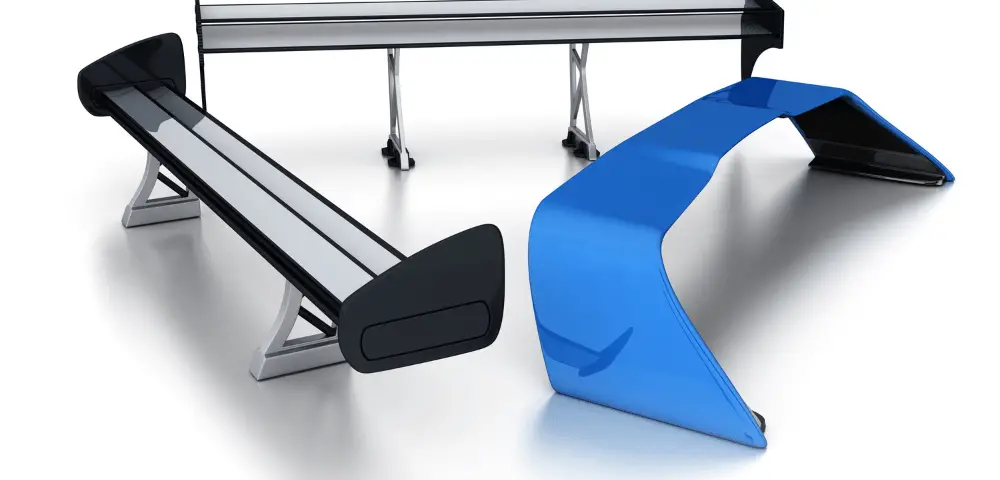
Have you ever seen the fancy fiberglass aids added to sports car bumpers? Apart from giving these autos a distinct get-out-of-my-way look, these accessories improve aerodynamics.
To illustrate this, I’ll be exploring two of the most popular bumper mods: front splitter vs front lip. Both parts alter airflow around your car, but they do it in different ways, and understanding the difference helps you choose the right one — and can even affect how your tires wear and grip the road.
In short: a front splitter is a rigid, flat extension (usually carbon fiber or fiberglass) installed below the car’s front bumper, while a front lip is a smaller, often flexible piece attached directly to the bottom edge of the bumper itself. A “lip spoiler” is essentially a compact version of a front spoiler, not a separate category.
Read on to learn about their functions, how they differ from front spoilers, and what each one means for handling, tire wear, and grip.
The Purpose of a Splitter?
A front splitter is an individual extension installed at the bottom of a vehicle’s front bumper. This feature has two important traits that you should keep in mind. One, it’s completely flat — a factor that allows it to sit parallel to the ground once installed.
Two, it extends quite a bit in front of the bumper, often protruding past the car’s body.
Most performance splitters are made of carbon fiber or fiberglass for rigidity and weight savings, though budget options are made of ABS plastic, polyurethane, or alumalite composites.
The core function of a front splitter is to create a pressure difference between the air flowing above and below the car.
As a car accelerates, air pressure builds at the front of the vehicle. Part of that air is directed up and over the body, while the rest is forced underneath. Because the air traveling under the car is harder to manage and generally at higher pressure than the air flowing smoothly over the top, the result is lift — an upward force that reduces how firmly the tires press into the road.
This lift reduces contact patch pressure at the front tires, which can translate into vaguer steering response and reduced grip at speed. To counter this, car enthusiasts add splitters to their front bumpers.
A properly designed front splitter reduces lift by blocking air from rushing underneath the car and generating a high-pressure zone on top of the splitter itself, which pushes the front end down — creating downforce. That downforce helps the front tires maintain contact with the pavement, improving turn-in response, high-speed stability, and overall traction. For more on how tire contact patch and pressure affect grip, see our guide on tire pressure and performance.
The Purpose of a Lip?
A front lip is a smaller accessory that bolts or clips directly onto the bottom edge of the front bumper, following its contour rather than extending flat and parallel to the ground like a splitter. Depending on the manufacturer, it may be made of flexible rubber, urethane, or rigid ABS plastic. You’ll sometimes hear it called a “lip spoiler” or “air dam.”
Bumper lips serve functions similar to splitters, but on a smaller scale. These functions include:
Reducing drag
One of the main functions of a bumper lip is to reduce drag.
As you drive, the car encounters resistance from air streaming under and over it, which slows it down and reduces fuel efficiency. A front lip partially blocks air from entering the space beneath the car, smoothing out airflow and reducing turbulence-induced drag.
Improving looks
Adding a front lip is one of the easiest ways to give a car a sportier, lower-looking stance. It adds visual aggression to the front end without the drastic appearance of a full splitter.
Protecting the bumper
A front lip also helps protect the lower edge of the bumper — the area most prone to curb rash, scrapes, and road debris impacts — by acting as a sacrificial buffer.
What Is the Difference Between a Splitter and a Front Lip?
Many people confuse a front lip with a front splitter, and the terms are often used interchangeably online, but they’re built and function differently. Here’s what sets them apart:
Structure and Composition
The most notable difference between a front splitter and a front lip is their shape and rigidity.
A splitter is a flat, rigid piece of bodywork that extends outward below the front bumper, typically made of composite materials like carbon fiber or fiberglass, and is usually supported by rods or brackets to keep it from flexing under aerodynamic load.
A lip, by contrast, hugs the shape of the bumper rather than sticking out flat, and is usually made of a more flexible material like urethane or ABS plastic (true rubber lips are less common today due to durability concerns). It doesn’t extend outward nearly as much as a splitter does.
Function
Both the front splitter and front lip work by disrupting the air flowing over and underneath your car, which increases front-end downforce and improves traction, handling, and high-speed stability.
However, the degree to which each part achieves this differs based on its structure and placement.
Because a splitter sits closer to the ground and extends further forward, it blocks significantly more air from passing underneath the car and generates more measurable downforce.
A lip, since it doesn’t extend out as far, disrupts airflow less aggressively. If your primary goal is track-level performance gains, a splitter will generally do more — but it also requires careful ride-height and ground-clearance consideration to avoid damage on rough roads or steep driveways.
How Splitters and Lips Affect Tire Grip and Wear
Since downforce increases the vertical load pressing the tires into the pavement, both splitters and lips can improve front-tire traction under hard cornering and braking — but added load also means added stress.
- More even wear at speed: Reduced front-end lift helps keep the contact patch consistent at highway and track speeds, which can reduce uneven or cupped wear that happens when a tire repeatedly loses and regains contact pressure.
- Increased front-tire load: More downforce means the front tires work harder, which can accelerate wear on the front axle, especially on front-wheel-drive cars. Rotating tires regularly and checking tire pressure becomes more important once aero parts are added.
- Alignment matters more: Splitters are typically installed on lowered vehicles, and lowering a car changes suspension geometry. Getting a proper alignment afterward helps prevent premature edge wear.
Should You Get Your Car a Front Splitter or Front Lip?
This decision should be based on the goal you’re trying to achieve.
If you’re looking for a subtle appearance upgrade, some drag reduction, and extra bumper protection without major ground-clearance concerns, a front lip is the easier, more street-friendly choice.
If your priority is maximizing downforce, traction, and high-speed stability — and you’re willing to deal with lower ground clearance and more careful driving around curbs and speed bumps — a front splitter is the better option.
Installation and Cost Considerations
Front lips are generally the easier and cheaper of the two to install. Many bolt-on or clip-on kits can be installed at home in an afternoon using basic tools, double-sided automotive tape, and a handful of hardware clips. Lip kits for mainstream vehicles are typically among the least expensive exterior mods available, while custom carbon fiber lips for specific makes cost considerably more.
Front splitters range widely in price depending on material and brand — universal ABS splitters are the most affordable, while vehicle-specific carbon fiber splitters with mounting brackets and support rods sit at the premium end. Because splitters extend further and sit lower, professional installation is often recommended to ensure proper mounting, adequate clearance, and that factory under-bumper components (like sensors or tow hooks) aren’t obstructed.
Regardless of which you choose, check local regulations — some regions have minimum ground clearance laws that affect how low a splitter can sit.
Does a Front Splitter Make a Difference?
Yes, it does. Front splitters make a measurable difference to a car’s performance, particularly at higher speeds where aerodynamic forces matter most.
They improve handling by limiting airflow beneath the car, which reduces front-end lift and drag. On tracks and twisty roads, this translates to more confident turn-in and braking.
Some splitter designs also help direct additional air toward the radiator and brakes, aiding cooling under sustained hard driving, though this depends heavily on the specific design and ducting rather than being a guaranteed benefit of every splitter.
Splitter vs. Spoiler vs. Lip: Clearing Up the Terminology
These terms get mixed up constantly, so here’s a clearer breakdown:
- Front spoiler is the broad, umbrella term for any front-end aerodynamic device designed to “spoil” disruptive airflow and reduce lift. Splitters, lips, and air dams are all technically types of front spoilers.
- Front splitter is a specific, rigid, flat type of front spoiler that extends forward from under the bumper and is built to generate real, measurable downforce — commonly seen on track-focused and race cars.
- Front lip / lip spoiler is a smaller, usually flexible or semi-rigid type of front spoiler that follows the bumper’s contour. It reduces drag and improves looks but produces far less downforce than a true splitter.
So while it’s accurate to say a splitter is a type of front spoiler, it isn’t accurate to say all front spoilers are splitters — a lip spoiler and a splitter are both subcategories of the same broader concept, not synonyms for each other. Splitters and underbody aero are also commonly paired with a rear diffuser to balance front and rear downforce — an imbalance between the two can upset handling.
Front spoilers (including splitters) are standard equipment on many performance and track-oriented vehicles, and aftermarket versions are also popular upgrades for everyday cars.
Other Features That Improve a Car’s Aerodynamics
When it comes to improving your car’s aerodynamics, front spoilers and bumper lips aren’t the only players in the game. Other common aero accessories include:
- Rear diffuser — located at the rear underside of the car, the diffuser acts like an expansion channel. It smooths the transition of air exiting from underneath the car back into the surrounding high-pressure atmosphere, reducing drag and turbulence.
- Rear wings — these reduce lift at the rear axle by using the car’s own airflow to generate downforce, similar in principle to an inverted airplane wing. This improves rear traction and grip, especially under hard braking and cornering.
For a deeper technical look at how these aerodynamic principles work, SAE International and major automotive engineering publications offer detailed explanations of downforce, drag coefficients, and underbody airflow management.
Frequently Asked Questions
Can I install a splitter or lip myself?
Lips are generally DIY-friendly with basic tools. Splitters, especially those requiring support rods and precise alignment to the bumper, are often better left to a shop to avoid cracking the material or creating uneven gaps.
Will a splitter or lip affect my ride quality or tire wear?
Neither part directly changes ride quality, but added downforce increases load on the front tires, and lower ground clearance from a splitter increases the risk of scraping. Keep an eye on alignment and tire wear patterns after installation.
Conclusion
If you’ve been looking for ways to improve the aerodynamics of your car, you’ve probably run into the front splitter vs. front lip debate.
A front splitter is a rigid, flat piece of bodywork installed at the bottom of the front bumper, built to generate real downforce. A front lip, meanwhile, is a smaller, more flexible accessory that follows the bumper’s contour, offering modest drag reduction, a sportier look, and bumper protection.
Both are technically types of front spoilers, both improve your car’s looks, and both alter airflow to improve performance — the right choice depends on whether you want maximum downforce or an easier, more street-friendly upgrade. Whichever you pick, keep an eye on alignment and tire wear afterward, since changes to front-end aero and ride height both affect how your tires contact the road.