
Last updated: September 2026. This comparison is refreshed periodically to reflect current tire lineups, so you can trust the information here even years after publication.
Out of the many tire manufacturers across the world, there are two giants we’re speaking of today that have earned renowned goodwill and are two of the most popular tire brands in the world.
But, which one is better among them- Pirelli, or Goodyear?
Pirelli vs Goodyear at a Glance
Here’s a quick summary before we dive into the details. Prices below are approximate ranges and vary by size, so always check current retailer pricing for your specific fitment.
| Attribute | Pirelli | Goodyear |
|---|---|---|
| Best for | Performance driving, sports cars, high-speed handling | All-around daily driving, towing, off-road, commercial use |
| Typical price range | Mid to high, often slightly lower than comparable Goodyear performance tires | Mid to high, competitive across passenger and light truck categories |
| Treadwear warranty range | Roughly 45,000–70,000 miles depending on model | Roughly 45,000–65,000+ miles depending on model |
| Strengths | Cornering grip, braking, steering feedback | Durability, ride comfort, fuel efficiency, product breadth |
| Vehicle types covered | Passenger and performance vehicles | Passenger, light truck, commercial, farm, aviation, racing |
Pirelli
Founded in Milan, Italy in 1872, Pirelli has grown into one of the largest tire manufacturers in the world.
Involved primarily in the manufacturing and distribution of passenger and performance vehicle tires, Pirelli operates across more than 160 countries with manufacturing sites and a broad dealer network worldwide.
The brand is also known for sponsoring some of the world’s most prestigious motorsport events, a tradition dating back over a century.
Pirelli continues to serve as the official tire supplier for the FIA Formula One World Championship and the FIM World Superbike Championship.
Goodyear
The Goodyear Tire & Rubber Company was founded in 1898 in Akron, Ohio and remains one of the world’s largest tire manufacturers.
The scope of its products isn’t just limited to passenger vehicles but also trucks, earthmovers, farm equipment, large commercial vehicles, race cars, and even aviation tires.
The brand was named after Charles Goodyear, the inventor of vulcanized rubber (the company was founded decades after his death, not by him directly).
In the early 1900s, Goodyear also manufactured airships and blimps, a legacy that continues today with the iconic Goodyear Blimp used in advertising and event coverage.
Goodyear has also held a long-standing reputation in motorsport tire supply and has historically been closely associated with NASCAR tire supply.
What to consider – Pirelli vs Goodyear?
Goodyear tires are offered for almost all types of vehicles mentioned above. From aviation to passenger cars, the tires can take a huge amount of beating.
Goodyear tires are meant for high mile running and off-roading. If one prefers a tire that is up for almost any duty, Goodyear tires are the ones to consider.
Pirelli Tires on the other hand are for the performance enthusiasts and petrol heads.
Along with producing tires for cars meant for everyday use, Pirelli specializes in making tires for sports cars that are fast, handle well, and have unbelievable stopping power.
Notable Pirelli Tires
Pirelli’s lineup evolves over time, and specific models are periodically updated or replaced with newer generations. The models below represent long-running categories in Pirelli’s range; always confirm the current version number when shopping.
1) Pirelli Cinturato P7 All Season Plus
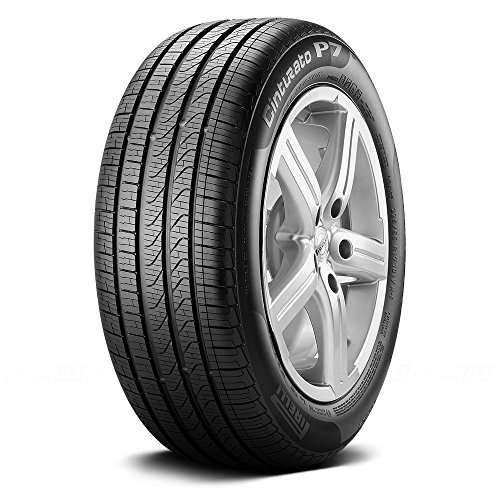

The Cinturato All-Season Tire is a sport touring tire that offers a blend of all-season traction, comfort, and handling dynamics that give the driver confident control of the vehicle.
With a thick network of sipes, lateral grooves in the outer tread blocks, and an optimized tread profile, this tire is built for high-performance grand touring.
The tires offer a decent amount of traction on snow and light ice too, making the Cinturato one of Pirelli’s most versatile all-season options.
Treadwear warranties on this model typically fall in the 65,000–70,000 mile range depending on size and speed rating, which is strong for a tire in this category.
2) Pirelli P Zero (All Season / All Season Plus)

Pirelli’s P Zero all-season line is OEM equipment for many performance car manufacturers, including several European luxury and sports brands.
These ultra-high performance all-season tires use an asymmetric tread pattern to deliver excellent grip and are well matched to high-performance sports cars for the level of power and cornering loads they handle.
Despite the extra power produced by these vehicles, the tires are grippy enough to handle light snow and light rain reasonably well, though they are not a substitute for dedicated winter tires.
Apart from the sporty tread pattern, a solid center rib supports confident handling, quick acceleration, and high-speed braking.
Treadwear warranties in this category commonly range from 40,000–50,000 miles, which is competitive for an all-season performance tire.
3) Pirelli P4 Four Seasons Plus
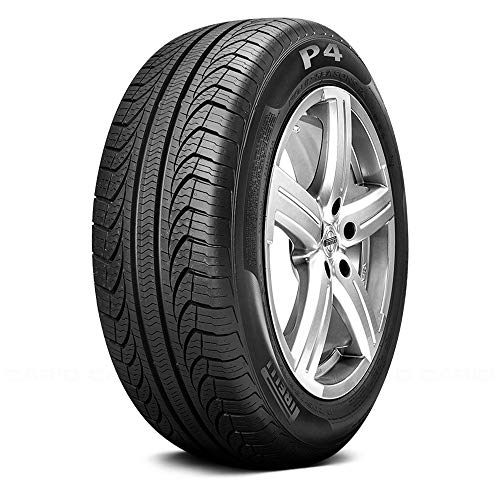
The Four Seasons Plus tire was developed for minivans, sedans, and coupes and offers a blend of comfort, low rolling resistance, long tread life, low road noise, and all-season traction on wet, dry, and snowy conditions.
An asymmetric tread pattern along with a continuous center rib and siping helps deliver confident handling on wet and dry surfaces.
This tire also reduces the risk of hydroplaning thanks to variable-angle lateral grooves and central circumferential grooves that help water escape between the tire and the road.
Notable Goodyear Tires
1) Goodyear Eagle F1 Asymmetric All-Season

The Eagle F1 Asymmetric line is a high-performance tire family that uses a special compound and asymmetric tread pattern to deliver strong performance on wet and dry surfaces. Goodyear has updated this line through several generations, so check which generation is currently available before buying.
The tire is well suited for high-performance sedans and coupes since it provides confident high-speed cornering and precise steering feedback.
Grooves designed to actively channel away water and slush help maintain grip in wet conditions. Treadwear warranties on this model are typically in the 45,000-mile range.
2) Goodyear Eagle LS
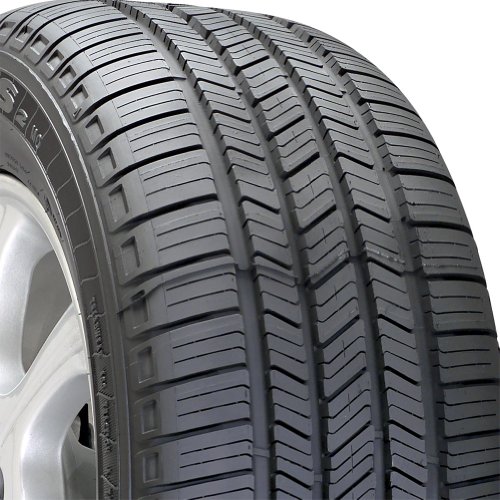
The Eagle LS is considered one of the better tires for grand touring, thanks to the high level of comfort it offers in all seasons.
Smooth ride quality makes the tire a strong choice for luxury sedans. The Eagle LS is also an OEM tire for many crossovers, sedans, and pickup trucks.
The independent yet symmetric tread block design minimizes road noise to keep the ride quiet.
Wide channels on the tread aid in dissipating water to prevent hydroplaning and improve wet traction, while the sipes aid traction in light snow conditions.
The tire’s construction is also built for high-speed durability.
3) Goodyear Assurance WeatherReady
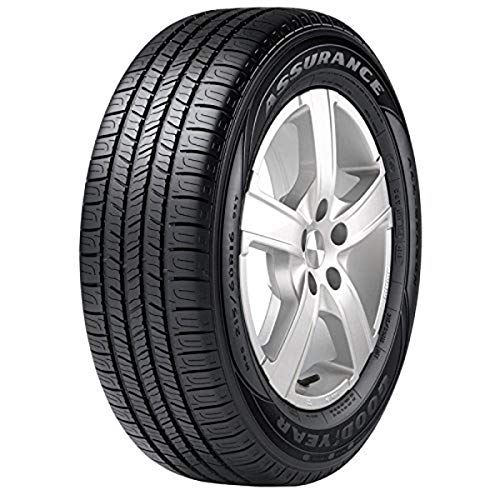
The Assurance WeatherReady is an all-weather tire built to handle a wide range of conditions while lasting a long time.
The tire is built keeping in mind the longevity and safety of the vehicle under varying conditions, and it offers low rolling resistance to improve fuel economy.
The tread pattern is designed to make the Assurance line comfortable, quiet, and consistent in performance.
This is a solid tire for touring due to its ability to handle wet, dry, or snowy conditions. The tire is typically offered with a treadwear warranty in the 60,000-mile range from Goodyear.
Features face to face- Pirelli vs Goodyear
1) Quality
Pirelli and Goodyear are brands that have been around for well over a century.
Both brands use modern manufacturing technology to develop and produce tires. Despite catering to different target markets, they’re on the same page when it comes to quality control and engineering investment.
Independent testing organizations such as Tire Rack and Consumer Reports have consistently rated both brands’ flagship lines among the top performers in their respective categories, reinforcing that neither brand has a clear quality advantage overall.
We say that both brands earn similar marks when it comes to quality.
2) Who is more durable?
The points for the durability criteria go to Goodyear tires. They cater to almost every type of vehicle on the road and are experienced in making tires for aircraft and earthmovers.
With such a broad product lineup, Goodyear has a strong track record of producing durable, long-lasting tires.
It’s not that Pirelli tires aren’t durable — they are — but Pirelli focuses more on performance-based tires, where grip is often prioritized over outright longevity. Its touring tires do focus on durability, but as a brand, Goodyear generally edges it out here.
3) Ride Comfort/ Road noise
While Pirelli makes tires that grip excellently under high-speed cornering and also those that cater to comfortable grand touring, Goodyear serves a wider slice of the daily-driver market, and as a result Goodyear tires tend to do a slightly better job on the comfort criterion overall compared to Pirelli’s lineup.
Goodyear has invested heavily in minimizing road noise, not only on its touring tires but across many other product lines.
Pirelli too makes comfortable tires but as a brand, Goodyear has a slight edge over Pirelli in this area.
4) Pricing
Both brands offer tires across a wide range of price points, from budget-friendly touring options to premium ultra-high-performance models. Exact prices shift often due to raw material costs, size, and retailer promotions, so we won’t quote specific figures here — check current listings for up-to-date pricing on the specific size you need.
Generally speaking, comparable Pirelli performance tires tend to be priced a bit more competitively than equivalent Goodyear performance models, though this varies by specific size and model.
We can’t say the same for every model, but on average, Pirelli tends to have a slightly friendlier pricing structure in the performance segment.
5) Handling
Pirelli’s tires are performance-focused and built for top-speed driving, high-speed cornering, and performance racing.
Their touring tires are engineered so a driver can confidently push a car at higher speeds and still keep it under control in challenging situations.
Pirelli has the edge over Goodyear on this criterion since its products are focused on high-performance driving, handling, and braking. Goodyear also manufactures tires meant for similar purposes, and while capable, they generally aren’t tuned quite as sharply as Pirelli’s performance lines.
6) Treadlife
Goodyear tires are generally found to last longer than comparable tires from Pirelli. This can be attributed to Goodyear’s focus on building tough, long-wearing rubber compounds.
The brand has developed several proprietary technologies aimed at durability and puncture resistance across its lineup.
One may find tires from Pirelli to be slightly softer, mainly owing to a high-performance profile that relies on a softer compound to stick to the road. Goodyear generally gets the points in the treadlife criterion.
7) Performance
As mentioned earlier, Pirelli’s tires are focused on performance and handling.
Their tires grip the road well in most conditions and provide better steering feedback to the driver. The tires do an excellent job of making one have fun behind the wheel of a fast car, while helping maintain safety.
There are plenty of tire models from Goodyear meant for high-speed performance, and they too deliver strong results.
However, Pirelli, being a specialist in this niche, tends to extract that extra bit of performance from its tires.
8) Driving Style
Pirelli and Goodyear are both focused on customer bases that are quite different from one another.
If your driving style is performance-focused, with a need to carve through corners with excellent traction in dry and wet conditions, then tires from Pirelli would suit you better.
On the other hand, tires from Goodyear are built for a wider range of priorities. They offer solid performance but are also tuned for longer tread life, lower rolling resistance for fuel economy, and quiet, comfortable ride quality.
Most Standout Features- Pirelli vs Goodyear?
For Pirelli, we want to highlight features like excellent handling, shorter braking distances in favorable conditions, sharp steering feedback, competitive pricing, and strong traction across weather conditions.
Pirelli is practically a byword for performance, and is recognized for its specialty in producing high-performance sport and touring tires.
Goodyear tires stand out in terms of durability, fuel economy, ride comfort, longevity, safety, tire toughness, and high mileage figures.
Their tires perform well overall and are more focused on the practical aspects that matter most in everyday driving.
What do customers and independent testers think?
Feedback across owner forums and retailer reviews tends to align with the general characterizations above. Owners report that Goodyear tires feel more practical and suited to almost all driving conditions.
Meanwhile, owners of Pirelli tires often say the tires let them enjoy driving their cars more.
They feel they have better control of their cars and the tires give them a higher sense of confidence in wet and dry weather conditions, particularly in higher-powered vehicles.
Independent test outlets such as Tire Rack and Consumer Reports frequently rank both brands’ flagship products near the top of their categories, which supports the overall conclusion that both companies produce well-engineered tires aimed at different priorities rather than one being objectively “better” across the board.
Is Pirelli better than Goodyear?
If you’re talking about performance tires that offer excellent handling and braking at higher speeds, then yes, Pirelli generally has the edge over Goodyear.
But if you’re talking about tires that offer long tread life, strong fuel economy, and a comfortable ride across a huge range of vehicle types, Goodyear tends to come out ahead.
Frankly speaking, comparing the two brands directly is a bit like comparing an apple to an orange. It is a subjective choice based on your needs and driving preferences.
If performance, fun, and precise handling are your priorities, Pirelli is the brand to consider. But for durability, tread life, and all-around practicality, Goodyear is a strong pick.
Frequently Asked Questions
Are Pirelli tires more expensive than Goodyear?
Not necessarily. Pricing depends heavily on the specific model and size. In the performance category, comparable Pirelli tires are often priced similarly to or slightly below equivalent Goodyear performance tires, but this varies by model, so it’s best to compare specific tires for your vehicle.
Which brand lasts longer, Pirelli or Goodyear?
On average, Goodyear tires tend to have longer treadwear warranties and are generally built with longevity as a higher priority, especially in their touring and all-season lines. Pirelli’s performance-oriented tires typically use softer compounds for grip, which can mean shorter tread life in exchange for better handling.
Which brand is better for winter driving?
Both brands offer dedicated winter tire lines in addition to all-season options with light snow capability. For serious winter conditions, a dedicated winter tire from either brand will outperform an all-season tire. Neither brand’s all-season lineup should be treated as a substitute for winter tires in regions with heavy snow and ice.
Do Pirelli and Goodyear make tires for the same vehicle types?
Not entirely. Goodyear has a much broader product range, covering passenger cars, light trucks, commercial vehicles, farm equipment, and even aviation tires. Pirelli’s range is more concentrated on passenger and performance vehicles, with a strong focus on sports cars and grand touring applications.
Where can I find independent test data on these tires?
Outlets like Tire Rack and Consumer Reports regularly publish test results comparing tires by category, including wet/dry braking, handling, noise, and treadwear. These are useful supplements to owner reviews when narrowing down a final choice.
For more buying guidance, see our related articles on tire types explained and how to properly maintain tire pressure, both of which can help you get the most out of whichever brand you choose.