

The best tire chains for snow and ice are the ones that actually fit your tire size, match your vehicle’s clearance, and that you know how to install in a parking lot with cold hands and bad light. Cable chains work best for most passenger cars and crossovers with tight wheel wells, link chains deliver the most traction for trucks and SUVs that need to climb grades or break through packed snow, and diagonal (cross-link) chains split the difference for mixed-use fleets and tow vehicles. Beyond picking a style, you need the right size for your exact tire, a clear understanding of your state’s chain law, and a few minutes of practice before the storm hits. This guide walks through all of it.
How Tire Chains Work
Tire chains wrap around the tread of a drive tire and bite into packed snow or ice in a way rubber alone cannot. A winter or all-terrain tire relies on tread voids, siping, and a soft compound to grip; chains add metal links or cables that physically dig in, cutting through compacted snow instead of rolling over it. This is why chains outperform even the best winter tires in deep, unplowed snow or on glare ice at low speed, even though they’re far worse than tires on dry or wet pavement.
Chains only help the tires they’re installed on. On a front-wheel-drive car, that typically means the front axle; on rear-wheel-drive trucks, the rears; on all-wheel-drive vehicles, manufacturers usually specify the front axle for steering control unless the owner’s manual says otherwise. Chains are also a supplemental traction device, not a replacement for winter tires. They’re designed for low-speed use (most manufacturers cap speed at 25-30 mph) over snow and ice, not as daily-driver equipment. Running chains on dry, bare pavement for more than a few hundred feet wears them out quickly and can damage both the chain and the tire.
Cable Chains vs Link Chains vs Diagonal Chains
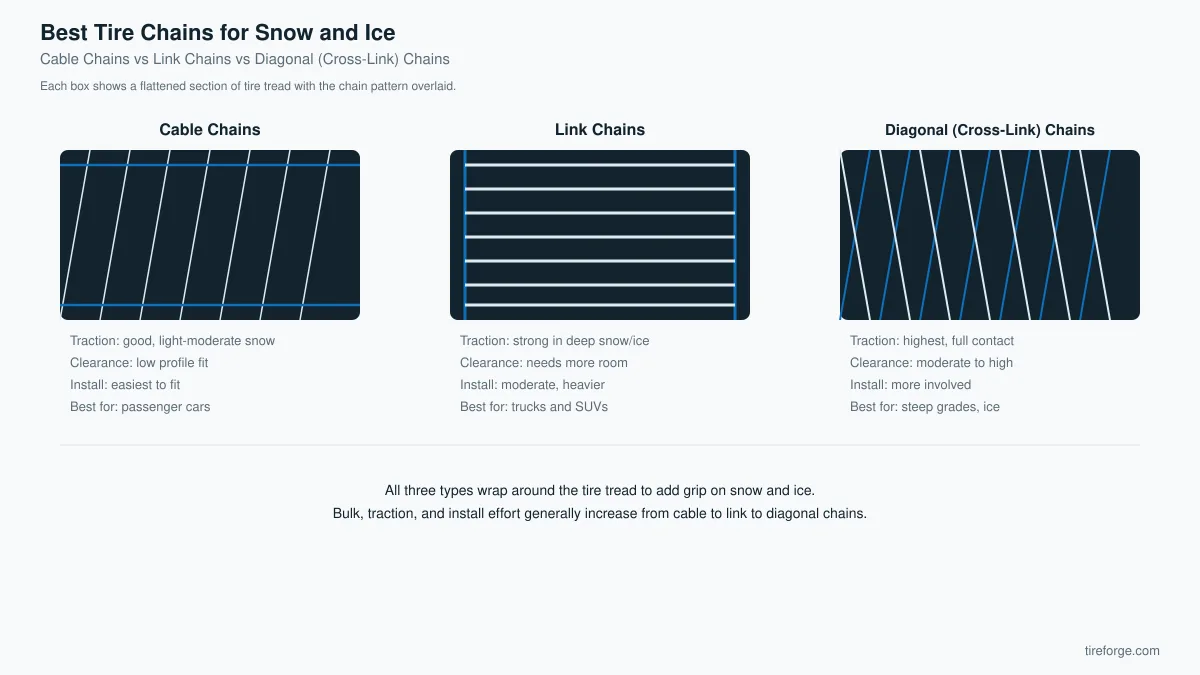
Each chain style trades traction for clearance, weight, and ease of installation. Matching the style to your vehicle matters as much as matching the size.
Cable Chains
Cable chains use steel cables with small traction cleats instead of full metal links. They’re thin, lightweight, and flex easily, which makes them the go-to choice for vehicles with low ground clearance, tight wheel wells, or minimal clearance between the tire and suspension components — think sedans, minivans, and many crossovers. They’re also generally the easiest style to install for a first-timer. The tradeoff is traction: cable chains provide noticeably less bite than link chains, especially on ice, and the thinner cables wear out faster on abrasive surfaces like sand or gravel-covered roads.
Link Chains
Link chains (sometimes called ladder or diamond-pattern chains depending on link orientation) use heavier-gauge steel links across the tread face. They provide the most aggressive traction of any common chain style and hold up better over repeated use, which is why they’re favored by truck owners, plow operators, and anyone driving in mountain passes with mandatory chain checkpoints. The downside is clearance and weight — link chains need more room between the tire and the fender liner or brake components, and they’re harder to install correctly, especially diamond patterns that require more precise tensioning.
Diagonal (Cross-Link) Chains
Diagonal chains sit between the two, using a cross-link pattern that gives better traction than cables with less bulk and weight than full ladder-style link chains. They’re a common factory-recommended option for SUVs and light trucks that need real traction but don’t have unlimited wheel-well clearance. They’re a reasonable middle-ground pick when you’re not sure which direction to go.
Choosing Chains for Your Tire Size
Chain sizing is based on your tire’s section width and aspect ratio/wheel diameter, not the vehicle make and model, so the same chain size chart applies whether you drive a compact sedan or a mid-size SUV with the same tire dimensions. Nearly every chain manufacturer publishes a size chart cross-referencing tire sizes (like 225/65R17) to a chain size number. Always check your actual installed tire size from the sidewall — not the size that came on a trim level years ago — because a tire upgrade or size change can bump you into a different chain size. If you’re unsure how to decode your sidewall, our guide to reading a tire sidewall walks through every number and letter.
If your exact tire size isn’t listed, or you’re working with an aftermarket tire that doesn’t match factory specs, measure the chain’s adjustable range against your tire’s actual tread width and diameter rather than guessing from the box label. Our guide to measuring tire chains includes reference graphs that make this straightforward. The most common mistake buyers make is ordering by rim diameter alone (assuming all 17-inch tires need the same chain) — aspect ratio and section width change the fit enough that a chain sized for a narrow 215mm tire will not seat correctly on a wider 265mm tire even if both ride on 17-inch wheels.
Legal Requirements by State
Chain laws vary significantly, and they change with conditions, so always check current state DOT advisories during winter storms rather than relying on memory from a previous season. That said, a few general patterns hold across most snow-belt states:
| Chain Law Level | What It Typically Means |
|---|---|
| Level 1 / Advisory | Chains recommended but not required; traction tires (mud+snow or 3-peak) may be accepted in place of chains |
| Level 2 / Required | Chains or traction devices required on designated vehicles; 4WD/AWD vehicles with adequate tread may be exempt |
| Level 3 / Mandatory | Chains required on all vehicles except those designed for extreme conditions (commercial-grade snow tires on all axles); no exemptions |
States like California, Oregon, and Washington post chain control levels on mountain passes during storms, and officers actively enforce them at checkpoints — fines for non-compliance when chains are required can be substantial, and getting stuck without them can mean sitting roadside until conditions improve. Many states also restrict certain chain types: some ban studded link chains on bare pavement sections to protect road surfaces, and a few limit chain use to specific date ranges (commonly late fall through spring). If you regularly drive mountain routes, keep chains in the vehicle year-round during that window rather than assuming you’ll have time to buy them once a storm is forecast.
Top Chain Picks for Cars, SUVs & Trucks
Rather than chasing a single “best” chain, match the style to the vehicle class and how often you’ll actually use them.
- Commuter cars and minivans: Cable chains sized to the factory tire remain the most practical choice — they’re light, store in a small bag in the trunk, and are approved for occasional use under most state Level 1 and Level 2 laws.
- Crossovers and mid-size SUVs: Diagonal or cable chains designed for the vehicle’s clearance work well for occasional snow routes; owners of vehicles like the Subaru Outback often find factory-recommended cable chains sufficient for their driving, as covered in our Subaru Outback tire guide.
- Full-size trucks and tow vehicles: Link chains rated for the tire’s load range handle the added weight of towing or plowing better than cable chains. Owners running larger LT-metric tires on trucks like the F-150 should confirm chain fitment against the specific tire size listed in our F-150 tire guide, since larger tires may need a different chain class than the passenger-size equivalent.
- Severe mountain or commercial use: Heavy-duty diamond-pattern link chains built for repeated use and higher load capacity are worth the extra install time and weight.
Across all categories, buy chains rated for your tire’s load range, not just its diameter — a chain undersized for the tire’s load can stretch, loosen, and come off at speed, which damages the chain, the tire, and sometimes the fender or brake lines. If you’re unsure how load range affects fitment, our load range guide explains how C, D, E, and LT ratings factor into tire and chain sizing.
Installation & Storage Tips
Install chains before you need them, not during a storm on the shoulder of a highway. Lay the chain flat, drive the vehicle forward a few feet onto the chain if possible, then wrap it around the tire and connect the inner and outer ends according to the manufacturer’s sequence. Most chains need a short drive (around 10-20 feet) followed by a re-tightening, since the chain settles and loosens slightly once it’s been driven on. Skipping this re-tightening step is the single most common installation mistake — a loose chain slaps against the fender well, wears through quickly, and can come off entirely.
Practice installing your chains at home, in good light, before winter arrives. It takes most people two or three attempts to get comfortable with the process, and doing that practice run in your driveway is far better than learning on the fly in freezing wind at a chain-up area. Keep gloves, a small tarp or mat to kneel on, and a flashlight with your chains in the vehicle.
For storage, always rinse chains after use to remove road salt and grime, which accelerates rust and weakens links or cables over time. Dry them fully before storing in a sealed bag or bin — damp chains left coiled in a trunk will rust solid by the next season. A light coat of oil on link chains before off-season storage helps prevent corrosion. Inspect chains annually for stretched links, frayed cables, or broken cross-links before the first storm; damaged chains should be replaced rather than repaired, since a failed link at speed can whip and damage the vehicle or tire. If you’re timing a broader winter prep purchase, including new tires alongside chains, our guide to the best time to buy tires can help you plan around seasonal pricing.
Frequently Asked Questions
Can I use tire chains on an all-wheel-drive vehicle?
Yes, but check your owner’s manual first. Most AWD manufacturers specify installing chains on the front axle only, both for clearance reasons and because front chains preserve steering control. Installing chains on all four tires of an AWD vehicle without manufacturer approval can cause drivetrain binding on vehicles with a locked center differential.
Do tire chains damage pavement or my tires?
Driving on chains over bare, dry pavement for extended distances will wear the chain quickly and can scuff tread or sidewalls. Chains are designed for snow and ice coverage; remove them once the road is clear. Some states restrict certain chain types specifically because of pavement wear concerns on bare sections of mountain highways.
Are cable chains as good as link chains?
Not for maximum traction — link chains generally outperform cable chains on ice and deep snow. But cable chains are easier to install, lighter, fit tighter clearances, and are perfectly adequate for occasional use on cars and crossovers that mainly need to meet chain-law requirements rather than climb steep, snow-packed grades.
How do I know what size tire chains to buy?
Match the chain size to your tire’s actual installed size (section width and aspect ratio/wheel diameter) using the manufacturer’s size chart, not your vehicle’s trim level or rim diameter alone. When in doubt, measure your tire directly against the chain’s adjustable range before buying.