
The tread pattern on a tire isn’t just cosmetic — it’s engineered geometry that determines how the tire handles water, noise, cornering grip, and wear. If you’ve ever looked at a new tire and wondered why the tread looks different from side to side, or why one tire has a clear “rotation direction” arrow and another doesn’t, the answer comes down to one of three pattern families: symmetric, asymmetric, and directional. Each one trades off differently between ride comfort, wet traction, handling precision, and rotation flexibility, and picking the wrong one for your driving style can leave performance on the table or create unnecessary wear issues.
This guide breaks down what each pattern type actually does, where it shines, where it falls short, and how to identify which one is already mounted on your car.
What Tread Pattern Type Means
Tread pattern type refers to how the grooves, blocks, and sipes are arranged across the face of the tire. Manufacturers design this layout to balance a handful of competing goals: channeling water out from under the contact patch, keeping road noise low, maximizing dry grip, and wearing evenly over tens of thousands of miles. No single layout does all of those things equally well, so engineers choose a family of pattern based on the tire’s intended use — a fuel-sipping commuter tire needs different priorities than a summer performance tire or a winter tire.
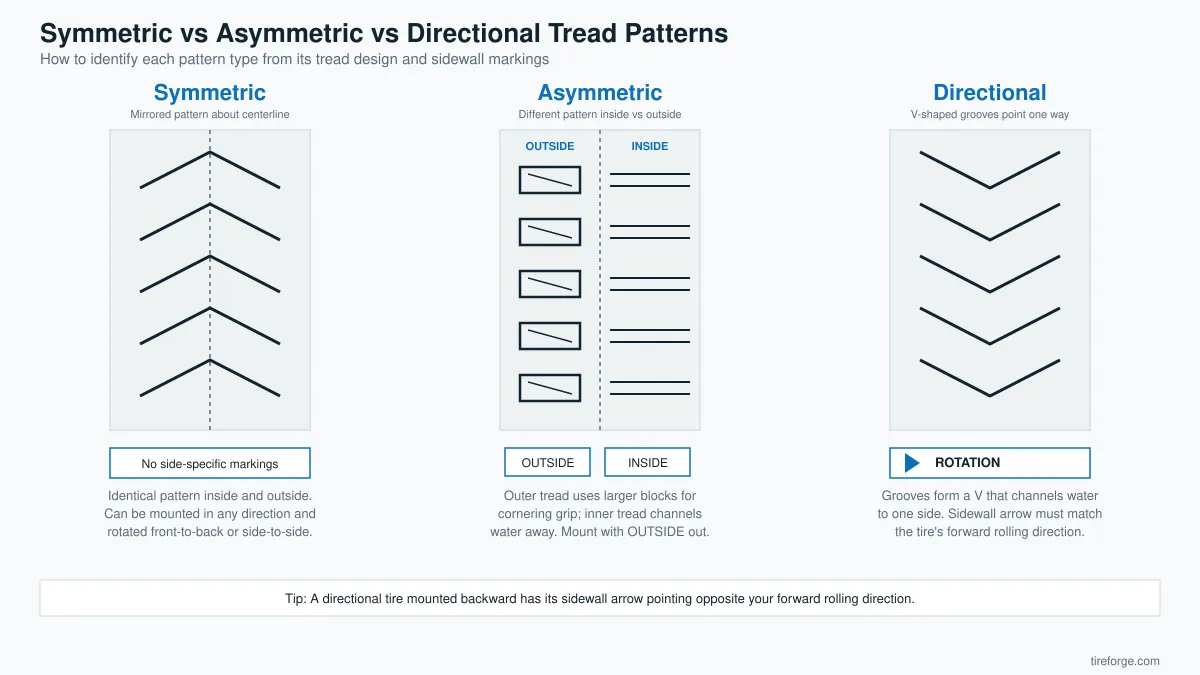
The three families differ in symmetry along two axes: side-to-side (inboard vs outboard half of the tread) and front-to-back (whether the tread looks the same read in either rolling direction). Symmetric tires are identical on both halves and roll the same either direction. Asymmetric tires have two distinct tread zones across the width but can still roll either direction. Directional tires are designed to roll in only one direction, indicated by a V-shaped or arrow pattern pointing one way. Understanding this distinction matters when you’re buying, rotating, or even just assessing whether a tire was installed correctly — a topic covered in detail in our piece on what happens when a directional tire goes on backwards.
Symmetric Tread: Pros, Cons & Best Uses
Symmetric tread is the oldest and most common pattern style. The tread blocks and grooves repeat in a continuous, uniform pattern across the entire tire face, and the pattern reads the same whether you’re looking at it rolling forward or backward. This simplicity is the whole point.
The biggest practical advantage is rotation flexibility. Because there’s no mandated direction and no inboard/outboard requirement, a symmetric tire can be rotated in virtually any pattern — front to back, side to side, or in a full X-pattern — which spreads wear more evenly and extends tread life. This flexibility is why cross-rotation patterns are so often paired with symmetric tires; see our breakdown of cross rotation vs straight rotation for how that plays out in practice.
Symmetric tires also tend to run quieter and ride more comfortably than directional designs, because the repeating pattern doesn’t generate the same harmonic noise pulses. They’re typically the least expensive to manufacture, which is why most economy and standard all-season tires use this layout.
The trade-off is performance ceiling. Symmetric patterns don’t optimize separately for dry cornering grip and wet evacuation the way asymmetric designs do, so at the limit — hard cornering, aggressive braking in the wet, high-speed stability — they generally fall short of asymmetric or directional alternatives. For daily commuting, grocery runs, and moderate-mileage highway driving, though, symmetric tread remains a sound, budget-friendly default.
Asymmetric Tread: Pros, Cons & Best Uses
Asymmetric tread splits the tire face into two different zones with different block shapes, usually marked “outside” and “inside” on the sidewall. The outer half typically uses larger, stiffer tread blocks with less siping to maximize contact area and rigidity during cornering, when the outside shoulder carries most of the load. The inner half uses smaller blocks and more grooving to handle water dispersion and wet grip, since that zone matters less for cornering stiffness.
This split design lets engineers optimize for two jobs at once instead of compromising on one uniform pattern. The result is noticeably better dry handling and cornering stability than a comparable symmetric tire, while still maintaining solid wet performance — which is why most performance all-season and summer tires use this layout today.
Asymmetric tires can be rotated front-to-back on the same side of the vehicle, but not side-to-side, since flipping them would put the cornering-optimized outer tread on the inboard side. This limits rotation flexibility compared to symmetric designs and means you need to track which side each tire was on. Installers who ignore the “outside” marking and mount these backward don’t destroy the tire, but they do sacrifice the handling and wet-grip balance the design was built for.
Asymmetric tread is the right call if you want a noticeable step up in cornering confidence and high-speed stability over a basic symmetric all-season, without committing to the stricter rotation rules and typically higher noise of a directional tire.
Directional Tread: Pros, Cons & Best Uses
Directional tread forms a V- or arrow-shaped pattern across the tire, designed to channel water outward from the center toward both shoulders as the tire rotates in one specific direction. That single-direction water evacuation is extremely efficient, which is why directional patterns dominate winter tires, high-performance summer tires, and many mud and all-terrain truck tires where aggressive self-cleaning and hydroplaning resistance matter most.
The main strength is wet and snow traction. The V-shape actively pumps water and slush away from the contact patch faster than symmetric or asymmetric designs can, significantly reducing hydroplaning risk at speed and improving traction in slush and standing water. Many directional designs also bite well in loose snow and mud because the lugs are shaped to scoop and expel debris rather than pack it in.
The downside is rotation inflexibility. Directional tires must always roll the same way, so they can only be rotated front-to-back on the same side of the car — never side-to-side — unless they’re dismounted and remounted on the wheel, which some shops will do and others won’t bother with. This is also the pattern type most prone to installation mistakes; a shop in a hurry can mount a directional tire backward, which won’t cause immediate failure but will measurably hurt wet grip and increase road noise until it’s corrected. If you’re unsure whether your tires are installed correctly, that’s worth checking immediately.
Directional tires also tend to be the loudest of the three families at highway speed, since the V-pattern creates a more pronounced, rhythmic noise pulse than a symmetric or asymmetric layout.
How to Identify Your Tire’s Pattern Type
You don’t need to guess — manufacturers mark the pattern type directly on the sidewall, though the labeling conventions differ slightly by brand.
- Directional tires usually show a rotation arrow and the word “Rotation” printed on the sidewall, pointing in the direction the tire must roll when viewed from the outside of the vehicle.
- Asymmetric tires are typically labeled “Outside” on one sidewall and “Inside” on the other, and must be mounted so those markings face the correct direction on the vehicle.
- Symmetric tires generally have no directional arrow or inside/outside marking at all — the tread looks identical from either sidewall.
If the sidewall markings are worn off or you bought the tire used, look at the tread itself. A continuous, repeating pattern with no obvious V-shape and identical appearance from both sides is almost certainly symmetric. A clear V or chevron shape pointing one way is directional. A tread with visibly different block sizes or groove depths across the width, even if there’s no visible V, is likely asymmetric. When in doubt, a tire shop can identify it in seconds, and it’s worth confirming before any rotation or replacement — especially if you’re also checking remaining tread life with a method like the ones in our tread depth measurement guide.
Choosing the Right Pattern for Your Driving Needs
For most daily drivers prioritizing low cost, quiet ride, and maximum rotation flexibility to extend tread life, symmetric tires remain a sensible, low-maintenance choice. If your priority shifts toward confident cornering and a noticeably sharper handling feel — common with sportier sedans, coupes, or drivers who want more composure on winding roads — asymmetric tread delivers that upgrade without demanding major changes to maintenance habits.
If you live somewhere with heavy rain, slush, or snow, or you simply drive at highway speeds often enough that hydroplaning resistance matters, directional tread’s superior water evacuation is hard to beat — it’s a major reason directional patterns show up so often on dedicated winter tires. Just go in understanding the rotation limitation and the slightly higher risk of installation errors.
| Pattern Type | Rotation Flexibility | Noise Level | Best For |
|---|---|---|---|
| Symmetric | Highest (any pattern) | Lowest | Daily commuting, budget tires, long tread life |
| Asymmetric | Moderate (front-back, same side) | Moderate | Sporty handling, performance all-seasons |
| Directional | Lowest (front-back, same side only) | Highest | Wet/snow traction, winter and performance tires |
Whichever pattern you choose, performance only holds up if the tire is mounted correctly, rotated on schedule, and paired with a vehicle that’s properly aligned — an out-of-spec alignment will cause uneven wear regardless of tread design, which is a separate issue from pattern type covered in our alignment vs balancing guide.
Frequently Asked Questions
Can I mix symmetric and directional tires on the same vehicle?
It’s not recommended. Mixing tread types can create inconsistent handling and braking characteristics between axles, especially in wet or snowy conditions. If you must run different patterns temporarily, keep the same type on each axle rather than mixing diagonally.
Does tread pattern affect tire noise more than tread compound?
Both matter, but pattern geometry is usually the bigger factor in highway noise. Directional and more aggressive asymmetric patterns tend to produce more rhythmic noise than symmetric designs, independent of the rubber compound used.
Is directional tread always better in snow?
Not automatically — siping density, rubber compound, and overall tread design matter as much as the directional shape itself. However, directional patterns are common on dedicated winter tires because the V-shape pairs well with aggressive snow-biting lugs.
How do I know if my directional tire was installed backward?
Check the sidewall rotation arrow against the direction the wheel spins when the car moves forward. If it’s reversed, you’ll often notice increased road noise and reduced wet traction, and a shop can remount it correctly without needing a new tire.
Do asymmetric tires wear faster than symmetric ones?
Not inherently, but because they can’t be rotated side-to-side, uneven wear patterns can develop if rotations are skipped. Sticking to the recommended front-to-back rotation schedule keeps wear even over the tire’s life.