
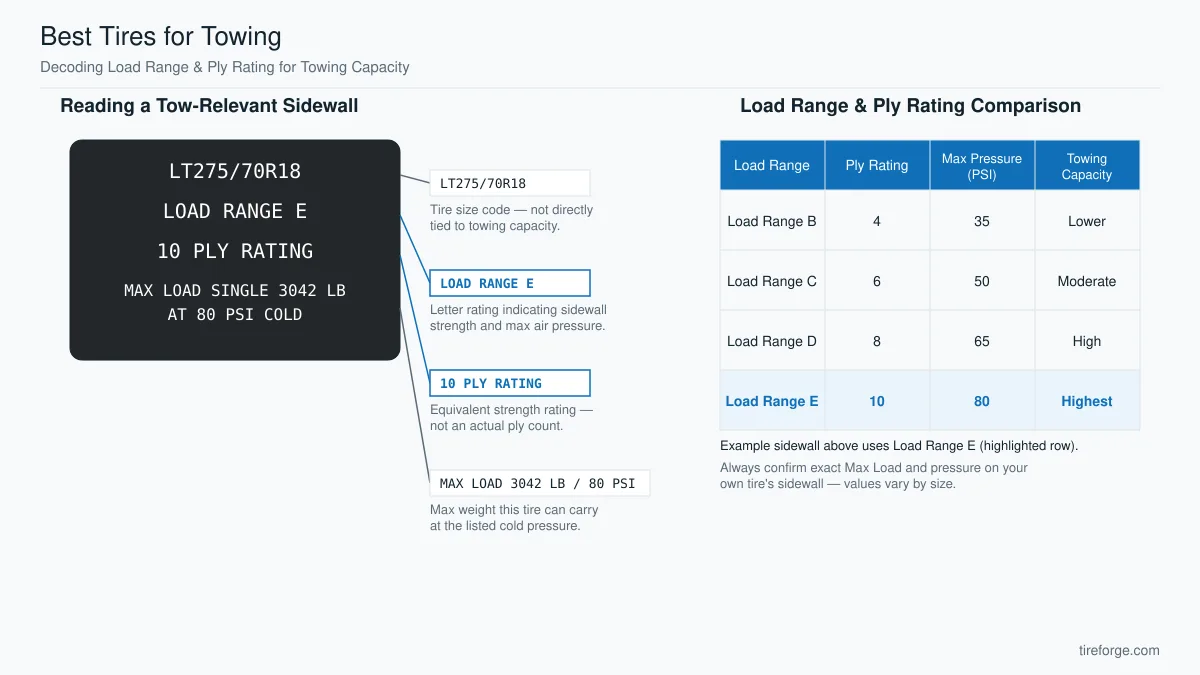
The best tires for towing are load-range-rated tires—typically Load Range E or higher on half-ton and heavier trucks, or the max-rated OE size on SUVs—paired with a stiffer sidewall construction and a tread compound built for sustained heat under load. Towing isn’t just “driving with extra weight behind you.” It changes how a tire flexes, heats up, and resists sway, which means the all-season tires that feel fine for commuting can become the weak link in your setup the moment you hook up a trailer.
Below is a practical breakdown of what actually matters when you’re shopping for tow-rated rubber, how to read the numbers on the sidewall, and which tire types make sense depending on whether you’re towing with a half-ton truck, a heavy-duty diesel, an SUV, or pulling the weight on the trailer’s own axle.
How Towing Changes Tire Requirements
A tire supporting a vehicle at its curb weight and a tire supporting that same vehicle plus 5,000-10,000 lbs of tongue weight and trailer mass are doing two very different jobs. Towing adds vertical load, which increases the contact patch pressure and generates more heat through the sidewall with every rotation. Heat is the enemy of rubber compounds and belt packages—it’s the single biggest driver of tread separation and blowouts on tow rigs, especially on long highway hauls in summer.
Towing also shifts weight rearward and increases braking distances, which means the rear tires (or trailer tires) absorb more load transfer during deceleration than they would unloaded. A tire that’s marginal on load capacity won’t necessarily fail in the driveway—it’ll fail three hours into a trip once internal temperatures climb and the casing starts to flex beyond its design limits.
Finally, towing exposes weaknesses in tread design that don’t matter during normal driving. Tires with soft, chunky all-terrain blocks can squirm under lateral load, contributing to trailer sway. This is why the right towing tire isn’t always the tire that scored well in a magazine’s comfort test—it’s the one with the load capacity, stiffness, and heat tolerance to handle sustained work.
Load Range & Ply Rating for Towing
Load range is the single most important spec for towing, more important than tread pattern or brand reputation. It tells you the maximum air pressure and corresponding load capacity a tire can handle. Modern radial tires use letter designations that correspond to an equivalent ply rating, even though most no longer use actual multi-ply cotton or steel body construction.
| Load Range | Ply Rating (Equivalent) | Typical Max PSI | Common Use |
|---|---|---|---|
| C | 6-ply | 50 psi | Light SUVs, crossovers, light trailers |
| D | 8-ply | 65 psi | 3/4-ton-lite loads, mid-size trucks towing |
| E | 10-ply | 80 psi | Half-ton and 3/4-ton trucks, heavy trailers |
| F | 12-ply | 95 psi | Heavy-duty diesel trucks, commercial towing |
A common mistake is assuming a bigger, more aggressive-looking tire automatically tows better. Tread size says nothing about load capacity—only the load range and the load index number next to the tire size (like “121” on a LT275/70R18) tell you how much weight it’s rated to carry at its max pressure. If you’re replacing factory tires on a half-ton truck like an F-150 or Ram 1500 with a trailer package, matching or exceeding the OE load range is non-negotiable; dropping from Load Range E to a Load Range C “comfort” tire will quietly erode your safety margin even if the tire looks similar. For trucks specifically built around towing, it’s worth reviewing options built for the platform, such as the picks in our Ford F-150 tire guide or the Ram 1500 tire guide, both of which flag load-range-appropriate options.
Best Tire Types for Trucks vs SUVs vs Trailers
Trucks
Half-ton and heavy-duty trucks used for towing do best with Load Range E (or F for 3/4-ton and 1-ton diesels) light truck (LT) tires rather than passenger (P-metric) tires. LT-metric construction uses a reinforced sidewall and stiffer belt package designed specifically to resist the flex and heat buildup that comes from carrying real cargo and trailer tongue weight. Highway all-season and conservative all-terrain patterns tend to tow more predictably than aggressive mud-terrains, which often have lower load ratings relative to their size and generate more heat and road noise under sustained highway loads.
SUVs
Three-row SUVs and smaller crossovers towing light to mid-size trailers (utility trailers, small boats, pop-up campers) usually stick with P-metric or Load Range C/D tires, since most SUVs aren’t built around the same frame and axle capacities as trucks. Here, the priority shifts slightly toward matching the vehicle’s max tow rating in the owner’s manual and choosing a tire with a strong highway-speed temperature rating (A is best) rather than chasing the highest load range available. Minivans and family SUVs with modest tow packages, like those covered in our Toyota Sienna and Honda Odyssey guides, generally don’t need LT tires at all—just a quality touring or grand-touring tire within the OE load index.
Trailers
Trailer tires (ST-metric, or “Special Trailer”) are a different animal entirely. They use stiffer sidewalls than passenger tires to resist sway, since a trailer axle doesn’t have the vehicle’s suspension geometry managing lateral forces. ST tires are not designed for steering or braking traction the way vehicle tires are, so don’t cross-shop them against LT tires—they serve a different structural purpose and should only go on the trailer axle, never on the tow vehicle.
Sidewall Flex & Sway Considerations
Sidewall stiffness directly affects towing stability, and it’s one of the most overlooked specs by people shopping on price or tread looks alone. A softer sidewall—common in passenger-tuned all-season tires—flexes more under lateral load, which translates into a vaguer, more wandering feel when a trailer pushes the rear of the tow vehicle during crosswinds, passing trucks, or quick lane changes. This flex is also a contributing factor in trailer sway, though it’s rarely the only cause (hitch weight distribution and trailer loading matter just as much).
LT and ST tires counter this with reinforced casings, often adding an extra belt or heavier sidewall ply specifically to reduce deflection. This is part of why a tire that feels slightly harsher unloaded—more road feedback, a firmer ride—often tows better: that same stiffness is what keeps the tire’s footprint stable when weight is pushing down and sideways at once.
Tire pressure plays an equally large role here and is the most common mistake towing drivers make. Underinflated tires flex more at the sidewall, building heat and reducing steering precision exactly when you need both. Most tow-rated tires require close to their maximum sidewall pressure when loaded near capacity—far higher than the