
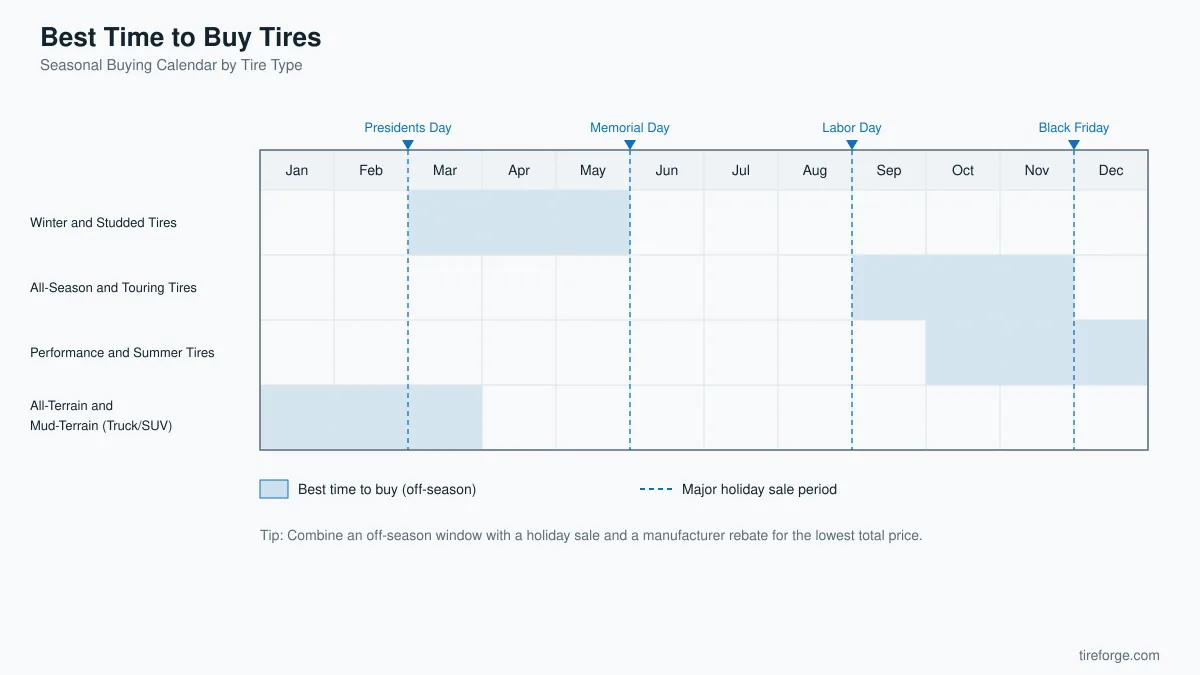
The best time to buy tires is during the spring and fall changeover seasons (March-May and September-October) or around major sales holidays like Black Friday, Memorial Day, and Labor Day, when manufacturers run rebate promotions and retailers discount inventory to move volume. But timing is only half the equation — buying off-season for your specific tire type and stacking a manufacturer rebate on top of a retailer sale is how you actually maximize savings without settling for old stock or the wrong tire for your climate.
Why Tire Prices Fluctuate Seasonally
Tire pricing isn’t random. It follows predictable supply, demand, and manufacturing cycles. Retailers and manufacturers plan promotions around two forces: when consumers are most likely to buy, and when they need to clear inventory to make room for new production runs.
Demand spikes right before winter (people suddenly need snow or all-season tires before the first storm) and right before summer road-trip season. Retailers know this and often raise prices or hold steady during these high-demand windows because they don’t need to discount to move product — people are buying out of necessity, not bargain-hunting. Conversely, during shoulder seasons when demand dips, retailers and distributors are sitting on inventory they’d rather sell at a lower margin than store.
Manufacturers also run rebate cycles tied to their own production and marketing calendars, which don’t always align with weather. A $70 rebate on a set of four tires might run in April even though most people aren’t thinking about tires until their car fails an inspection in July. Understanding that these two systems — retailer discounting and manufacturer rebates — operate independently is the key to finding windows where both overlap, which is when the real savings happen.
Spring and Fall Changeover Deals
Spring (roughly March through May) and fall (September through October) are the two biggest tire-buying windows of the year, and for opposite reasons.
In spring, drivers who ran winter tires are swapping back to all-seasons or summer performance tires, and dealers want to clear out the last of the winter tire stock before it sits in a warehouse for seven months. This is when you’ll find the deepest discounts on winter and studded tires — sometimes 20-30% off, because retailers would rather sell at a reduced margin than store rubber that’s aging on the shelf. If you buy winter tires in spring, store them properly in a cool, dry place to prevent the rubber from degrading before you mount them; see our guide on where to store winter tires in the off-season for specifics.
In fall, the dynamic flips. Retailers push all-season and summer tire clearance to make room for incoming winter tire shipments, and manufacturers often launch fall rebate programs specifically to drive winter tire sales before the first freeze. The catch: if you wait until the first snowfall to shop, you’re buying at peak demand with the weakest selection and the least negotiating leverage. Shopping in late September, before the rush, gets you both selection and pricing advantage.
Holiday Sales Patterns (Black Friday, Memorial Day, and More)
Several national holidays have become unofficial tire sale events, and each has a slightly different character worth knowing before you shop.
- Black Friday / Cyber Monday (late November): This is typically the single best combined event of the year because it stacks a retailer doorbuster discount with manufacturer year-end rebates. Expect bundled offers like free installation, alignment checks, or prepaid gift cards on top of a direct price cut.
- Memorial Day (late May): Marks the unofficial start of summer road-trip season. Retailers discount all-season and touring tires to capture drivers prepping for travel. Rebates here tend to favor passenger and crossover tire lines rather than performance or winter products.
- Labor Day (early September): A secondary push before fall changeover season begins. Less aggressive than Black Friday but still worth checking, especially for truck and SUV all-terrain tires.
- Tax refund season (February-April): Not a retailer-driven holiday, but a real demand spike. Many shoppers use refund money for big-ticket maintenance, so some retailers run promotions specifically timed to this period.
The common mistake is assuming every holiday weekend has a tire sale worth chasing. In reality, Black Friday and the spring/fall changeover windows consistently outperform smaller holidays. If you only have bandwidth to time one purchase per year, Black Friday and early-to-mid September are the two to watch.
Off-Season Buying Strategy by Tire Type
“Off-season” means something different depending on what kind of tire you need, so a single blanket strategy doesn’t work for every driver.
Winter and Studded Tires
Buy in spring, right after winter ends. Demand craters and retailers discount remaining stock heavily rather than warehouse it for six to eight months. The risk is buying tires that sit in storage long enough to age — check the DOT date code and avoid anything more than two years from manufacture by the time you’ll actually mount them. Our guide on how old new tires should be when you buy them walks through reading those codes.
All-Season and Touring Tires
Buy in fall. Retailers are clearing all-season stock to make room for winter inventory, and since these are the highest-volume tire category, discounts tend to be broad and competitive across brands.
Performance and Summer Tires
Buy in late fall or winter. Demand is lowest when nobody’s thinking about summer driving, and manufacturers sometimes run off-cycle rebates to keep performance lines moving during the slow months.
All-Terrain and Mud-Terrain (Truck/SUV)
These don’t follow strict seasonal patterns as tightly, since truck owners buy for durability and towing year-round. Watch for manufacturer rebates tied to truck-specific lines instead of chasing a calendar window.
Manufacturer Rebate Timing
Manufacturer rebates are separate from retailer sales, and understanding the difference changes how you shop. A retailer discount lowers the shelf price immediately. A manufacturer rebate is typically a mail-in or online-submission reimbursement processed after purchase, often in the form of a prepaid card, and it’s funded by the tire brand, not the store.
Major manufacturers tend to run rebate cycles several times a year, commonly clustering around:
- Early spring (March-April), tied to winter-to-all-season changeover
- Early fall (September-October), tied to all-season-to-winter changeover
- Black Friday through year-end, tied to holiday shopping and fiscal year-end sales targets
The biggest mistake buyers make with rebates is missing the submission deadline. Rebate offers almost always have a claim window — often 30 to 60 days from purchase — and require your original receipt plus the tire’s DOT number. Take a photo of your receipt and invoice at the point of sale, and submit the claim within a week rather than letting it sit in a drawer. Also confirm whether the rebate is a prepaid card (useful but sometimes has activation fees) or a direct statement credit, since that affects the real value of the deal.
Stacking matters here: a retailer’s seasonal clearance price combined with an active manufacturer rebate is where the best total savings live, often beating either discount alone by a meaningful margin.
Tips for Locking in the Best Deal Year-Round
Even outside peak sale windows, there are ways to control costs and avoid overpaying.
- Shop by tread depth, not just by season. If your current tires are approaching 4/32″ of remaining tread, don’t wait for a sale calendar — unsafe tires are a bigger cost than a missed discount. Use our tire tread depth measuring guide to check where you stand before deciding whether you can wait for a better price.
- Price-match across retailers. Many national tire chains and warehouse clubs will match a competitor’s published sale price, which lets you buy immediately instead of waiting out a sale window.
- Buy in sets of four when possible. Mixing tread depth or tire models on the same axle can affect handling and traction, and most seasonal promotions are structured around four-tire purchases anyway, making per-tire cost lower.
- Check manufacturer warranty terms before buying on price alone. A cheaper tire with a shorter tread life warranty can cost more over time. Review our tire warranty guide to compare what’s actually covered.
- Don’t upgrade size purely because it’s on sale. If you’re considering a larger wheel/tire package, make sure it’s actually compatible with your vehicle first — see our plus sizing guide before committing to a deal that doesn’t fit your car.
- Verify the sidewall specs match your original fitment. Sale pricing sometimes pushes close-but-not-exact sizes; confirm with our guide to reading a tire sidewall before paying.
Set a calendar reminder two weeks before each seasonal window (early March, late August, mid-November) to start comparing prices. Waiting until the week you need tires almost always means paying full price out of urgency rather than strategy.
Frequently Asked Questions
Is it cheaper to buy tires online or in-store?
It depends on the retailer and installation costs. Online tire sellers sometimes offer lower sticker prices, but you’ll need to arrange mounting and balancing separately, which can offset the savings. In-store purchases during a seasonal sale often bundle free installation, which can make the total cost comparable or better.
Do tire prices go up in winter?
Generally yes for winter-specific tires, since demand spikes right before the first snow. All-season and summer tire pricing is less affected by winter demand and may actually see discounts as retailers try to move that inventory before focusing shelf space on winter products.
How often should I actually replace tires regardless of sales timing?
Tread depth and age matter more than the calendar. Most tires need replacement between 4/32″ and 2/32″ of remaining tread, and rubber compounds degrade even with tread left if the tire is six years or older. Don’t delay a necessary replacement just to wait for a sale — a worn tire is a safety risk that outweighs the savings.
Are manufacturer rebates worth the extra paperwork?
Usually yes, especially during Black Friday and spring/fall changeover periods, when rebate amounts tend to be highest. The paperwork is minimal — typically a receipt and the tire’s DOT code submitted online — and the payout can meaningfully lower your total cost per tire.