
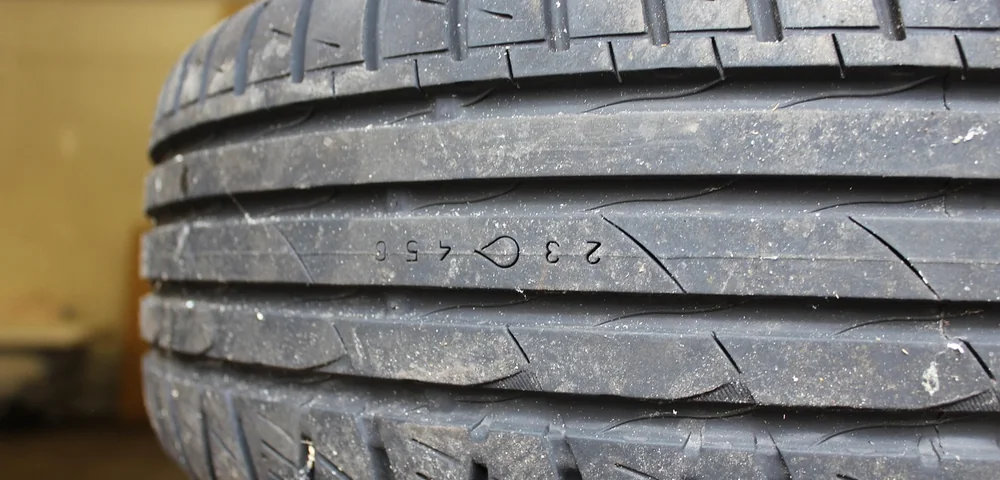
Tire feathering is a wear pattern where the edges of each tread block are sharp on one side and rounded off on the other, so the tire feels smooth when you run your hand from the inside edge toward the outside edge and rough running the other direction. It’s almost always caused by incorrect toe alignment, and it gets worse the longer you drive on it. Catch it early with a tread-depth gauge or even your bare hand, correct the alignment, and the tire can usually be saved. Ignore it, and you’ll be shopping for a replacement set thousands of miles before you should have had to.
What Is Tire Feathering & How to Spot It
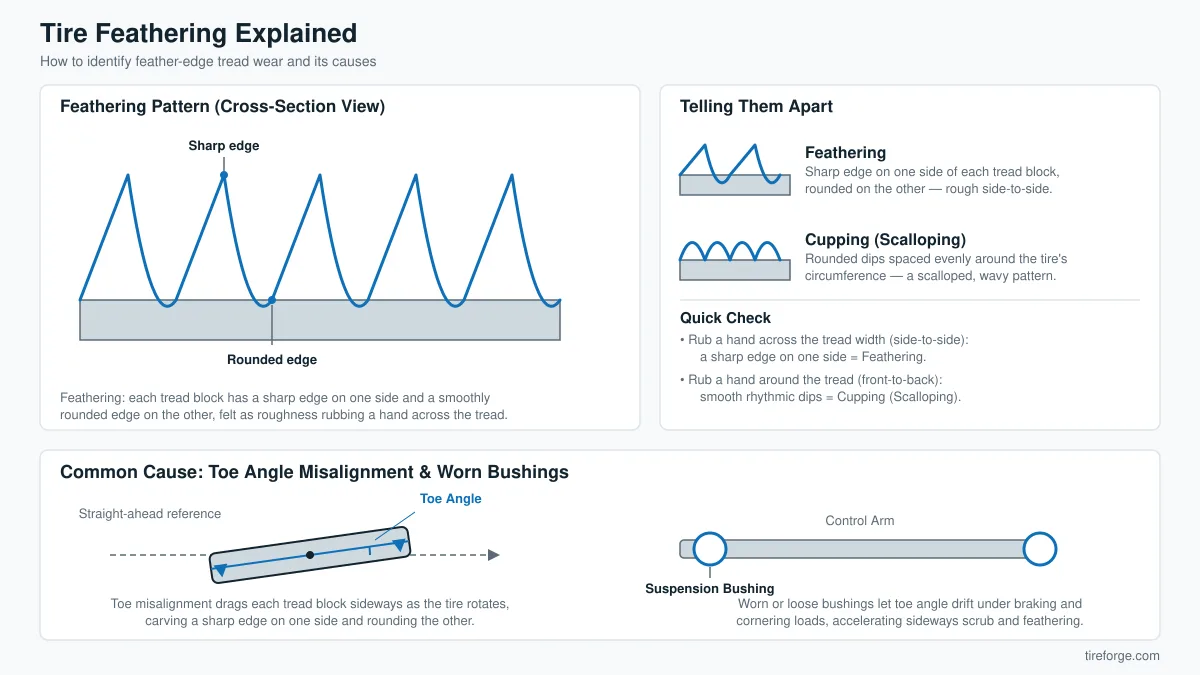
Feathering shows up as a saw-tooth pattern across the tread blocks, most commonly on the front tires of front-wheel-drive and all-wheel-drive vehicles. Each individual tread lug develops a sharp, angular edge on one side and a smoothed, rounded edge on the opposite side, because the tire is being dragged sideways slightly as it rolls instead of rolling straight.
The easiest way to detect it is tactile, not visual. Run your palm flat across the tread, moving from the inboard edge of the tire toward the outboard edge, then reverse direction. A feathered tire will feel noticeably smoother in one direction and catch on your skin in the other, almost like petting a cat backward. Visually, feathering can be subtle on all-season tires with small tread blocks and more obvious on tires with large, open shoulder blocks like all-terrain or performance tires.
You’ll often notice secondary symptoms before you ever touch the tread: a faint hissing or humming road noise that builds with speed, slightly reduced fuel economy from the added rolling resistance, and sometimes a vague, wandering feel in the steering. If you’re already in the habit of checking tire tread depth monthly, add a hand-feel check across the tread at the same time — it takes ten seconds and catches feathering long before it’s visible from three feet away.
Feathering vs Cupping vs Scalloping
These three wear patterns get confused constantly because they all produce noise and uneven tread, but they come from different root causes and need different fixes.
Feathering
Feathering is directional: smooth one way, sharp the other, across each tread block. It’s caused almost exclusively by toe misalignment — the tire is scrubbing sideways as it rolls forward.
Cupping (Scalloping)
Cupping, sometimes called scalloping, shows up as dish-shaped dips spaced around the circumference of the tire, usually every few inches. It feels bumpy in every direction, not smooth-then-rough like feathering. Cupping is a suspension problem: worn shocks or struts, bad bearings, or a tire that’s out of balance, causing the tire to bounce and hop rather than maintain constant contact with the road.
Telling Them Apart
| Pattern | Feel | Primary Cause | Typical Location |
|---|---|---|---|
| Feathering | Smooth one direction, rough the other | Toe misalignment | Across tread block edges, often one axle |
| Cupping/Scalloping | Bumpy in all directions | Worn shocks/struts, bad balance, loose bearings | Scattered dips around circumference |
| Edge wear (one-sided) | One shoulder worn more than the other | Camber misalignment | Inner or outer shoulder only |
A technician diagnosing wear should always check both the feel and the pattern location before quoting a repair, since an alignment won’t fix worn struts and a strut replacement won’t fix bad toe.
Common Causes: Alignment, Toe Angle & Bushings
Toe angle is the single biggest contributor to feathering. Toe describes whether the front edges of a pair of tires point slightly inward (toe-in) or outward (toe-out) relative to each other when viewed from above. A small amount of toe is specified by every manufacturer and is usually measured in fractions of a degree, but even a tenth of a degree outside spec causes the tire to scrub sideways continuously as it rolls, which shaves the tread blocks unevenly in exactly the feathered pattern described above.
Toe goes out of spec for a handful of common reasons. Hitting a pothole or curb hard enough to bend a steering or suspension component is the most sudden cause. Worn tie rod ends and loose tie rod adjusting sleeves let toe drift over time even without an impact. Worn control arm bushings allow the whole suspension corner to shift position under load, changing toe dynamically as you accelerate, brake, and corner — this is a sneaky cause because the alignment can measure fine on a static rack and still feather on the road. Aftermarket lift kits and lowering kits that don’t include corrected alignment components are another frequent culprit, especially on trucks and SUVs that see plus-sized wheel and tire upgrades.
Camber and caster problems can contribute to feathering too, though they more commonly cause one-sided shoulder wear on their own. In practice, feathering is rarely caused by a single bent part — it’s usually a combination of slightly worn bushings, a tie rod with a little play, and toe that’s crept a few hundredths of a degree out of spec, all adding up to enough lateral scrub to feather the tread within a few thousand miles.
Is Feathering Dangerous to Drive On?
Mild feathering isn’t an emergency, but it’s not harmless either, and it compounds the longer you ignore it. The immediate risks are reduced grip and faster tread loss. A feathered tire has less usable, flat-contact rubber meeting the road at any given instant, which modestly increases stopping distances on wet pavement and reduces steering precision, especially noticeable during quick lane changes or emergency maneuvers.
The bigger danger is what feathering tells you about the rest of the vehicle. Since toe misalignment and worn steering components cause feathering, a feathered tire is a visible symptom of an underlying mechanical issue that can also affect handling predictability, especially during hard braking or in a tire blowout scenario where precise steering input matters most. A loose tie rod end severe enough to cause rapid feathering can, in worst cases, fail completely.
From a cost standpoint, feathering accelerates tread wear significantly — a tire that should last 60,000 miles can be bald at the shoulders or center within 15,000–20,000 miles if the toe problem isn’t corrected. Driving on a feathered tire doesn’t usually cause sudden failure the way a sidewall bulge or deep puncture would, but it does mean you’re burning through tread life and fuel economy for every mile you delay the fix. Treat noticeable feathering as a