
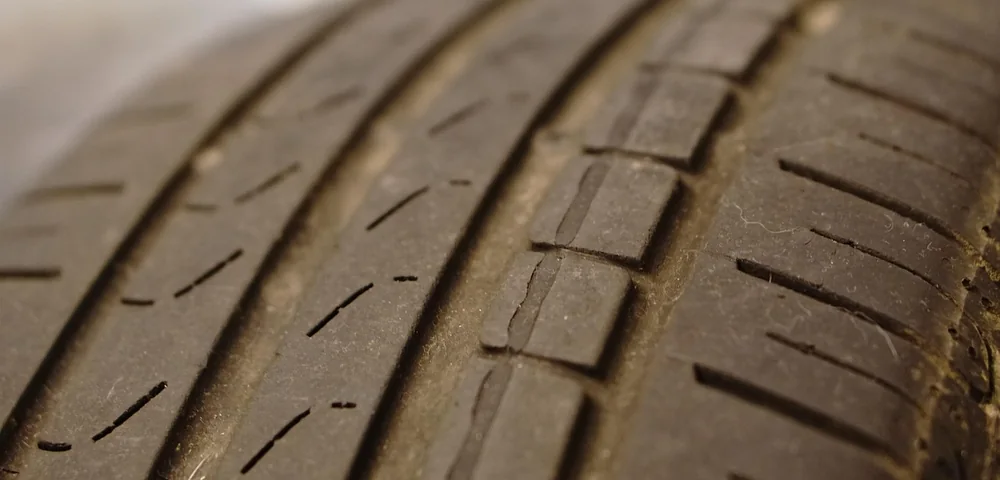
Skip tire rotations long enough and the consequences show up in four predictable places: your tread wears unevenly, your handling and braking get worse, your warranty claim gets denied, and your fuel bill creeps up. None of this happens overnight, which is exactly why it’s so easy to ignore. But by the time you notice a problem, you’ve usually already lost thousands of miles of usable tread and real safety margin. Here’s exactly what goes wrong, in order, and how to fix it if you’re already behind.
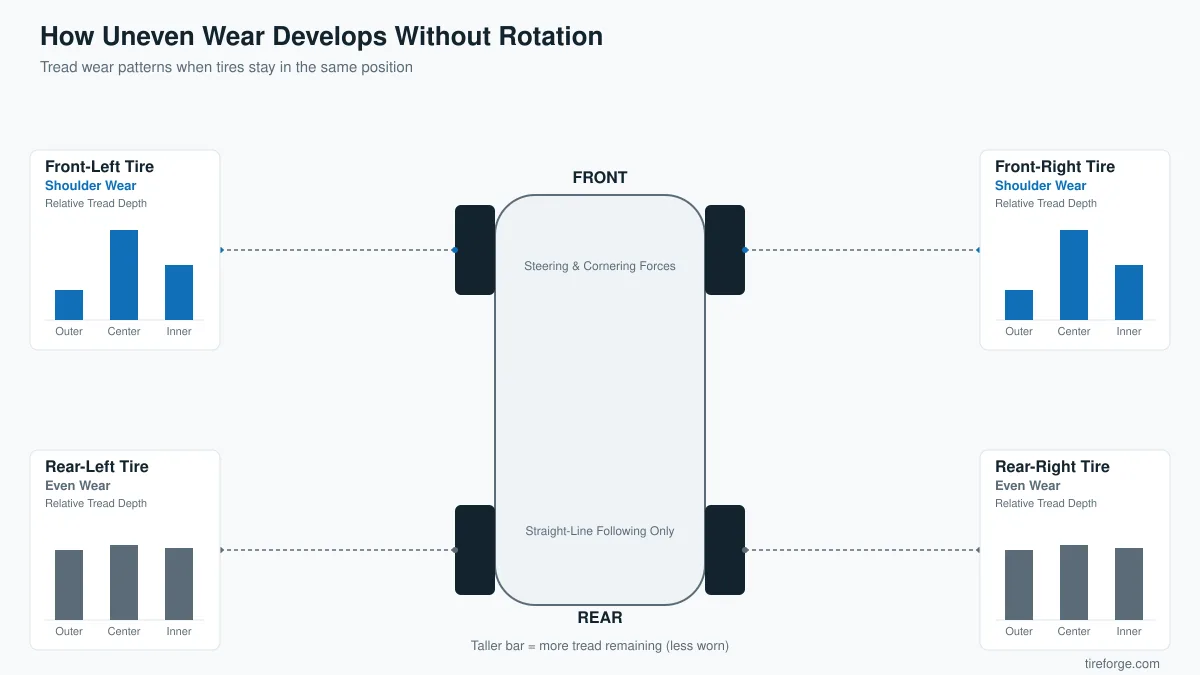
How Uneven Wear Develops
Every tire position on your car carries a different load and does a different job. Front tires handle steering, braking weight transfer, and (on front-wheel-drive cars) acceleration torque — so they wear faster and in different patterns than rear tires. On most vehicles, front tires wear down 20-40% faster than rears because they do more of the work. Add in factors like camber, toe alignment, and road crown, and each of the four positions develops its own signature wear pattern: feathering on the edges, cupping from suspension harmonics, or center wear from overinflation.
Rotation exists to average out these differences before they become permanent. When you never rotate, the wear patterns at each corner just keep compounding in the same direction. A front tire that’s wearing on its outer edge due to slight camber or hard cornering will keep wearing that way until the tread is gone on that edge, even while the rest of the tire still has life left. This is the core answer to what happens if you don’t rotate your tires: you don’t get even wear that happens to be a little worse, you get wear patterns that become exaggerated and eventually irreversible. For a deeper look at why front and rear tires degrade differently, see which tires wear faster — front or rear.
Impact on Handling & Braking
Uneven tread depth between axles changes how your car responds, and not in subtle ways. If your front tires wear faster than your rears (common on FWD cars), you end up with more tread in the back than the front. That mismatch reduces front grip relative to rear grip, which can make the car feel less responsive to steering input and more prone to understeer in corners or during panic braking. In wet conditions, the effect is magnified — a front tire with 4/32″ of tread remaining takes significantly longer to clear water than one with 8/32″, increasing hydroplaning risk right where you need traction most.
Braking distances also suffer. Tires with uneven wear don’t grip the road uniformly across their contact patch, and if cupping or feathering has developed, the tire’s actual contact with the pavement becomes inconsistent under hard braking. Combine this with an existing alignment issue — which unrotated tires often mask rather than reveal — and you can end up with a car that pulls to one side under braking. If you’ve noticed your vehicle pulling, it’s worth reading about why a car pulls when accelerating and how unbalanced tires cause pulling, since neglected rotation is a frequent root cause of both complaints.
Effect on Tread Life & Warranty Claims
Tire manufacturers design treadwear warranties around the assumption that you’re rotating on schedule — typically every 5,000 to 8,000 miles, or at every other oil change. Most warranty paperwork explicitly states that failure to provide rotation records voids mileage warranty coverage. That means if your front tires wear out at 25,000 miles on a tire rated for 60,000, and you can’t produce receipts showing rotation at the recommended intervals, the manufacturer or retailer can — and often will — deny your claim or prorate it unfavorably.
Beyond the warranty paperwork issue, skipping rotation shortens overall tread life even when you ignore the paperwork angle entirely. A tire that wears unevenly reaches its legal/safe tread depth limit (2/32″ in most U.S. states) on its worst section long before the rest of the tire is actually used up. You end up replacing tires — sometimes just one or two, sometimes all four for even handling — well before you’ve extracted the mileage you paid for. For more on how this plays out financially and what the paperwork actually requires, see the complete guide to tire warranties. And if uneven wear forces an early replacement decision, should you replace all four tires walks through when a partial replacement is acceptable versus when it causes more problems than it solves.
Fuel Economy Consequences
Uneven tread depth and wear patterns increase rolling resistance in ways that aren’t always obvious from the driver’s seat. A tire with feathered edges or cupping doesn’t roll as smoothly — it generates extra vibration and scrub as it rotates, and that lost energy has to come from somewhere, which means the engine works harder to maintain the same speed. Independent fuel-economy testing by tire manufacturers and consumer groups has generally found that neglected tire maintenance (including rotation, alignment, and inflation) can cost several percentage points of fuel economy over time.
It’s rarely one single rotation-skipping incident that tanks your MPG; it’s the cumulative drag of a car running on four tires that are all wearing differently, combined with the alignment drift that often goes unnoticed alongside it. Drivers who skip rotations for 30,000+ miles commonly report noticing a fuel economy dip only after they finally replace tires and alignment is corrected — at which point the improvement feels dramatic, simply because the baseline had degraded so gradually. The lesson: fuel economy loss from skipped rotations is real but sneaky, which is exactly why it’s easy to attribute to gas prices or driving habits instead of tire condition.
Signs You’ve Skipped Rotations Too Long
There are clear physical tells that rotation has been neglected for too long, and catching them early can still save you money:
- Visible tread depth difference axle-to-axle: Use a tread depth gauge or the penny test on all four tires. A difference of more than 2/32″ between front and rear is a strong signal.
- Cupping or scalloped wear: A wavy, scooped pattern around the tire’s circumference, often accompanied by a humming or rhythmic noise at speed.
- Feathered edges: Tread blocks that feel sharp on one side and rounded on the other when you run a hand across them — a classic alignment-plus-no-rotation symptom.
- Vibration at highway speed: Often from a tire that’s worn unevenly enough to throw off balance, even if it was balanced correctly when installed.
- One tire noticeably louder than others: Uneven wear changes the tire’s noise signature; a front tire with aggressive edge wear can generate a distinct drone.
- Steering pull or wander: Especially noticeable on uncrowned roads or during braking, as described above.
If you’re seeing two or more of these signs, don’t just rotate and move on — get an alignment check at the same time, since unrotated tires often hide an alignment problem that’s been quietly accelerating the wear the whole time.
How to Get Back on Track
The good news is that catching the problem late doesn’t mean you’re out of options — it just means the fix needs to be more deliberate than a routine rotation. Start with a full tread depth measurement at all four positions, ideally at the inner, center, and outer edges of each tire, not just one spot. This tells you whether the wear is axle-based (rotate and monitor), edge-based (alignment issue), or cupped (suspension component, often a worn shock or strut).
Next, get an alignment performed before you rotate, not after — rotating tires onto a misaligned suspension just moves the uneven-wear problem to a new corner of the car instead of fixing it. Once alignment is confirmed, rotate using a pattern appropriate for your drivetrain (front-to-back for non-directional tires, X-pattern for many FWD cars, side-to-side for directional tires) and reset your schedule going forward — every 5,000-8,000 miles, or at every other oil change, logged somewhere you can actually find later. If you’re doing this yourself without a full lift, rotating tires with one jack is a practical guide worth following so you don’t skip corners out of convenience.
Finally, be honest about tires with wear differences greater than 4/32″ between positions — in that range, rotation alone won’t equalize things, and you may be better off replacing the most-worn tires or all four, depending on remaining life and your budget. The best practices guide for tire rotation covers interval recommendations in more detail if you want a maintenance schedule to build around going forward.
Frequently Asked Questions
How long can I go without rotating my tires before it becomes a real problem?
Noticeable uneven wear can start within 6,000-10,000 miles on many vehicles, especially FWD cars or those with slightly aggressive alignment settings. Beyond 15,000-20,000 miles without rotation, wear differences are often severe enough to be irreversible without replacement.
Can I fix uneven wear just by rotating late?
Rotation only helps even out wear that hasn’t progressed too far. Once one tire’s tread depth is significantly lower than the others (generally more than 3-4/32″ difference), rotating won’t restore lost life — it just redistributes the problem.
Does skipping rotation void my tire warranty even if the tire fails for another reason?
It depends on the manufacturer and the failure type. Workmanship and defect warranties are usually unaffected, but treadwear mileage warranties almost always require proof of rotation at recommended intervals, so skipping it puts that specific coverage at risk.
Is rotation less important for all-wheel-drive vehicles?
It’s actually more important. AWD systems can be damaged by tires with different circumferences caused by uneven wear, since the drivetrain expects all four wheels to rotate at consistent relative speeds. Some AWD manufacturers specify tighter tread-depth-difference tolerances than conventional FWD or RWD vehicles.