
The fastest way to measure tire tread depth is to insert a tread depth gauge (or a coin) into the tire’s main grooves at three spots — inside, center, and outside edge — and read the shallowest measurement. If it’s at or below 2/32 inch, the tire is legally worn out and needs to be replaced regardless of how it looks otherwise. Everything below explains why that number matters and how to get an accurate reading using tools you almost certainly already have.
Why Tread Depth Matters for Safety
Tread grooves exist to channel water, slush, and debris away from the contact patch so rubber can actually touch pavement instead of hydroplaning on top of a film of water. As tread wears down, those channels get shallower and can no longer move water fast enough, especially at highway speeds. Studies from tire manufacturers and safety agencies consistently show stopping distances on wet pavement increase dramatically once tread drops below about 4/32 inch, and the effect accelerates as depth approaches 2/32 inch.
A tire with 8/32 inch of fresh tread might stop a car in roughly 300 feet from 60 mph on a wet road. The same tire worn to 2/32 inch can need well over 400 feet in the same conditions — that’s more than an extra car length of stopping distance you don’t have in an emergency. This is also why tire pressure and tread depth work together: even a properly measured tread depth can’t compensate for underinflation, which is why it’s worth pairing tread checks with a look at your highway tire pressure setup. Bald or near-bald tires also lose their resistance to punctures and sidewall damage, since there’s less rubber buffer between the road and the internal belts.
The Penny Test Step-by-Step
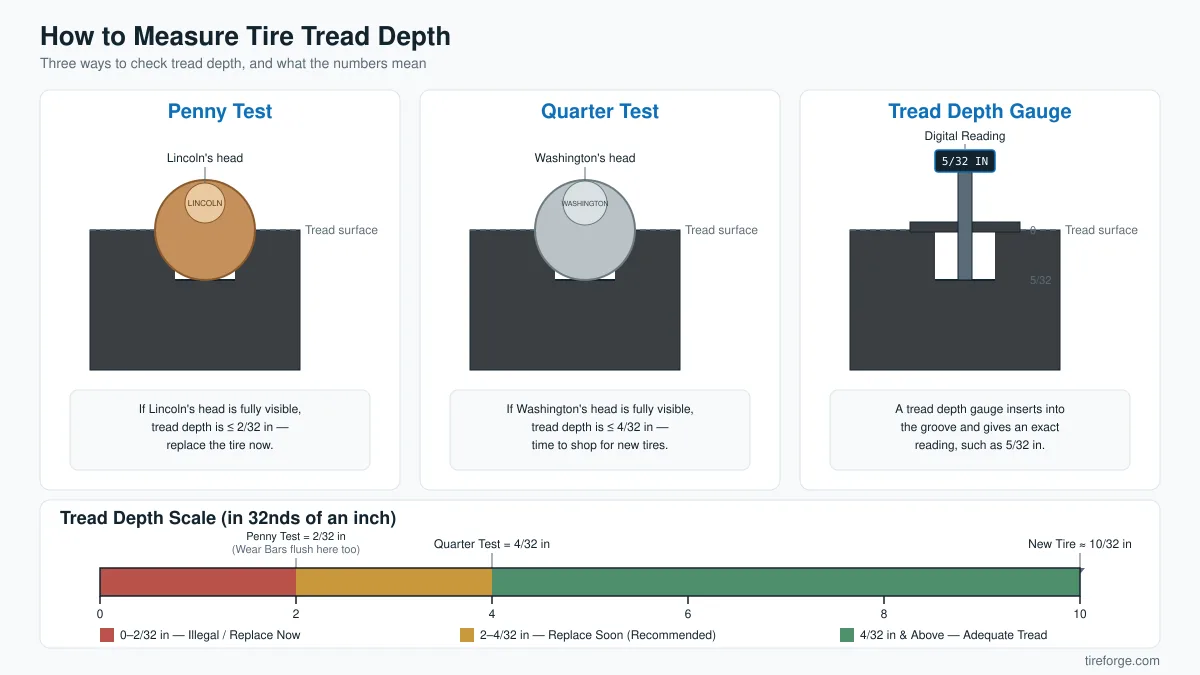
The penny test is the classic DIY method, and it still works because Lincoln’s head on a US penny sits at a known, consistent height. Here’s how to do it correctly:
- Grab a penny and hold it with Lincoln’s head facing you, upside down.
- Insert it into a tread groove at several points across the tire — not just one spot.
- If part of Lincoln’s head is always covered by tread, you have more than 2/32 inch remaining.
- If you can see all of his head, no matter where you insert the penny, the tire is at or below 2/32 inch and needs replacing.
The most common mistake is testing only the center of the tread. Tires wear unevenly — inner and outer edges often wear faster than the center due to alignment issues or camber wear, or vice versa with underinflation. Always check the inside edge, center, and outside edge of each tire, and check all four tires, not just the ones that look worn. If you notice one tire wearing much faster than its opposite, that’s often a sign of an alignment problem, which is also a common cause of a car pulling to one side.
The Quarter Test for More Precision
The penny test only tells you when a tire has hit the legal minimum — it doesn’t tell you how much useful life is left before that point. The quarter test fills that gap using George Washington’s head, which sits at a height corresponding to about 4/32 inch.
To do it, insert a quarter upside down into the tread groove the same way you would a penny. If the tread covers part of Washington’s head, you have at least 4/32 inch remaining, which is generally considered the threshold for safe wet-weather and winter traction. If his entire head is visible, you’re below 4/32 inch and should start budgeting for new tires soon, especially if you drive in rain or snow regularly.
Many tire shops and safety advocates recommend treating 4/32 inch as your real replacement trigger rather than waiting for the legal 2/32 inch minimum, particularly for vehicles that see winter weather. The quarter test is a good middle checkpoint: run the penny test to confirm you’re not at the hard legal limit, then run the quarter test to see how much margin you actually have left for wet or snowy conditions.
Using a Tread Depth Gauge
Coin tests are useful because they require no tools, but a dedicated tread depth gauge gives you an actual number instead of a pass/fail estimate, which matters if you want to track wear rate over time. Gauges are inexpensive and come in a few styles:
- Simple pen-style gauges with a spring-loaded probe and a sliding scale — accurate and cheap.
- Dial gauges that give a more precise readout, popular with alignment shops and racers.
- Digital gauges with an LCD display, which are easiest to read but need a battery.
To use one, press the base of the gauge flat against the tread blocks on either side of a groove, then push the small probe straight down into the groove until it bottoms out. Read the depth where the probe meets the scale. Take at least three readings per tire (inner, center, outer) and record them — writing measurements down lets you calculate wear rate over a few months and predict roughly when you’ll hit replacement depth. A gauge is also the only reliable way to catch uneven wear patterns early, before they become visible to the eye, such as the scalloped wear associated with tire cupping.
Minimum Legal Tread Depth by State
In the United States, the federal baseline for legal tread depth is 2/32 inch across most states, measured at the shallowest point of the major tread grooves. However, a handful of states have adopted different thresholds or additional rules, and some require different minimums for steer axles on commercial trucks versus other positions. Because these rules can be updated by state legislatures, always confirm current requirements with your state’s DMV or department of transportation before an inspection, rather than relying on a fixed number that may have changed.
| Requirement Type | Typical Minimum | Notes |
|---|---|---|
| Passenger vehicle (most states) | 2/32 inch | Federal baseline standard |
| Commercial truck steer tires | 4/32 inch | Stricter due to higher load and steering demands |
| Commercial truck drive/trailer tires | 2/32 inch | Same as passenger baseline in most jurisdictions |
| States with annual safety inspections | 2/32 inch (checked at inspection) | Failing inspection typically requires immediate replacement |
Even where 2/32 inch is technically legal, it’s the bare minimum for avoiding a citation — not a safety recommendation. Treat it as the point of no return, not a target.
Tread Wear Indicator Bars Explained
Every modern tire also has built-in wear indicators, so you don’t have to rely solely on coins or gauges. These are small raised bars molded into the bottom of the main tread grooves, spaced at intervals around the tire. As the tread wears down, these bars stay the same height while the surrounding rubber wears away, so they become flush with the tread surface once the tire reaches 2/32 inch remaining.
To find them, look for small triangle or arrow markers on the tire’s sidewall near the edge of the tread — these point to where the wear bars sit inside the grooves. Run your finger or eye down that groove and you’ll see the raised bar bridging across it. When the bar is flush with the surrounding tread blocks, that tire is legally worn out at that location.
The advantage of wear bars is speed — you can do a quick visual walk-around without any tools. The downside is they only confirm the 2/32 inch legal minimum, similar to the penny test, and they don’t tell you if you’re approaching that point. Use wear bars for quick monthly checks, and pull out a gauge or quarter periodically for a more precise picture, especially before a long road trip or before winter sets in.
When to Replace Based on Depth
Tread depth alone should drive your replacement decision more than tire age or appearance in most cases, though age matters too — rubber compounds degrade over time even with tread left, which is a separate consideration from wear. As a general framework:
- 8/32 to 6/32 inch: Tire is in good shape; continue normal rotation and pressure checks.
- 6/32 to 4/32 inch: Wet traction is starting to decline; a good time to start shopping and comparing tires so you’re not rushed later.
- 4/32 to 3/32 inch: Replace before winter or before any trip through heavy rain; snow traction is significantly compromised below this point.
- 2/32 inch or below: Legally worn out and unsafe; replace immediately.
Don’t wait until all four tires hit the same depth to replace them together unless they’re actually wearing evenly — mismatched tread depth front to rear can affect handling balance, and mismatched side to side can indicate an alignment issue worth fixing before new tires go on. If you’re unsure whether uneven wear is covered under a manufacturer defect versus normal wear, it’s worth reviewing how tire warranties typically handle wear-related claims before you buy replacements. And if a low-tread tire develops a leak on top of being worn, don’t bother patching it — check whether the damage is repairable first, since tires below 2/32 inch generally shouldn’t be repaired and returned to service anyway.
Frequently Asked Questions
Is the penny test actually accurate?
Yes — Lincoln’s head sits at a consistent height corresponding to 2/32 inch, so the penny test reliably identifies when a tire has hit the legal minimum. It just doesn’t give you a precise number above that threshold the way a gauge does.
Can I mix the penny and quarter tests on the same tire?
Absolutely, and it’s a smart approach: use the penny test to confirm you’re above the legal minimum, then the quarter test to see if you’re still above the safer 4/32 inch threshold for wet and winter traction.
How often should I check tread depth?
Check monthly, or before any long road trip, and always before winter weather arrives. Pairing tread checks with routine pressure checks takes only a few minutes and catches problems early.
Do all four tires wear at the same rate?
Not usually. Front and rear tires often wear differently based on drivetrain layout, and alignment or suspension issues can cause one side to wear faster. That’s why measuring all four tires at multiple points is important rather than checking just one.
Does tread depth affect fuel economy?
Slightly — worn tires can actually improve fuel economy marginally due to reduced rolling resistance, but this is never worth the tradeoff in wet-weather safety and stopping distance.