

Garage tire storage doesn’t have to be complicated, but doing it wrong can shave real life off a set of tires before they ever touch the road again. Storing tires safely is especially important for drivers who swap between summer and winter sets instead of running all-season tires year-round.
Contrary to what most people expect, you can’t just dump your tires in any corner of the garage and assume they’ll retain their performance the next time you mount them. Heat, humidity, UV light, and improper positioning all accelerate rubber degradation.
Thankfully, safely storing tires in a garage is easy once you have the right tools. This guide covers the top rules for garage tire storage, the 12 most popular products that are both effective and economical, and answers to the questions readers ask most.
Quick Answer: The Best Way to Store Tires in a Garage
Store unmounted tires upright in a cool, dry, dark area away from direct sunlight, heaters, and ozone-producing equipment (like furnaces or electric motors). Rotate them monthly to prevent flat-spotting, and use a wall mount, dolly, tire rack, or breathable cover to keep them off bare concrete. Mounted tires can be stacked or hung instead.
Storing Tires in a Garage – Top Rules!
The right way to store tires depends on several factors: whether the tires are mounted or unmounted, the available space you have, local climate, and how long they’ll sit before use.
Upright Position Is the Better Way to Store Unmounted Tires
Tire manufacturers generally recommend storing unmounted tires in an upright position. Since they don’t have a wheel attached, they won’t roll away for a long distance.
You should also reposition the tires roughly once a month. Doing so helps ensure that the tires don’t get affected by flat-spotting and remain in top condition, since the weight of an unused tire resting on one spot for months can cause a temporary (and sometimes permanent) flat area on the tread.
Stacking Unmounted Tires Is a No-Go
Another important thing to remember is to never stack unmounted tires on top of each other.
This is often the first instinct for many people because it saves space, and it’s a shortcut you’ll sometimes see in busy tire shops.
However, stacking unmounted tires puts a lot of pressure on the sidewall at the point of contact, which can distort the tire’s shape over time and shorten its usable life.
Mounted Tires Can Be Stacked or Hung
Storing mounted tires is quite different. The wheel and rim can bear the load, so the sidewall isn’t doing all the work.
So you can safely stack mounted tire-and-wheel assemblies or hang them from a rack.
It is, however, not recommended to store them upright without securing them. Mounted tires are heavier and can roll for long distances if they tip over, which can be dangerous in a garage with people, pets, or vehicles nearby.
How Climate and Humidity Affect Tire Storage
Where and how you store your tires matters almost as much as the rack or cover you choose. Rubber compounds naturally harden and lose flexibility over time, a process called oxidative aging, and heat, humidity, UV exposure, and ozone all speed it up.
- Temperature: Aim for a cool, stable environment. Avoid attics, uninsulated sheds, or spots near furnaces, water heaters, or electric motors, which generate ozone that attacks rubber.
- Humidity: Excess moisture can promote mold and accelerate rubber breakdown, while very dry conditions can cause rubber to crack. A dry garage with some airflow is ideal — avoid sealing tires in airtight plastic without ventilation for long periods.
- Sunlight and UV: Direct sunlight and fluorescent lighting both emit UV rays that degrade rubber and cause fading or cracking. Store tires in a dark area or cover them.
- Contact surface: Avoid letting tires sit directly on bare concrete for extended periods, especially in damp climates — a pallet, mat, or rack keeps them off the slab.
Most tire industry guidance suggests that properly stored tires can last many years before age-related hardening becomes a safety concern, but even unused tires should be inspected regularly for cracking, and most manufacturers recommend replacing tires around the 6 to 10-year mark from their manufacture date regardless of tread depth.
Products for Safely Storing Tires in Any Garage
Safely storing tires in your garage isn’t difficult, but most garages have limited space, and you can’t fill the entire area with spare tires.
Fortunately, a number of products can help you deal with this issue while keeping your tires in good shape.
The four most popular solutions that take up limited space and work well for garage tire storage are:
- Wall mounts
- Tire dollies
- Tire covers
- Overhead tire hangers
The following sections cover the main advantages and disadvantages of each solution, along with some well-reviewed options worth considering. As always, check current listings for availability and pricing before buying, since products and specs can change.
Wall Mounts
Wall mounts are an excellent solution for safely storing tires whether they’re mounted or unmounted. If you’re storing tires for more than one car, they can be a lifesaver.
You’ll easily be able to organize and identify the tires you want. It’s also quite simple to load a tire onto a wall mount, and the best part is that you won’t have to spend a lot of money to get one set up.
Here are some well-regarded wall mounts worth comparing.
1. HyLoft 01031 Folding Storage


HyLoft 01031 is one of the most popular wall mount choices on the market. The wall mount is well suited for storing seasonal tires and keeping them in good condition.
HyLoft 01031 is easy to install and rated to hold roughly 300 to 400 lbs. Made from steel with scratch resistance, it’s designed for long-term garage use.
Pros
- Scratch-resistant
- Can hold around 300 lbs easily
- Saves space in home garages
Cons
2. MAXXHAUL 70489 Adjustable Wall Mount

MAXXHAUL 70489 is another well-recommended wall mount. It’s built from heavy-duty steel tubing and can easily hold up to 4 standard tires.
For convenience, the wall mount folds up, letting you save space when it isn’t in use.
Pros
- Easy to install
- Adjustable tire rack
- Lightweight
Cons
- Steel tubes can sag if used for heavy tires
3. FibreHead FH-4WH Flush Wheel Hangers

If you’re looking for an understated wall-mount alternative, FibreHead FH-4WH is worth a look. The mounting hardware is designed to be minimally intrusive, keeping your garage wall looking clean.
FibreHead lets you configure the mounts to your liking so you can use wall space more effectively.
Pros
- Each mount is rated for roughly 120 lbs
- Made with heavy-duty stainless steel
- Hardly noticeable when unused
Cons
- Installation is slightly more time-consuming compared to alternatives
4. Steel Wall Mount Folding Tire Rack

This wall mount is a good choice if you want something simple that can store seasonal tires safely. It folds up, letting you save space when it isn’t in use.
With adjustable width, it can be customized to fit your storage needs.
Pros
- Durable steel bars
- Easy to install
- Functional wall mount
- Good value for money
Cons
- Some customers have reported difficulty adjusting the lower bars
5. Rolling Tire Rack

Finding a wall mount for a single car’s worth of tires is easy, but what happens when you need to store seasonal sets for two cars?
That’s where a rolling tire rack steps in. Instead of buying two wall mounts, a rolling rack like this can store and accommodate up to 8 tires in one footprint.
Many of these racks come with a protective cover to help shield the tires from dust, rain, sunlight, and corrosion.
Pros
- Compact design
- Heavy-duty and durable steel
- Waterproof protective cover
- Caster wheels
Cons
- Lower rack level can’t fit tall tires
Tire Dollies
If you love working on your car or run a workshop, a tire dolly is a handy addition.
Tire dollies make it easy to store and move wheels around a home garage without strain. Most are designed to be stable and durable enough to handle the weight of several tires at once.
The following are some of the better-reviewed tire dollies on the market.
6. MaxxHaul 80746 Tire Dolly

One of the first recommendations you’ll get when it comes to tire dollies is the MaxxHaul 80746.
Rated to handle around 300 lbs, this dolly is built with molded polyethylene for durability and strength. It can typically handle around five tire-and-wheel assemblies, or more loose tires stacked without wheels.
Pros
- Can rotate 360 degrees for added maneuverability
- Small and compact design
- Built-in storage for ease of use
Cons
- Large tires can hang off the frame
7. Adjustable Tire Wheel Dolly

Another popular choice among customers is the adjustable tire wheel dolly.
This heavy-duty tire dolly is made with durable steel suitable for shop use.
It’s easily adjustable and rolls on 3-inch nylon casters capable of handling up to 4 standard tires.
Pros
- Extendable to roughly 32.5″
- Convenient design
- 3″ wheels allow the dolly to be moved around easily
Cons
- Heavier than some alternatives
8. John Dow Industries JDI-TT1-HD

When it comes to heavy-duty tire dollies, John Dow is another popular choice. Measuring around 31.4″, it can hold up to 4 tire-and-wheel assemblies.
It’s built to ease the transport of tires and can be stored efficiently since multiple units stack together.
Pros
- Comes with a locking caster
- Built-in tool tray
Cons
- Pricier than many other dollies
Tire Covers
Tire covers are exactly what they sound like — a simple, affordable way to store your seasonal tires. You can also use them to protect the tires currently mounted on your car when parked for extended periods.
Tire covers help block UV exposure and moisture, which supports longer tread and sidewall life.
The following are some notable tire covers on the market.
9. Kurgo Seasonal Tire Tote
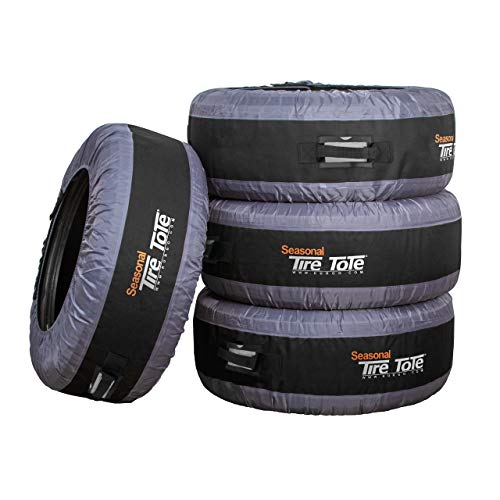
The Kurgo Seasonal Tire Tote is a solid choice.
It includes a handle to let you easily lift and move the tire, along with an adjustable fit so it can accommodate various tire sizes.
Pros
- Backed by a lifetime warranty
- Durable material protects tires from the elements
- Stackable for efficient storage
Cons
- Included ID card slots can feel loose
10. SoGuDio Tire Storage Cover

No tire cover is perfect, but the SoGuDio tire storage cover comes close. It’s designed to hold up to 4 tires stacked together for compact storage.
The cover is made of 420D silver-coated Oxford material, which adds durability and tear resistance.
It helps protect tires against rain, dust, and sun damage.
Pros
- Includes 2 strong handles for convenience
- Shrink- and stretch-resistant
- Zipper for easy access
Cons
- Standard warranty period is relatively short
11. Heininger 5392 Large GarageMate

Heininger 5392 is a popular choice for many customers. This heavy-duty tire cover comes in multiple sizes and is an inexpensive addition to your garage. The largest size fits tires up to about 30″ in diameter.
It’s simple to install and includes a convenient zipper closure.
Pros
- Includes drawstrings for convenience
- Comes with a storage bag for the cover itself
Cons
- Hand-wash only
Overhead Garage Storage
If efficient use of space is your biggest concern, an overhead garage storage rack is a great fit.
Even with limited floor space, utilizing the ceiling gives you a dedicated spot for tires and other bulky items without crowding the garage.
The following is one of the best-known overhead garage storage racks currently available.
12. FLEXIMOUNTS 4×8 Overhead Garage Rack

The Fleximounts 4×8 overhead garage rack balances safety and functionality well. With ample vertical support and a large contact surface, you can store multiple items securely.
The wide wire deck and frame are designed for maximum stability and provide plenty of space for storage.
You can even expand storage capacity using compatible hooks and clamps to hang frequently used items.
Overall, this overhead rack offers an impressive load capacity around 600 lbs and is a strong option for anyone serious about reclaiming garage floor space.
Pros
- Expandable storage space
- Good option if you’re concerned about flood damage to floor-stored items
- Adjustable height, roughly 22″ to 40″ from the ceiling
- High-quality hardware
Cons
- Installation can take a while
Garage Tire Storage FAQ
Should tires be stored vertically or horizontally?
For unmounted tires, vertical (upright) storage is generally better. It avoids concentrated weight on one section of the tire and helps preserve its round shape. Mounted tire-and-wheel assemblies can be stacked horizontally since the wheel supports the load.
Should tires be stored in bags?
Storing tires in bags designed specifically for tire storage is fine and often helpful, since they block UV light and limit dust and moisture exposure.
If you use a general-purpose bag instead, clean the tires first and remove as much trapped air as possible, and make sure the bag still allows some airflow rather than sealing in moisture completely.
Is it bad to stack tires?
Stacking mounted tire-and-wheel assemblies is fine. For unmounted tires, it’s best to avoid stacking them for long periods; if you must, place a protective barrier such as cardboard or a towel between them and keep the stack aligned and low.
Is it better to store tires inflated or deflated?
For tires still mounted on wheels, it’s generally fine to leave them at normal operating pressure, or slightly reduced, rather than fully deflating them — full deflation isn’t necessary and can make the bead seat less secure. For unmounted tires (no wheel), there’s no pressure to maintain at all. If you’ve heard advice to reduce pressure before long-term storage, check your tire manufacturer’s specific guidance rather than assuming a fixed percentage, since recommendations can vary by tire type and storage duration.
How long can tires sit in storage before they go bad?
Even with ideal storage conditions, rubber ages over time. Most tire manufacturers recommend inspecting tires for cracking after about 5 years and replacing them by around 6 to 10 years from their manufacture date (found on the sidewall), regardless of remaining tread depth.
Final Thoughts
Safely storing tires can seem complex at first. There are several factors to balance — protecting tires from heat, humidity, and UV exposure while also making efficient use of limited garage space.
With the tools covered here, and a cool, dry, dark storage spot, you can keep your seasonal tires in great shape while keeping your garage organized.