
If you’re wondering whether to cross your tires corner-to-corner or keep them running on the same side, the short answer is this: non-directional tires on a front-wheel-drive car usually want a crossed pattern (forward cross or X-pattern), rear-wheel-drive and AWD vehicles often do better with a rearward cross, and directional tires or staggered fitments are restricted to a straight front-to-back rotation only — or sometimes no rotation at all. The right choice depends on your drivetrain, your tire’s tread design, and whether your wheels are the same size front and rear. Get it wrong and you won’t ruin your tires overnight, but you will accelerate uneven wear, shorten tread life, and in the case of directional tires, you could actually create a safety issue by mounting them backward.
This guide breaks down every pattern, explains why each one exists, and gives you a clear decision path so you’re not guessing the next time your tires go up on the lift.
Why Rotation Pattern Matters
Tires wear unevenly because every corner of a car does a different job. Front tires on a front-wheel-drive car handle acceleration, braking, and steering simultaneously, so they wear 20-40% faster than the rears in typical driving. Rear tires on a rear-wheel-drive car see more wear from acceleration and load transfer under braking. Add in camber settings, road crown, and your own driving habits (hard cornering wears the outer shoulders, heavy braking wears the center), and you get a tire that’s visibly more worn in specific spots after just 6,000-8,000 miles.
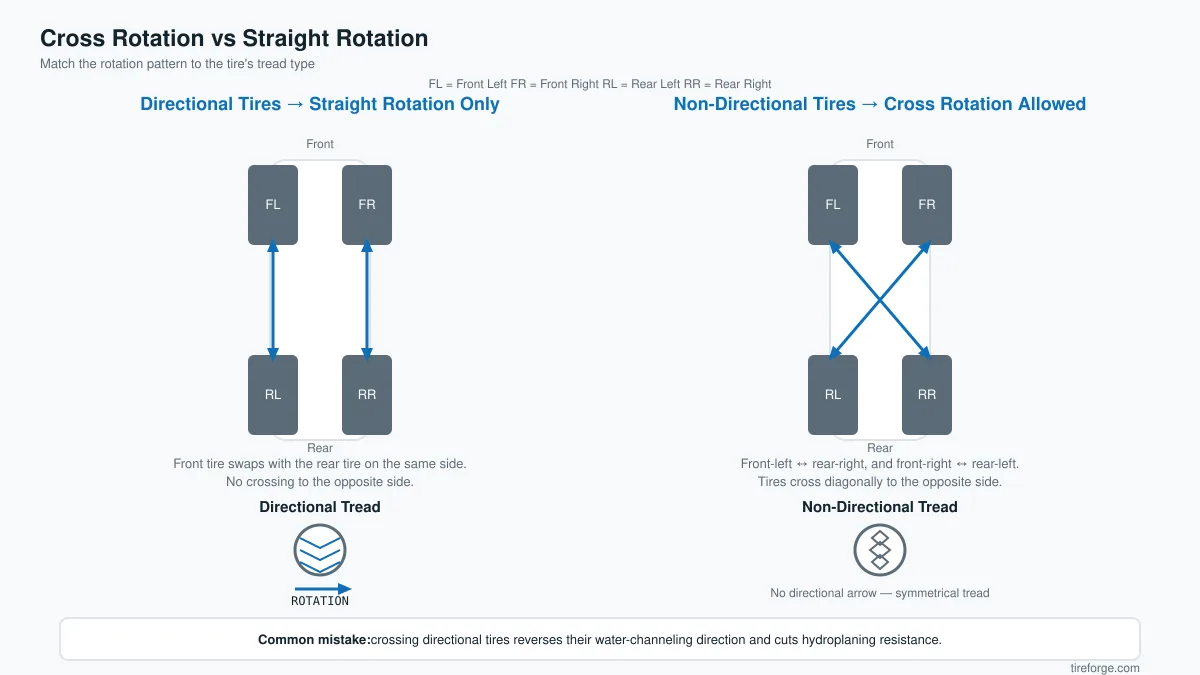
Rotation exists to even that wear out across all four tires so they age together instead of one pair needing replacement years before the other. The pattern you choose determines how effectively that happens. A straight rotation only swaps front-to-back on the same side, which evens out wear from acceleration/braking but does nothing for side-specific wear like camber-related shoulder wear. A crossed rotation moves tires diagonally, exposing each tire to both sides of the car and both axles over its lifetime, which generally produces more uniform wear overall.
Skipping rotation entirely, or using the wrong pattern, is one of the most common reasons people end up buying tires in pairs instead of getting a full set to wear out together. For the mechanics of timing and intervals, see our guide on best practices for tire rotation.
Front-Wheel Drive Rotation Patterns
Most FWD vehicles use the forward cross pattern. The two rear tires move straight forward to the front axle, while the two front tires cross diagonally to the rear axle. This works because FWD front tires wear fastest and most asymmetrically — they handle power delivery, steering input, and most of the braking load. Crossing them to the rear lets them wear differently under reduced stress, while the relatively fresh rear tires move up front to do the hard work.
Here’s the logic in plain terms: front tires tend to wear the outer shoulders from cornering scrub, since front tires turn and rears don’t. Moving a front tire to the rear (same side, no cross) would just continue wearing that same shoulder pattern. Crossing it to the opposite rear corner exposes the tire’s less-worn shoulder to a different set of forces, which balances things out over the tire’s life.
A common mistake is applying rear-wheel-drive rotation logic to a FWD car, or skipping the cross because a shop is in a hurry. Another mistake is assuming all FWD cars use the same pattern regardless of tire type — if the tires are directional, the forward cross is not allowed, because it would mount the tread facing the wrong rotational direction. We’ll cover that distinction in detail further down. Always check your owner’s manual first; some manufacturers specify a pattern that overrides the generic rule based on their particular suspension geometry.
Rear-Wheel & AWD Rotation Patterns
Rear-wheel-drive and most AWD vehicles use the rearward cross, which is essentially the forward cross in reverse. The front tires move straight back to the rear axle, while the rear tires cross diagonally to the front. This matches the wear pattern of RWD/AWD vehicles, where the rear tires typically handle more acceleration force and the front tires do most of the steering-related wear but less overall stress than a FWD front end.
AWD deserves special attention because many systems are far less tolerant of mismatched tire diameters than FWD or RWD. Even a small difference in rolling circumference between tires — from uneven wear, different brands, or mixed tread depths — can put sustained stress on the center differential or transfer case in a full-time AWD system, sometimes leading to expensive drivetrain damage. That’s exactly why AWD vehicles benefit from more frequent rotation (every 5,000 miles rather than 7,500-8,000) and why replacing all four tires together, rather than two, is often the safer long-term call on these platforms.
Some performance AWD vehicles and trucks with significant front/rear weight bias may specify a straight rotation instead of a cross, particularly if they came with staggered wheel widths. Don’t assume; check the manual or the tire placard on the door jamb. A shop defaulting to