
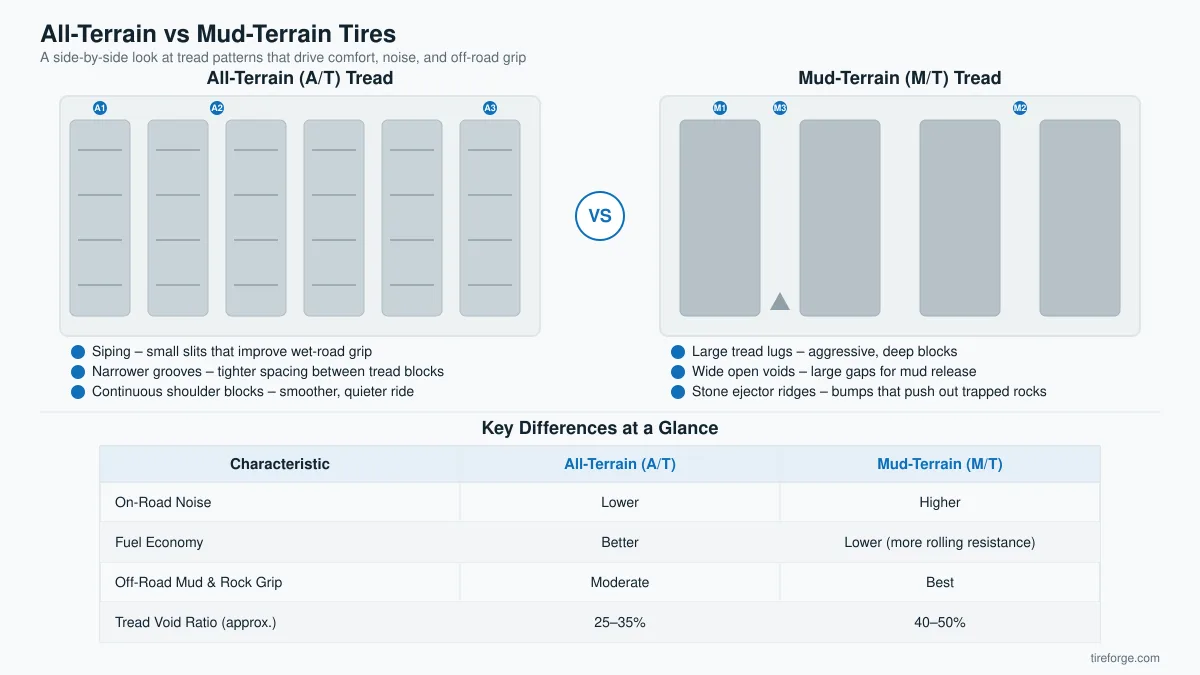
If you’re choosing between all-terrain (A/T) and mud-terrain (M/T) tires, the short answer is this: all-terrain tires are the right call for trucks and SUVs that spend most of their time on pavement with occasional dirt, gravel, or light trail use, while mud-terrain tires make sense if you regularly drive in deep mud, loose rock, or need maximum traction for serious off-roading and can live with more noise, faster wear, and worse fuel economy. The rest of this guide breaks down exactly why, so you can match the tire to how you actually drive instead of how you wish you drove.
Tread Design Differences Explained
The biggest difference between A/T and M/T tires comes down to tread block size, void ratio, and siping. All-terrain tires use a tighter tread pattern with smaller, more numerous blocks and continuous siping (the small slits cut into the tread). This design keeps more rubber in contact with the road at all times, which is what gives A/T tires their stable, car-like feel on pavement. The void ratio — the amount of open space between tread blocks — is moderate, usually enough to evacuate water and loose dirt without sacrificing too much on-road grip.
Mud-terrain tires flip that priority. They use large, aggressive, widely spaced lugs with deep voids between them — often 50% more open space than an A/T pattern. Those gaps are designed to bite into mud and loose rock and then fling debris out of the tread as the tire rotates, a self-cleaning action you can actually hear and feel on a muddy trail. Many M/T tires also add stepped or serrated shoulder lugs that act like paddles for extra traction when the tire is loaded sideways in a rut, plus thicker sidewall lugs for sidewall protection and additional bite when aired down. The tradeoff is that this aggressive geometry creates more road noise, more irregular wear potential, and less consistent contact patch on hard surfaces.
On-Road Comfort & Noise Comparison
This is where most buyers who don’t need an M/T end up regretting the purchase. All-terrain tires, especially ones built in the last several years with computer-optimized tread patterns, are genuinely close to all-season tires in ride quality. Cabin noise is noticeably higher than a touring tire, but it’s a low, consistent hum most drivers adjust to within a week. If quiet highway cruising matters to you, it’s worth comparing specific A/T models, since noise levels vary a lot between brands — our breakdown of quiet all-terrain tires covers which models prioritize cabin comfort without giving up off-road capability.
Mud-terrain tires are a different experience entirely. The large tread voids that make them so good in mud also act like air chambers that generate a droning, sometimes rhythmic roar at highway speed — it’s common for M/T-equipped trucks to be 5-10 dB louder than the same truck on A/T tires, and decibels are logarithmic, so that difference is very noticeable, not subtle. Ride comfort also suffers somewhat because M/T tires typically use stiffer sidewalls for durability and load-carrying, which transmits more road imperfection into the cabin. If you daily-drive your truck and only off-road a few times a year, this noise and harshness penalty is the single biggest reason to stick with an A/T.
Off-Road Performance: Mud, Rock & Sand
All-terrain tires perform well on packed dirt, gravel roads, light snow, and mild trails. Their tighter tread pattern gives decent traction without excessive noise, but in deep mud, the smaller voids clog quickly, turning the tread into a smooth, slick surface with almost no grip. On rocky terrain, most A/T tires lack the thick, reinforced sidewalls needed to resist cuts and punctures from sharp edges.
Mud-terrain tires are purpose-built for exactly those conditions. In deep mud, the aggressive lugs dig past the slick surface layer to find traction underneath, and the open voids self-clean on each rotation instead of packing solid. On rock crawling, reinforced sidewalls with additional lug protection resist sidewall punctures and allow for more aggressive airing down without pinching the tire against a rim edge. In sand, however, M/T tires can actually underperform a properly chosen A/T or dedicated sand tire, because narrow, aggressive lugs tend to dig in and bog the vehicle down rather than float on top of loose sand — flotation depends more on contact patch and tire pressure than lug aggressiveness. The practical takeaway: M/T tires dominate in mud and rock, A/T tires are more balanced across mixed terrain, and neither is automatically best in sand.
Fuel Economy & Wear Differences
Rolling resistance is directly affected by tread design, and this is an area where A/T tires have a clear edge. The tighter, shallower-void pattern of an all-terrain tire creates less squirm and deformation as it rolls, which translates to better fuel economy — typically a noticeable but not dramatic difference, often in the range of 1-3 mpg depending on the vehicle and tire size. Mud-terrain tires, with their deep lugs and large voids, flex more under load and generate more rolling resistance, which shows up at the pump.
Tread life follows a similar pattern. A/T tires are generally designed with wear in mind for daily driving and commonly carry treadwear warranties in the 50,000-65,000 mile range, though actual mileage depends heavily on vehicle weight, alignment, and rotation habits. M/T tires are built primarily for traction and durability off-road rather than longevity on pavement, and their large, unsupported lugs wear faster and less evenly on highway miles — many M/T tires carry little to no mileage warranty at all. A common mistake is buying mud-terrains for a truck that’s driven 90% on the highway; the owner pays for off-road capability they rarely use while burning through tread and fuel faster than necessary.
Which Tire Type Fits Your Driving Style
Be honest about your actual driving mix before choosing. If your truck sees pavement, highway commuting, light gravel roads, occasional snow, and maybe a few trips to a campsite or job site with a dirt access road, an all-terrain tire covers all of that competently without major compromise. This describes the vast majority of truck and SUV owners, even ones who bought their vehicle specifically for its off-road capability.
If you’re regularly driving through standing mud, deep ruts, rocky trails, or need to winch through genuinely difficult terrain — think hunting leases, overlanding routes, or farm and ranch work in wet conditions — a mud-terrain tire earns its keep. The extra noise and fuel cost become a reasonable trade for not getting stuck. A middle path also exists: hybrid tires sometimes marketed as