
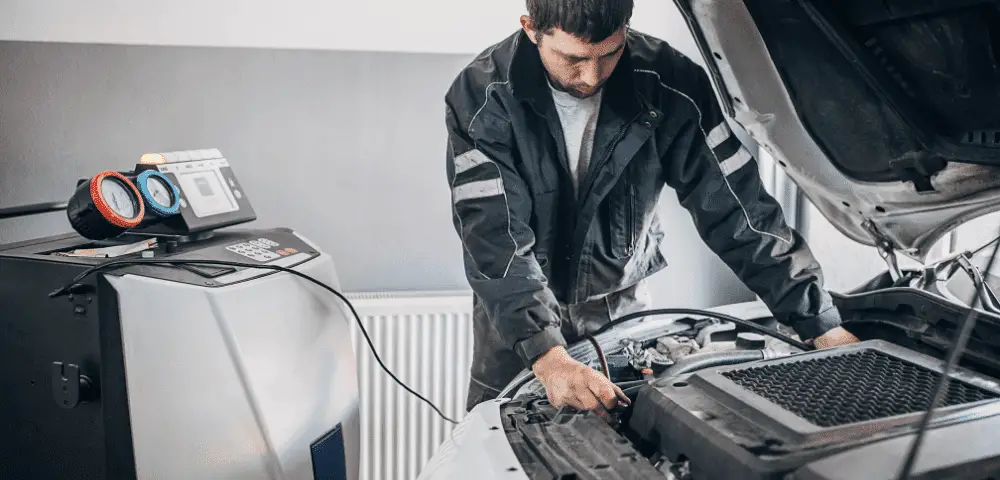
A stuck thermostat cannot fix itself. It’s a mechanical part with a wax pellet and spring that either seizes open or closed, and once it fails, it needs to be replaced — there’s no way to “unstick” it permanently on its own. Below, we cover what causes a thermostat to stick, how to tell whether it’s stuck open or closed (the symptoms are very different), and the steps to diagnose and fix the problem.
A failing thermostat won’t damage your tires directly, but an overheating engine can force you to pull over unexpectedly or limit power while driving — which matters just as much as tire condition when it comes to safe, reliable trips. If you’re already checking your car’s cooling system, it’s worth pairing that with a look at your tire condition as part of routine maintenance.
What Causes a Thermostat to Stick?
The thermostat regulates how much coolant reaches the radiator, keeping the engine at its ideal operating temperature. It sticks — either open or closed — most often because of:
- Mineral deposits or debris buildup on the valve, common in cooling systems that haven’t had a coolant flush in a long time
- Corrosion inside the housing, especially if the coolant hasn’t been changed on the manufacturer’s recommended interval
- A worn-out spring or wax pellet that no longer expands/contracts correctly with temperature
- Air pockets in the cooling system after a repair, which can prevent the thermostat from reading temperature accurately
A stuck thermostat is one of several possible causes of engine overheating, alongside a blocked radiator, a failed cooling fan, or a low coolant level.
Normal Operating Temperature
Most gasoline engines are designed to run between roughly 195°F and 220°F (90°C–105°C) once warmed up, though the exact range depends on the vehicle and thermostat rating specified by the manufacturer — check your owner’s manual or a repair reference like a Haynes or Chilton manual for your specific model. When the engine is cold, the thermostat stays closed to let the engine warm up quickly; once it reaches the target temperature, the thermostat opens to let coolant circulate through the radiator and keep temperatures stable.
Stuck Open vs. Stuck Closed: Symptom Comparison
The symptoms of a stuck-open thermostat and a stuck-closed thermostat are almost opposite, so it’s important not to mix them up when diagnosing the problem:
| Symptom | Thermostat Stuck Open | Thermostat Stuck Closed |
|---|---|---|
| Engine temperature | Runs cooler than normal; may never reach operating temperature | Rises quickly, often leading to overheating |
| Temperature gauge | Reads low or stays near “cold” | Reads high, sometimes into the red zone |
| Coolant flow | Flows continuously, even right after starting | Blocked until the engine gets very hot, if it opens at all |
| Cabin heater | Weak or lukewarm air, especially at idle or low speed | Normal at first, then no heat once overheating begins |
| Fuel economy | Reduced — the engine computer adds extra fuel while it thinks the engine is cold | Reduced due to overheating and possible limp mode |
| Risk level | Lower immediate risk, but accelerates engine wear over time | High risk — can warp the cylinder head or blow a gasket quickly |
How to Tell If Your Thermostat Is Stuck
Never remove the radiator cap while the engine is hot or running — pressurized, near-boiling coolant can cause serious burns. Let the engine cool completely first. With the engine cold, you can do a simple check:
- Cold-start check: Start the engine cold and feel the upper radiator hose. If it gets hot almost immediately, coolant is flowing before the engine has warmed up — a sign the thermostat is stuck open.
- Warm-up check: If the upper hose stays cool for a long time while the temperature gauge climbs, and the lower hose stays cold, the thermostat may be stuck closed and blocking flow to the radiator.
- Overheating risk: If your engine overheats within minutes of driving, stop immediately and let it cool — a stuck-closed thermostat is one of the most common causes.
Other Signs of a Bad Thermostat
Beyond the temperature and hose behavior above, watch for:
- A “check engine” light triggered by the coolant temperature sensor
- Temperature gauge swinging erratically instead of holding steady
- Coolant leaking around the thermostat housing gasket
- Gurgling or knocking noises from the engine bay, which can indicate air pockets or boiling coolant
Could It Be the Water Pump Instead?
A failing water pump can produce overheating symptoms that look similar to a stuck thermostat, so it’s worth ruling out. Signs of a failing water pump include:
- Overheating caused by insufficient coolant circulation, not a blocked thermostat
- Coolant leaks near the front of the engine, often from the pump’s weep hole
- Rust-colored residue or corrosion on the pump housing
- A grinding or whining noise from the water pump pulley/bearing
Can a Stuck Thermostat Fix Itself?
No — a thermostat that’s stuck will not free itself up or return to normal operation over time. Occasionally, a stuck-open thermostat that’s only lightly jammed by debris can be knocked loose by a cooling system flush, but this isn’t something to count on and shouldn’t be treated as a permanent fix.
Most vehicle thermostats today are sealed, non-serviceable units — you can’t disassemble one and replace individual valves or springs inside it. If a thermostat is stuck, the standard repair is to replace the entire thermostat with a new one rated for your vehicle’s specified opening temperature. Before replacing it, also inspect the radiator hoses for kinks, collapse, or blockages that could be mimicking a thermostat problem.
How to Fix a Stuck Thermostat
If diagnosis points to a stuck thermostat, whether open or closed, replacement is the reliable fix. Always consult your vehicle’s service manual for the exact thermostat location and torque specs, since procedures vary by make and model.
Step 1: Let the Engine Cool Completely
Park on a flat surface and apply the parking brake. Let the engine sit until it’s fully cool — this can take an hour or more after driving, or overnight for the safest results. Never open the cooling system on a hot engine.
Step 2: Locate the Thermostat Housing
Open the hood and find the thermostat housing, typically where the upper radiator hose connects to the engine. Its exact location varies by vehicle, so check a repair manual or online diagram for your specific model if you’re not sure.
Step 3: Drain Coolant and Remove the Housing
Drain enough coolant from the radiator to get below the thermostat housing (consult your manual for the drain plug location), then remove the housing bolts to expose the thermostat. Never do this while the system is pressurized or hot.
Step 4: Inspect and Replace the Thermostat
Remove the old thermostat and gasket or O-ring. Check for visible corrosion, debris, or a valve that won’t move freely — any of these confirm it needs replacing. Install a new thermostat rated to the manufacturer’s specified opening temperature, along with a new gasket or O-ring to prevent leaks.
Step 5: Refill Coolant and Bleed Air
Reinstall the housing, refill with the correct coolant type and mixture for your vehicle, and bleed any air pockets from the system (many vehicles have a bleeder valve for this). Trapped air can cause the temperature gauge to read incorrectly even with a good thermostat.
Step 6: Test-Drive and Recheck
Start the engine and let it idle while watching the temperature gauge. Once it reaches operating temperature, feel the upper radiator hose — it should now be hot, confirming the new thermostat has opened. Take a short test drive and recheck coolant level once the engine has cooled again.
Can You Drive a Car With a Stuck Thermostat?
It depends on whether the thermostat is stuck open or closed.
Thermostat Stuck Open
You can generally keep driving short-term, since the engine won’t overheat. However, running consistently below operating temperature increases engine wear, hurts fuel economy, and can trigger a check engine light. Get it replaced soon rather than driving on it indefinitely.
Thermostat Stuck Closed
No — this is not safe to drive on. Coolant can’t reach the radiator, so the engine will overheat quickly, risking a warped cylinder head, blown gasket, or complete engine failure. If you suspect this, stop driving and have the vehicle towed or repaired before continuing.
Frequently Asked Questions
Conclusion
A stuck thermostat cannot fix itself, and driving on one — especially stuck closed — risks serious engine damage. Whether your gauge is reading unusually low (stuck open) or spiking toward overheating (stuck closed), the fix is the same: diagnose which state it’s stuck in, then replace the thermostat.
Keeping your cooling system in good shape is just as much a part of routine car care as checking tire pressure and tread depth. If you’re overdue for a broader maintenance check, take a look at our guide on spotting and fixing cracked tires while you’re under the hood addressing the thermostat.
Check your thermostat’s behavior today, and get it replaced before a stuck-closed thermostat turns into a much costlier engine repair.